Everywhere and Nowhere, in Wyoming and Cyberspace

Not only our skies are endless. Now, so are the possibilities.

“I think in 10 years the meaning of cities will change,” David Tabachnikov is saying. “Today, cities are focused on as places of work. The faster data improves, the more you can work remotely.”

Ah, yes, places of work. My mind wanders back to noisy newsrooms in the suburbs, and to skyscraper offices with an eagle’s view over the city to the river. Back over the miles and the years, to the place where “So what do you do?” was the first question, and the answer was always full of portent.

David is speaking with a Russian accent, but he’s somewhere in Belgrade, Serbia. I am sitting in my office upstairs in rural Dubois, Wyoming, looking at my monitor all morning for a second day. I’m bounded on all sides by a frame of large logs made of lodgepole pines, but I’m not really here.

Screenshot from 6nomads.com online Remote-first Conference
https://6nomads.com/remote-conf

As David speaks, the other participants in the Remote-First Online Conference chat with each other soundlessly, filling in a stream that flows down the right side of the screen. We are in Portugal, in China, in Virginia, in Moscow, in Brazil, in South Africa, in Utah, in the Ukraine. Everywhere and nowhere, because we could be anywhere. We’re in cyberspace.

“People can have the benefits of the city while far away from the city,” David continues. “You drive to a city an hour or so away two or three times a month to go shopping. But your cost of living is way lower. And your quality of living is way higher.”

Precisely.

“And it’s not just computer engineers any more,” he adds. “It’s architects. Psychiatrists. Even fortune tellers work on Skype. The most amazing this is that even medicine goes in this direction.”

(One of our family practitioners does telemedicine, I type down the chat stream. So does our drugstore.)

Being in rural Wyoming, I’m the novelty in this online conference of “digital nomads,” most of whom seem to be sitting in some city or other.

How matters have evolved since I first began to explore the telecommuter community about five years ago! Back then, there were a few weekly “tweetups,” where a host would struggle to inspire a few lonely outsourced freelances in chats dominated by marketing messages from startups that hoped to sell them software.

This year, there are at least 3 “off-line” (e.g., participants physically present) conferences specifically for remote workers. One begins tomorrow in Chang Mai, Thailand. A second will be in Austin, Texas, in April and a third in November in the Canary Islands.

Ad for Running Remote conference 2020 Austin Texas
https://runningremote.com/

The chat turns to climate–to how cold it is right now, in late evening in Moscow, compared to afternoon in Montreal. I lean back, rest my feet on the heated baseboard, and look away briefly, out the window. The ideas that keep floating toward me through the ether almost take my breath away.

For instance: Some new Internet companies explode the barriers of space and time, because by having people work across many time zones they can have 24/7 productivity all year. Hiring remotely allows them to find the best employees regardless of where people live, rather than competing in the relatively small talent pool wherever the firm is located.

Part of table showing information about remote-work employers

Salaries for computer engineers who work remotely from, say, India, are considerably higher than their own local firms will pay, because most companies that employ remote workers pay close to US salaries. (I type into the chat stream: What are the implications for third world economies?)

Someone types in a note of sympathy for our moderator over there in China, charming Ksenia, whose accent suggests Eastern European origins. Working for the second day at 3 AM, she’s looking tired. We wish her a cup of coffee. She says she doesn’t drink coffee; she likes tea. We ask her to hang in there. Someone recommends trying loud background music, and she asks what kind we’d like to hear.

Teamwork takes on a different form for digital nomads. Many of the speakers stress that good communication is of paramount importance, and technology to enhance it is evolving rapidly. One speaker demonstrates his new app, an online whiteboard. We try it out together, posting our ideas on virtual multicolored “Post-Its.” The chat stream applauds it loudly with emojis.

New forms of mingling go far beyond online meetings. I hear about an online pizza delivery service that will send pizzas to whole teams of remote workers, wherever they are, at the same time. Some remote-work teams have after-work happy hours on Zoom or Skype, when everyone brings a drink to the webcam.

The most successful all-remote firms, I hear, get together once or twice a year in what they call “off-site” retreats–an odd term for companies that no longer have a site. The idea of physical retreats may seem counter-intuitive for remote-work employers, but they do have benefits in terms of productivity. Communication improves greatly, speakers say, after people have spent a week in each other’s presence discussing the past year, planning the next year, and then getting outdoors together.

How it would inspire communications to hike in our wilderness! My best ideas don’t come during hikes, but they surely help to clear my head and I have some great conversations with my hiking buddy who likes to talk philosophy.
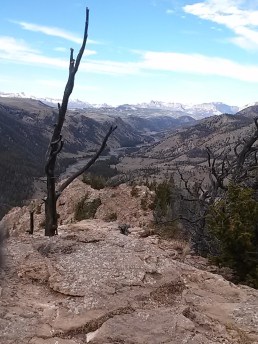
Canyon east of Dubois Wyoming

I think in 10 years the meaning of a mountain village will change too. We will no longer be a mere gas stop on the way to Yellowstone Park. The Park will just be one of the jewels in our crown, an ace in our hand.

Another will be our flawless Internet service, which is already world-class. A third will be that same beautiful seclusion that for so long has seemed a problem. Still another could be the very fact that we are not a city, not just a “place of work.”

Our industry will not be hewing giant logs from the forest, as it once was, but hewing concepts and designs from thin air and floating them down quite a different kind of stream to be processed further. This is quite clear to me now.

© Lois Wingerson, 2020

Thanks for reading! You can see new entries of Living Dubois every week if you sign up at the top of the right column at www.livingdubois.com.

Who’s writing? Check out About Me.

Time Warps in the Old West Times Square

Dates and timelines offer up curious parallels.

Away from my desk for a while. So I’m offering up some previous posts you may not have seen. This one published last year is completely relevant, because thoughts of our life left behind in the Brooklyn house still pop up now and then. Enjoy!

BanksWarmValley_croppedLocal historian Steve Banks gave another riveting talk a few weeks ago, this one about the history of traffic across this valley. Since then, I’ve been caught up in a sort of time travel.

I used to have the feeling that this Old West was much younger than the Back East I left behind. It must be part of the pioneer spirit you still feel out here, a sense of freshness and opportunity that reaches back from today’s new arrivals to the first intrepid white explorers.

Lately, I’ve been checking dates and making timelines. They parallel each other and resonate in very odd ways.

These four walls account for part of my confusion about time. They’re  made of huge logs felled nearby and chinked warmly together, much as the original settlers made their cabins. Our new house looks historic, but it is only decades old — far younger than the Victorian brownstone we left behind, which was built in 1880.

BrooklynHouseThe brownstone is 4 stories tall, has 4 bedrooms, and originally had a dining room and a receiving room for guests waiting to be admitted to the living room. It was remarkably modern for having central heating, fired by a coal furnace at the bottom.

In or around the same year it was built, Oran M. (“Old Man”) Clark, the first settler in this Wyoming valley, built his the first log cabin here — a windowless, one-room structure near the confluence of the Dunoir Creek and the Wind River. It too had “central heating,” People recalled that he often left the door open in winter so that he could run a huge log right across the middle of the room into the fireplace on the opposite wall. He would shift the log forward as it burned.

Clark didn’t file a homestead claim when he built the cabin, but he did claim to own the valley. Legend has it that in 1883, he raised his shotgun and ran off a party that included President Chester A. Arthur. He reportedly said that he had to give permission for anyone to enter the valley, and they didn’t have it. Wise men, they went to Yellowstone by another way.

For some reason he did, however, welcome John Burlingham and his son, who had come to Dubois to guide some dudes from Back East on a fishing trip. In fact, he coaxed the two men to return with their families, which they did in 1889.

For the first winter, the entire party stayed in Clark’s small, windowless log cabin. The following year they completed their own cabin, a few miles down the river. It was also windowless, with a dirt floor and a camp stove served by a pipe through the roof. A year later, Mahalia Burlingham gave birth to a stillborn daughter. Her husband John became the sought-after fiddler for dances across the entire region. He often left Mahalia alone with the children for months on end.

MabelsHill_1017According to Steve Banks, the first white man to visit the valley was probably a Kentuckian named John Dougherty. A fur trapper and trader, he fled south in 1810 from what is now Montana to escape an attack by Blackfoot Indians, crossing Shoshone Pass close to Ramshorn Peak and continuing down the Dunoir Valley to the Wind River. (This picture shows that valley.) A bullet from the attack remained in his side for the rest of his life.

Steve says that location, at the confluence of the Dunoir Creek and the Wind River about 12 miles west of the current town of Dubois, was like the Times Square of the Old West. The Valley of the Dunoir had been the north-south artery toward the crossroads of a  trade and migration route used by native Americans for time unknown. (The area has been part of the migration route for ancestors of the Shoshone for thousands of years.)

Early fur traders and explorers — men such as John Colter, John Hoback, and Jedediah Smith — passed this way, often guided by the natives.

WilsonPriceHuntIn 1811, a year after John Dougherty came down the Dunoir Valley with a bullet in his side, Wilson Price Hunt came through with a party of 68 people and 200 horses. Hunt was a co-owner of John Jacob Astor’s American Fur Company, headed toward Fort Astoria on the Columbia River in the northwest, hoping to establish fur trade with Russia and China.

Steve pointed out that Hunt’s party and their horses would have filled two Greyhound buses and 6 semi trucks. It was probably the largest single group of people ever to visit this valley. No settlement existed here at the time, except for a small Shoshone village.

The party had run out of food by the time they reached the base of the Dunoir. The natives, ill-prepared to feed them, advised Hunt to continue southward, crossing the Wind River, and over the mountains toward the Green River, where there were plenty of bison. The hunting detour cost them two weeks of progress; they should have headed west, upriver, where a friendly fort was only a few days away.

Frontiersman and explorer Jedediah Smith came this way about a decade later, in the winter of 1823-24. He brought with him a fur trapper named Daniel Potts, whose family owned Valley Forge in Pennsylvania. Potts was the first man to record a description of the geysers in what is now Yellowstone.

RiverHe also described our valley. “From thence across the 2d range of mountains to Wind River Valley …” he wrote in a letter on July 16, 1826. “Wind River is a beautiful transparent stream, with hard gravel bottom about 70 or 80 yards wide, rising in the main range of Rocky Mountains … The valleys near the head of this river and its tributary streams are tolerably timbered with cotton wood, willow, &c. The grass and herbage are good and plenty, of all the varieties common to this country. In this valley the snow rarely falls more than three to four inches deep and never remains more than three or four days, although it is surrounded by stupendous mountains.”

The West was younger, yes, but not by as much as I thought. As Dougherty was fleeing down the Dunoir and Hunt’s party was pleading for food with Shoshones in a mountain village a year later, my former home town of Brooklyn was just a small settlement across a wide river from Manhattan.

It didn’t incorporate as a village until 1817, only about seven years before Potts crossed this valley and saw the geysers. In 1898, Brooklyn was swallowed up in the creation of the great city of New York.

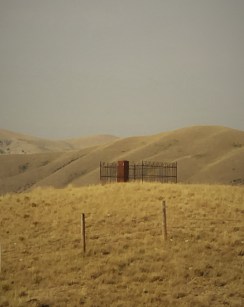
OMClark_graveTwelve years after that, “Old Man” Clark froze to death, alone in his cabin, during a winter storm. His grave sits atop a small hill, marked by an obelisk and surrounded by a wrought iron fence.

He had left money to buy ample whiskey for a wake. It took many tries for the mourners, who had stoked themselves well with his whiskey in front of his fireplace, to succeed  in sliding his coffin up that slope over the icy ground.

But they did. Here is his grave.

© Lois Wingerson, 2018
You can see new entries of Living Dubois every week if you sign up at the top of the right column at www.livingdubois.com.

Field Report: Encounters With Migrating Bipedals

A lone male and a mating pair, taking a break from the Front Range.

One of the migratory creatures most often sighted in Dubois during the summer is that distinctive species, the heavy-laden touring cyclist Homo bipedalist.

As with other wild creatures, it is crucial that drivers be vigilant for the touring cyclist, in order to avoid striking one. Their behavior can be unpredictable.

When possible, courteous drivers give them a wide berth and veer far to the left when encountering H. bipedalist as it travels on the shoulder. As with deer, they often appear in groups, and the first one in view is a sign that others are nearby.

The reason we see so many cyclists is that, as with deer and elk, our region is along a major migration route. In fact, it’s at the crossroads of two: The Continental Divide Trail that runs north and south, and the TransAmerica Trail, heading east and west.

Many creatures have been following these routes for time immemorial. Our local historian Steve Banks says that Native Americans, who often used game trails to guide them, followed the Wind River east and west and the trail down the Dunoir valley and up Union Pass as trade routes and during their seasonal migration cycle. The first European explorers in this area used Native Americans as their guides in turn, passing through the same intersection.

Although I often see migrating cyclists, I seldom have an opportunity to get close. This summer I’ve been fortunate to have two enjoyable encounters, both times with cyclists traveling northward from the Front Range of Colorado. One was a solitary individual following the TransAmerica Trail; the second was a mating pair following the Continental Divide.

The migrating species metaphor isn’t entirely a joke. Although many years ago we took bicycle trips of our own, these individuals do seem exotic to me now. I admire their stamina, their strength, and their determination. I can’t imagine doing what they do.

While driving eastward toward town one day, I saw a lone male heavy-laden cyclist laboring slowly westward. As he did not seem aggressive, I determined to stop for a closer inspection if I saw him again when I came back the other way.

He had progressed only a few miles when I returned. Having no special obligations that day, I decided to save him the hard slog over Togwotee Pass toward Yellowstone Park, if he was willing. I pulled over and approached cautiously.

“Would it be against your philosophy to accept a ride?” I said. He thought about it, smiled, and said, “Not at all.”

After loading his bicycle in back of the car, we set off again.

This wasn’t a race or some sort of personal challenge, he told me. He had come north on his bicycle to escape the dull and stressful routine of his job. He wasn’t using his cellphone for information, but just accepting events as they came along — including offers of rides.

We discussed whether he should venture into Jackson for groceries. I advised against it, as his object was to avoid stress and crowds. Along the way, he realized that by giving him a lift I had saved the need to use the supplies he already had, so he had no need to take the busy road to Jackson and could head straight into Yellowstone.

As we approached the top of the Pass, a thought occurred to me. “How’d you like to cheat?” I said. “I could drop you at the Continental Divide and then you could sail downhill just as if you’d climbed all this way.”

“That would be great!” he said. I was amused that he wanted to unload his gear and set off again without being seen, so we waited for all traffic to pass before we parted.

I encountered the mating pair on Union Pass one day when I went up there for a hike. They and had come north from their home in Denver to celebrate their anniversary by cycling the Continental Divide Trail.

Here, you see them sharing information with a cyclist heading the other direction. (It’s a pretty long steep climb that way, they told him.)

The male had many questions for me: Was there water at the bottom of this slope? Is it fresh? What’s the road like afterwards? How far is it to Falls Campground?

I answered to the best of my knowledge (yes, plenty; absolutely fresh; not bad, just one gentle climb and then a long set of switchbacks down to the highway; not sure but maybe 20 miles along the highway, mostly uphill). A while later, having finished my hike, I saw them again and offered them a ride.

They declined, knowing that it was downhill from there all the way to the highway. “Well if you’d like a drink at the bottom, feel free to stop by my house,” I replied, and told them how to find it.

Not long after I got home, they turned into the driveway. I offered each a beer, and I joined them on the front porch as they took a break.

They noticed that the wind had picked up, and it would be pushing against them as they headed uphill.

“And now I have that buzz,” said the woman, finishing her beer. They didn’t seem eager to start off again. I offered them a ride up to Falls Campground, and they accepted with evident relief.

Suddenly the man leaped up and ran toward the yard at the east side of the porch. “I’ve lost a piece of paper!” he said. (I had just been joking about things that would blow into the next county.)

He returned a few minutes later, empty-handed.

He brushed the loss away with a wave of his hand, saying he could easily make another. But having found the paper a few days ago, snared in a sagebush, I respectfully disagree.

Reading the two-sided document, I could see how much work and care he had put into it as he planned each step of the journey from Steamboat Springs to Whitefish, Montana. I put a red box around their journey so far; they were only about halfway there.

Alas, our meeting as strangers was all too careful. I wished we had shared contact information so I could send him the paper, if only as a souvenir.

Their journey must be long finished by now. I hope they made it safely, and that it has blessed their marriage.

© Lois Wingerson, 2019

Thanks for reading! You can see new entries of Living Dubois every week if you sign up at the top of the right column at www.livingdubois.com.

Who’s writing? Check out About Me.

Previous entries are listed in the Archives at the bottom of the right column.

Remotely and Wildly True: Of Dubois and Distance

Did National Geographic really call Dubois WY the most remote town in the lower 48? How remote is it, actually?

[Taking the chance for a spring break, I’m re-posting this piece of barely investigative journalism from a while ago, which inquired into a popular bit of rural mythology.]

Highway

Google “Dubois WY” and you’ll soon encounter a statement that it has been designated the most remote town (or sometimes the second remotest town) in the lower 48 states. Often this distinction is attributed to National Geographic.

When we moved to Dubois, my husband and I quickly took up calling it one of the most remote towns in the lower 48 when we described it to friends. We even trotted out some criteria, whose origin I no longer recall: Farthest from the nearest Interstate, fewest traffic lights (none), fewest number of highways that run through it (one), distance to the nearest large town (about 70 miles), or proportion of land within a 360-degree radius that is publicly owned (who knows, but lots).

But is this distinction actually deserved? How remote is Dubois, and compared to what and by which criteria? Last summer I began to study the question, with interesting results.

First, I couldn’t find any such statement about Dubois in the archives of National Geographic. And many other towns lay claim to the distinction of being most remote.

I turned to local sources, Dubois town hall and the library. Sandy Hurst at town hall offered up text from a 2011 press release about Dubois:

“A place considered by National Geographic as the most remote town in the lower 48 states…  it perches on the edge of several wilderness areas and is surrounded by national forests.”

This traced back to a strategic plan for Dubois by the Foundation for Urban & Neighborhood Development of Denver, Colorado, dated 1986. The report said that Dubois had been “recently identified in national news media coverage” as the most remote location in the lower 48–the same unconfirmed designation that I was already seeing, albeit even older.

Anna Moscicki at the library turned up a wonderful quote from the memoir of Ethel Waxham, mother of the geologist David Love who defined the geological history of the Yellowstone region. Waxham wrote about her arrival in Wyoming by stagecoach in 1905:

“The other passenger beside myself was a woman of fifty or sixty, white-haired, face weather worn, bright brown eyes, Mrs. Welty. She was post mistress at Dubois, the post office farthest from the railroad of any in the U.S.”

Delightful, written when the railroads were still expanding, and perhaps an insight into the town’s perception of isolation. But not that relevant today.

In the course of promoting Living Dubois on Twitter, I was fortunate to gain the interest of Marilyn Terrell, chief researcher for National Geographic, who has also been unable to find any source for that attribution of Dubois’ remoteness by her publication (so we ought to stop using it). But she did point me to an article in Smithsonian magazine describing what truly may be the most remote settlement in the lower 48: the community of Supai, Arizona, located at the base of the Grand Canyon. At the bottom of that 3,000-foot crevasse, it is reachable only by mule train, which is how they get their mail.

But Supai isn’t really a town: It’s designated by the US Census Bureau as a “census-designated place,” which is the Bureau’s term for a populated place that is not an incorporated village and has no municipal government. So does Dubois still qualify?

Overlook7Author Henry Grabar on the website citylab.com looked into which towns were most remote by the criterion of being farthest from the nearest Interstate highway, honoring Key West, Florida, as being farthest as the crow flies, and Copper Harbor and Eagle Harbor, Michigan, (251 and 238 driving miles from the nearest Interstate), with an honorable mention to Paisley, Oregon (209 miles) due to the sheer difficulty of driving to the big highway.

Dubois is “only” about 173 miles from the nearest Interstate, at Idaho Falls, and is interestingly equidistant from Interstates at Rawlins, Casper, and Livingston MT (200, 199, and 199 miles, respectively). But considering only towns that are completely surrounded by Interstates (rather than having a national border or large body of water on at least one side), I do wonder whether Dubois might qualify as having the largest average distance to the Interstate in all 4 directions (193 miles).

If you aren’t familiar with Dubois, please be assured that you can buy plenty of groceries and hardware supplies in town, and it’s even easy to find a cafe latte. And by that other criterion of remoteness, Internet access, Dubois is marvellously well-connected. You feel the remoteness mostly by your proximity to all that wilderness.

Speaking of which, there is one remoteness criterion Dubois can legitimately claim without dispute: It is TwoOceanPasscloser than any other town in the United States to the spot in the lower 48 that is most remote from any road, and therefore reachable only on foot or by horseback. This is Two Ocean Plateau in the southeastern corner of Yellowstone Park.

This spot has been designated by the United States Geological Service as the location in the “coterminous” United States that is most distant from any road (the trailhead is at Moran, an unincorporated community). Dubois is 44.1 miles from Two Ocean Pass as the crow flies, and the plateau is farther north. Jackson is 48.8 miles away.

There is one criterion for remoteness by which Dubois fails miserably. The residents are hardly remote in their behavior toward other people. It’s one of the friendliest places I’ve ever encountered, which is one reason we go all that way to get there.

@ Lois Wingerson, 2016

You can sign up at the top of the right column at http://www.duboiswyoming.com to see new posts on LivingDubois via email.

The Governor, Dubois, and Deadwood Gold

But for Dubois, Mark Gordon might have been a New Englander

Last weekend, I heard Wyoming’s new governor delivering an address at a conference. Mark Gordon began with a virtual driving tour of the scenic wonders of our state. People would whoop as he mentioned their regions – Devil’s Tower, Thermopolis, Lander.

What better way to endear yourself to a Wyoming audience than to extol the beauties of our state? Gordon was preaching to the choir, for certain.

I waited for a mention of Dubois and a chance to call out. But on his imaginary counter-clockwise circuit, Gordon  veered away and entered Yellowstone from the north.

I sat back and sampled the little fruit tart in front of me.

Eventually, near the end of the speech, I did have a chance for my shout-out and it took me by surprise. Gordon drew toward his close by alluding to his father, and it was not the history I would have imagined. Fundamentally, Mark Gordon–the epitome of a devoted advocate of the spirit of the American West– is in Wyoming because his father fell in love with the West in Dubois.

Crawford Gordon (1917-2014) was given one of those patrician East-Coast names made up of two last names joined together. He grew up on a farm in Lincoln, Massachusetts, and went to Harvard University, where he earned a degree in economics.

The young Crawford could easily have taken a bank job and stayed on out East, and his son could have been born in Massachusetts. But he chose the tougher life of ranching in Wyoming. That’s because at  the age of 15, Crawford visited CM Ranch in Dubois, where he developed a passion for the cowboy spirit and for rodeos. He had begun the evolution to the “Crow” Gordon he would be for the rest of his life.

For a while, young Crow Gordon rode the rodeo circuit. He won prizes at the Johnson County Fair and Cheyenne Frontier Days. I wonder what his parents thought.

That was long before Jerry Jeff Walker recorded these lyrics:

Why does he ride for the money?
Why does he rope for half share?
He’s losing his share, and he’s going nowhere …
He must have gone crazy out there.


At the age of 30, Gordon settled with his wife and began ranching near Kaycee, Wyoming, in the northeast of the state. The new governor grew up on that ranch.

I had a brief conversation with Mark Gordon last weekend. He is urbane and engaging, but he also has the demeanor of a Wyoming cowboy – soft-spoken and easy-going. Without inquiring, I took him for a rancher, that combination of businessman and farmer that is so prevalent among Wyoming politicians.

But like his father, Mark Gordon was educated back East. He  went to boarding school in New Hampshire and college in Vermont. After graduating — and I’m sure skipping his father’s dude ranch step, as he did grow up out here — he returned to Wyoming and began ranching.

When I spoke with the governor, of course I said I was from Dubois (not, strictly speaking, the truth). “You know,” he said, “my father created a silent film when he was at the CM Ranch. You should ask Twila Blakeman about it.”

I called the former Mayor yesterday, and she welcomed me to drop by for a copy of the film. When Gordon gave it to her, she uploaded it to her laptop, and then gave copies to the Dubois Museum, the CM Ranch and, yesterday, to me.

Called “Deadwood Gold,” the film shot in the 1930s is grainy and funny, impromptu and crowded with extras. Evidently Crow Gordon had inspired everyone staying at the ranch to dress up and pitch in.

It’s a 30-minute shoot-em-up Western that has all the classic features: a stagecoach, a gold find, a villain and a sassy lady, and a posse that leap into the stirrup, always galloping on the run off into the hills or back into the corral.

One of the “stars” is the founder of the CM Ranch, Charlie Moore, who was the son of a local old-timer. He went to the University of Michigan (my alma mater) for law school, hated it, and returned to open a ranch where he could impress young boys from the East with the independence and adventure of the West.

I don’t know precisely how Crow Gordon came to stay at the CM Ranch. Very likely his parents were among those whom Charlie Moore met during his business trips back east to promote his ranch.

In the case of the elder Gordon, he clearly achieved his objective. According to an obituary, Gordon’s passions were horses, ranching, rodeo – and opera. Like Charlie Moore and like so many who live out here (including his son, the new governor) he was obviously a fascinating hybrid of the rugged and the refined.

So often you find interesting little surprises as you learn about these Wyoming people. I’m still learning that lesson myself.

© Lois Wingerson, 2019

You can see new entries of Living Dubois every week if you sign up at the top of the right column at www.livingdubois.com

Dubois Cowboys: Still at Work

A morning’s effort, evoking many recollections

Cowboys2014Once in a while, on a summer morning, I awaken to what sounds like cattle in the living room.

There aren’t really cattle in the living room. The first time I heard this, however, I did leap out of bed to check.

It was just the clamor of cattle complaining loudly as they were being driven down the highway in front of the house, from a pasture uphill to the valley below. When one wandered onto our driveway, a cowboy rode over to steer it back.

Cattle trucks drive down the highway past the house all the time. But for a city girl, my first sight of these cowboys at work was pretty thrilling.

cowboysOne afternoon last week, I came home to the sound of whoops, whistles, and loud mooing in the valley. I ran over to take this picture.

They were driving these cattle into a corral from which they would be urged into a cattle truck, which would drive them elsewhere by other means.

I feel silly about it, having absolutely no personal experience about the life of a cowboy. But I still get excited at this sight.

This is an entirely different process than the one that inspired the term “cattle drive,” of course. This is a mere morning’s effort for these cowboys.

The original cattle drives, as anyone who has seen “Rawhide” will understand, were brutal and grueling months-long endeavors that somehow led to the idealized nostalgia that the term “cowboy” evokes today.

Smokey-hill-river-cattle-driveRecounted in the book Recollections of the Upper Wind River Valley, tales from the first cowboy in the area, Andy Manseau, make clear what it meant to be a cowboy in the old days. “In the fall of [18]98 I ran the J.K. Moore cattle,” he recalled. “… We were through rounding up and night herding them to be ready the next morning to drive them to the railroad at Casper.”

Two horses got away from one of the wranglers, and Manseau went after them. His horse tripped on a loose rope and Andy fell off, landing on his head and shoulders.

“I was unconscious for 24 hours. No one expected me to live….The doctor couldn’t do anything for me. My left arm was paralyzed and I had hurt my spine and lost my equilibrium. But I got over it!”

More recently, cowboys, Boyd told me, cowboys drove the cattle all the way to Hudson, where they’d be loaded onto cattle cars on the train. The cowboys had to return afterwards on horseback, of course.

But there were compensations: A string of bars at regular intervals along the highway once offered a place where cowboys could stop en route home. They’re all vacant now, obviously long since gone out of business. These days, the cattle truck drivers pass right on through to the next town.

Evidently I’m not the only person here to be excited at the sight of cowboys driving cattle. When I told Sandy about the tiny roundup next door to our house, she recalled the days before the cattle trucks, when the ranchers used to drive the cattle right through town in the fall and on down-county.

It was very exciting for the school children, she recalled, but the streets were very messy afterwards.

My friend Mary Ellen remembers that St. Thomas Church would halt services so the parishioners could go outside and watch the cattle drive through town. No doubt the cattle were so loud that they would have made the service inaudible anyway.

This brought back to her mind a tourist, an older woman driving a little sports car, whose progress was also halted by the cattle drive. Mary Ellen recalls that she was wearing white sneakers.

Cattle_BearBasinShe leaped out of the car, all excited, and began taking photographs. After the cattle had passed, there was no way to keep her sneakers clean when she returned to the car.

The cowboys are enchanting, but I often find the cattle an irritation. They might break through a fence and cause trouble. They sometimes get slow my progress on hikes.

© Lois Wingerson, 2018
You can see new entries of Living Dubois every week if you sign up at the top of the right column at www.livingdubois.com.

So the Doctor Came Over the Pass in the Snow …

Another blessing for our health on the heels of the new pharmacy.

IMG_1782“What happened to your hand?” friends were asking yesterday.

I explained that it’s really nothing, and then we tried to come up with an amusing answer. I got injured fending off a grizzly attack? (Not funny.) Got caught up when I was dallying the lasso? (Not even remotely plausible.)

In fact, the bandage is there to protect the minor laser burns sustained during my latest biannual ritual at the skin doctor. She found more of those pre-cancerous spots, and zapped them away. It’s ugly, but not painful, and it will heal quickly.

Why am I sharing this? Because of another blessing that has come to town, hot on the heels of our new pharmacy.

PassHighway022514_2For this visit, I didn’t have to take the usual 90-minute drive over Togwotee Pass to Jackson to see the dermatologist. This time (on the morning of our first snowfall, as it happens), the dermatologist and the rest of her team came to me.

This could have been their last monthly visit at the end of a six-month experiment. But they’ve decided to keep coming every month, year-round.

This is no small favor. That a specialist and her team will come over the Pass to spare dozens of us driving the other way in order to detect early skin cancer is a very important benefit in this remote town. At around 7000 feet, the sun is deceptively brutal here. It’s not hot, but it’s dangerous–especially for someone with a family history of skin cancer, but actually for anyone. I never go outdoors without a generous application of sunscreen and a hat with a brim.

Grandad_BarnDoorThere would not have been any sunscreen available to my grandfather, who was a Nebraska farmer with fair skin. I’m guessing there were no public-health messages about the risks of the sun during the Great Depression, and as you see him standing here in the barn door, he was not wearing a hat.

He died from melanoma that arose on the back of his neck. I envision him laboring for hours on his tractor, head bare, sun at his back as he plowed the furrows.

My mother (not a rancher but a teacher) regularly had pre-cancerous lesions taken off her skin. Now so do I, as do many of my neighbors. Thank heaven.

And thanks to Storey Donaldson, office manager of Western Wyoming Dermatology & Surgery, who proposed adding Dubois to their satellite offices in Pinedale and Afton.

IMG_1784_editedThis week was the end of a six-month pilot project to see whether the practice would attract enough patients in Dubois to justify the effort. Not only have they gained new patients from our town, Storey told me; about half of their visits in Dubois are from people farther down the valley, in Lander and Riverton, who would not want to make a 3-hour trip all the way over to Jackson.

Back in the day, someone would ride on horseback all day and hope to be able to bring a doctor back in time before the injured person died. Today, we have two clinics and regular access to preventive care. One clinic now offers dermatology visits once a month; the other offers telemedicine links to specialists at the best hospital in the state. There’s also an ambulance service with response times that match national standards, air lifts to regional intensive care centers, and search and rescue crews that venture out to help people injured in our wilderness.

IMG_1778In New York City, I left behind some of the best medical care in the world. But I don’t spend much time even thinking about that.

So what did I do after seeing the dermatologist on Wednesday, instead of spending 90 minutes driving back from Jackson? I put on my hat, of course, and took the dog for a ramble.

© Lois Wingerson, 2018
You can see new entries of Living Dubois every week if you sign up at the top of the right column at www.livingdubois.com.

Dubois to Dubois in Four Hours

Of our less remote “sister city” and the two mountain passes between.

PopulationSignReturning from a brief trip to Montana, our southward route down Interstate 15 took us straight past that other Dubois across the border, in Idaho. I couldn’t resist paying a visit.

This other Dubois is a few hundred yards from I-15. In Dubois, Wyoming, we live about 3 hours from the nearest Interstate–a fact that helps our town to qualify as one of the most remote in the lower 48.

This town is less remote, but nonetheless smaller. Our own “Entering Dubois” sign reads “POP 971.” But the town feels larger than that because many people live outside the town limits, in the mountains. There are no nearby mountains here. Dubois, Idaho, sits in a broad valley of grass and sage.

Some time ago I visited the third Dubois, in Pennsylvania, which is in the midst of mountains. It was named after a local lumber magnate, uses a capital “B” in the middle of its name (as he did), and had a population of nearly 8,000 at the last census.

A sign at the freeway exit for Dubois, Idaho, promises a visitor center, which turns out to be the new rest stop. There are restrooms, of course, but no welcome desk with someone behind it to welcome you. Large glass display cases give information about the region–most prominently the history of the Idaho National Laboratory at nearby Arco (population 995). It’s the site of “the world’s first and the United States’ only fatal reactor accident,” according to Wikipedia, in which 3 people died when an accidental steam explosion destroyed a nuclear reactor.

Main StreetI’ve been curious about Dubois, Idaho, because understandably some people confuse our Dubois with this Dubois on the other side of Jackson Hole. A tourist once told me that a shop clerk in Jackson told her to stock up on groceries and gas before heading over the Pass to Dubois because there’s nothing there. I had to laugh, thinking of our large grocery store and four gas stations. In this Dubois, the one gas station is boarded up and there’s no supermarket.

There are two motels and two restaurants, one of which got a five-star review on TripAdvisor only last week. I wish I had noticed it myself.

Founded in 1892 and originally named “Dry Creek,” the Dubois in Idaho is 22 years older than the one in Wyoming. This Dubois re-named itself around 5 years later, in honor of the same Idaho senator and Postal Service official who bestowed his own name on our Dubois, rather than allowing residents of a small Wyoming town to use the name they had chosen.

Ranch_Train

Dubois’ main street ends after a few blocks at this ranch and, beyond it, the train tracks. Trains first came through this area in 1879. I’ve read that there was talk of running a train line through Dubois, Wyoming, long ago, but it never happened.

Without an Interstate and a train we are truly isolated, in one sense. But far more traffic passes through our Dubois, being on one of the two main routes from Denver to Yellowstone. It didn’t seem that many other cars had ventured past the rest stop to explore this Dubois as we did.

WaterTowerI stepped out of the car to take a photo of the water tower, and had a brief chat with two town workers who were mapping water lines, standing inside the stone traffic circle at left. (Another difference: Not being transected by a Federal highway as Dubois, Wyoming, is, I’d guess this town is free to direct traffic flow any way it chooses.)

I asked them about the economic basis of the Idaho town. Agriculture, they replied. Mostly hay and, of course, potatoes.

The Episcopal church was built of clapboard, not of logs like our own. It has become the town museum.

TwoChurchesI noticed in passing that Dubois has its own visitor center housed in the small town library, but that was closed as we came through on a Wednesday afternoon.

To reach home before nightfall we had to hurry through Idaho Falls and on toward Jackson Hole. We passed through Victor, Idaho, a booming bedroom community for Jackson, at about 4:45. From that point on, we saw a continuous stream of cars heading in the other direction. These are the commuters who cross the steep and narrow highway over Teton Pass every day.

Speed limits are slow, between 25 and 35 mph. “There are no passing lanes,” someone wrote on a TripAdvisor forum, “so if you get caught behind a slow vehicle, you are pretty much stuck.” RVs and cars with trailers are advised to avoid this route.

My husband shifted to a lower gear as we headed downhill toward Jackson. There are runaway truck ramps every few miles on the 10% grade (one of them, alarmingly, on the opposite side of the road), and trucks are warned to stay in low gear almost all the way to the base on the eastern side. The endless single line of commuters extended almost all the way back into Jackson.

Togwotee_092618_4_darkOnce beyond Jackson and the construction at the new roundabout south of the airport, we were slowed only by a few out-of-state cars dawdling to look for bison or enjoy the view.
Heading toward our own Dubois and home, we took a new kind of pleasure in the drive over Togwotee Pass, which we always enjoy. This time we noticed the wide shoulders on the highway over this beautiful Pass, the gentle slopes, the broad curves, the 55 mph speed limit, and especially the frequent passing lanes.

Not to mention the splendid views.

© Lois Wingerson, 2018
You can see new entries of Living Dubois every week if you sign up at the top of the right column at www.livingdubois.com.

Another Dubois Distinction: The Bones in the Big Red Dead

Defying the experts in a search for remains.

IMG_1386I used to love scrutinizing the rocks as I hiked. I hoped to find something important.

I’d find pretty green and pink rocks, rocks with interesting shapes, rocks that might have been carving tools, once a petrified twig. I’ve mostly stopped doing that, because I really don’t know what I’m looking for, or at.

But some others do, and they have found it—in abundance.

Paleontologists “spend a lot of time walking around with their eyes glued to the ground, because that’s where the fossils are,” said Calvin So, a paleontology student at the University of Wisconsin. I heard him a few weeks ago at the Riverton Museum.

IMG_1268Two days earlier, the crew of the Nobby Knob Triassic Expedition had covered over their site southeast of Dubois to leave it behind for the winter. They have spent this past summer excavating a trove of remains from what So called “the dawn of the dinosaurs,” between 230 and 200 million years ago, during the Late Triassic.

Team leader Dr. Dave Lovelace gave a similar presentation at the Dubois Museum in July, when I was out of town. My husband went, and phoned me afterwards with astonishing news: Lovelace and the team have been tramping around the outskirts of town for the past four years, searching and digging for fossils.

They’ve been defying the experts, looking for remains in a geologic stratum in Wyoming that paleontologists have referred to as “the big red dead,” always thought to be a dry and barren period devoid of animal remains. The fact that the team has proved them wrong should not surprise us in Dubois, where we know that dry and apparently barren does not imply a lack of life.

“We have found an abundance of fossils,” So said, “contrary to what other people have been saying.” Almost everywhere they’ve looked in the Wind River Valley, Lovelace told me, they have found fragments of bone from this period.

IMG_1430After finding a tantalizing whole phytosaur skull near Lander, where a few Triassic finds were reported in the early 1900s, the team began to explore the red dirt on public land almost within view of structures in Dubois. In 2014, they found fossil fragments of extinct salamander-like creatures known as temnospondyls. The next year they determined where those fragments had been eroding from. This summer, the crew was digging at that spot for two months.

Who knew that these guys (and women) have been out there, as they put it, “digging up Dubois” for four years? (“Anyone who is interested can see us from the main drag in Dubois,” Lovelace said.) And who would have guessed what they’d uncover?

The red hill they named Nobby Knob (after a character in a fantasy book series) has yielded what Lovelace calls “amazing” remains of creatures with the wonderful name of Koskinonodon, a genus of extinct amphibian. Among them is a skull, probably a juvenile, that they affectionately named “Wally.”

When Wally died, sometime way back in a period when the continents were in entirely different shapes and orientations, this area was covered with a shallow lake. Think, So said, of a creature lurking partly submerged, waiting for something to ambush.

IMG_1271Extracting the fossils can be brutal work. To extract the fossils from the dirt, they cover them with plaster. One plaster “jacket” containing dozens of stone-covered fossils weighed 500 pounds, So said. It took about 400 hours of work to chip away painstakingly at the surrounding rock in order to expose the fossilized bones. Another weighed about 1000 pounds.

Once the specimens arrive in Wisconsin, the team exposes the bones. Then they run them through a CT scanner and analyze them using a custom imaging program that allows them to discern the individual bones inside a skull.

In 2016, the team began excavating another site nearby that is rich with remains. Lovelace calls the Serendipity Site a “mass death assemblage.” It’s a Late Triassic cemetery of sorts; a large collection of burrows containing the fossils of tiny early amphibians, probably distant ancestors of the salamanders. Many of their skeletons are preserved largely intact.

This could be echoes of a distant climate change. So said these may be the remains of creatures that went into estivation – a sort of hibernation intended to wait out a drought – and were doomed when the drought lasted too long.

This site adds to another prehistoric distinction for Dubois: A curator of the American Museum of Natural History in New York has called this region “the epicenter of Rocky Mountain archaeology,” because the prehistoric high-altitude villages found above Whiskey Basin a decade ago have changed our ideas about some of the earliest Native Americans.

IMG_1269Now this site is changing the way we think about some of the earliest vertebrates. There are enough late Triassic fossils just east of town to classify Dubois as a “world-class vertebrate paleontology locality,” Lovelace told me.

There are only 5 similar sites in the world, he says, and “this one is unique even among those rare localities.”

The other sites (in Poland, Portugal, Morocco, and New Mexico) are “multi-taxon sites” that include remains of several different types of animals. Most of them are random collections of bones and skulls, not large numbers of complete skeletons. The Dubois site is unique, according to Lovelace, because it preserves a single type of animal.

The remains at Nobby Knob are extraordinarily well preserved, in part due to the slow, shallow waters in which they were submerged, still showing remarkable features such as tiny teeth embedded in the palate at the roof of the mouth. Also, the vast majority of the skulls are small, and “small individuals are exceedingly rare.”

This leaves a number of unanswered questions: Were they small because they were all young? (It is not uncommon for adults to inhabit different areas than their young to avoid “their young becoming part of their diet,” he says.) Or are they a new and different species?

And another intriguing question remains: Why were more than half of the burrows at Serendipity not found empty, but still encasing the skeletons of tiny creatures doomed never again to walk that alien, ancient landscape? What was the fatal factor?

The crew will return next year to continue work at the site.

© Lois Wingerson, 2018. Thanks to Dr. Lovelace for reviewing the text for accuracy.

You can see new entries of Living Dubois every week if you sign up at the top of the right column at www.livingdubois.com.

Of Music, Longing, and Mysteries

Nostalgia for things never experienced?

StameyCowboys roping in baseball caps, and empty spaces on McNally Maps. Dry creeks and history on the page. Sycamores and prickly pear. Barrel racers with great big hair. Horses swishing flies out in the sun.

Those aren’t my words. They’re Dave Stamey’s words.

It seems like the whole town has come out to hear the cowboy songwriter, and not just because it’s the best thing going on right now. Nearly every seat in the big room at the Headwaters Center is taken. He has us in the palm of his hand.

“It’s a place, it’s a feelin’ and sometimes it’s just a state of mind. It may not be what you were lookin’ for, but it’s here in what you find. And it’s all these things. It’s the West.”

I get just a bit choked up at that, and I’ve only been here for 10 years, for crying out loud. The words and the music reach down somewhere to grab at me the way a good song can.  Somehow I feel a longing for something that I haven’t yet lost. In fact, I’ve barely begun to experience it.

Stamey takes a pause to take several jabs at a popular old song, “Riding Down the Canyon” by Smiley Burnett, which has featured in Western films and in recordings by many famous country singers. He recites a few of those lyrics.

“When evening chores are over at our ranch house on the plain, and all I’ve got to do is lay around,” he quotes. “Well, I don’t know where that ranch is, but when evening chores were finally over at our ranch, the very last thing you’d want to do is saddle up and ride down a canyon to watch the sunset.”

There’s a knowing chuckle from the audience, and I join in — not that I’ve ever done a single chore at a ranch. My only experience at ranches was as a dude, where I relaxed while others did the chores. To folks at their radios or in movie theater seats, the song  evoked a longing for a laid-back, heavenly way of life that didn’t actually exist.

DadatPiano“These songs were not written by cowboys,” Stamey adds. “These songs were written by little bald men at their pianos back in New York.”

Well, I do know a thing or two about that. My Dad was once a guy at a piano in New York.

There he met my mother, a lovely young classical singer trying to make her way in the big city, having grown up on a farm in Nebraska. She would have enjoyed Dave Stamey.

When they met, Dad was making his living by working for a Broadway composer (who probably was a little bald man with a piano). As time went on, Dad wrote many fine songs of his own, although they weren’t cowboy songs. He had sense enough not to write about what he didn’t know.

They include this one, ironically called “City Longing,” which is actually about longing to leave the city. The frenzied, self-promoting feel of New York disenchanted my soon-to-be parents, and they left to teach at colleges in the Midwest.

FiddleMando_editedI’ve always found it ironic that New York is where I ended up spending most of my life. Being the only child of two classical musicians, of course I grew up loving that kind of music. I learned several instruments. I used to play in string quartets and orchestras.

That is one of the very few things I miss about New York. In a small way, I do long for it. Watching an orchestra performance now is a sort of bittersweet torture. Nonetheless I crave it. So I impose it on myself, when I can.

A few days ago, I took a lovely ride over Togwotee Pass to Teton Village near Jackson, to watch the dress rehearsal of Mahler’s 3rd Symphony at the Grand Teton Music Festival.

Musicians crowded the stage: 9 string basses, 10 violas. Two sets of tympani. Lost in nostalgia, while I listened I watched them at work and relived it all: the feel of the tremolo on the string, the sound of counting bars inside my head, the sense of eyes flicking up to the conductor over the top of my glasses.

This kind of nostalgia I can explain. Other feelings puzzle me.

TableMountain3

When Mahler wrote his third symphony, he  was living in his mountain retreat in Austria. He used to go there in the summer to escape the pressures of his daily work life. We lived in Germany for a few years, so I speak both his language and his language of music. And now I live in the mountains, having retreated here from the pressures of our daily working life in the city.

In the third symphony, Mahler said, “the whole of nature finds a voice.” He described the final passages as “the peak, the highest level from which one can view the world.”

In Mahler’s music, I felt I could hear him speaking from the grave. He wrote pictures in sound: deep, rich, and complex–sometimes ominous and foreboding, at other times whimsical or light-hearted, with the strains of forest birds and distant trumpets. Sometimes he launched into the bouncing chords of a Tyrolean oompah band.

In my work as a science writer, I learned that neuroscientists have found that music touches the same nerves in your brain (I’d rather say “strings in your heart”) that trigger deep emotion.

It’s one of those things that scientists find out which you sort of knew all along.

MahlerI truly don’t miss living in Germany at all, but (as for many people who admire Mahler) the music overwhelmed me with feeling. He swept me back to Germany and into the mountain woodlands, leaving me with a feeling that I had experienced and gained something profound. (But what?)

A few days earlier, alone on the stage strumming on one guitar, Dave Stamey had evoked the feel of the entire American West with a few simple words and quiet melodies. And he had demonstrated how music can also evoke a longing for experiences that people haven’t even experienced.

No doubt a musicologist could parse way these two different musical languages differ in their grammar. But that wouldn’t explain how they can speak so distinctly inside my one little brain, somehow triggering those little hairs inside my ears to play on my neurons in ways that can summon up two entire worlds, separated by years of time and thousands of miles.

I might start pondering that again next time I look up at the stars or out over the valley. But of course I won’t ever figure it out.

© Lois Wingerson, 2018
You can see new entries of Living Dubois every week if you sign up at the top of the right column at www.livingdubois.com.