Character Reference: Celebrating in Crisis

These events in Dubois aren’t extraordinary. They’re typical.

pigroast1It was a good evening, that pig roast last Friday at the Rustic Pine. People were in a great mood.

That woman who got so angry when I touched her bumper while parking gave me a hug and a big smile and forgave me. A couple we haven’t seen in ages caught us up with their news, and I met someone new who’s just moved to town.

But above all, we helped Reggie with his medical bills.

I don’t believe I’ve ever met Reggie.  But we had heard about his shocking injury. Maybe lots of other people who were there also don’t actually know him. That’s the point.

pigroast5If I’ve learned one thing about Dubois, it’s this: If someone is in crisis, we’re supposed to do something about it.

The announcement in the tavern said “benefit,” but it also said “celebration party.” And it lived up to its billing.

The side room at the tavern was packed with townsfolk an hour after Happy Hour ended, and the mood was fairly giddy. A long food line formed behind the roasted pig. The high rafters echoed with chatter.

As we finished our meals, auctioneer Jim began his patter. Our good friend John barked out and pointed at the bidders raising their hands. My husband snared a fishing rod. I won a therapeutic massage.

Some items went for fairly ridiculous prices, considering their actual worth. Someone bid on and won a backpack, and then turned it back to be auctioned all over again. Bidders paid well above retail value for pecan pie and brownies from Julie’s bakery.

pigroast4

People laughed and whooped as the prices reached well into 3 figures for a framed wildlife photograph or a necklace. It was way too crowded and noisy to know who was winning what. But we hoped for the bids to rise and rise, driving down the burden of debt for Reggie and his family.

Suddenly I flashed back to a private-school benefit auction I attended once in a hotel ballroom in Manhattan, as a favor for someone. The room was hushed as bids rose to 5 figures for a stay in someone’s country home, say, or a private backstage tour. The competition, all too obviously, was not for the items themselves but for the claim to the fattest wallet.

pigroast2Years ago, before we bought our house in Dubois, we spent a few days here evaluating the town as a place to settle in rather than just visit over and over. That weekend, I saw posters for a fund-raiser to help a young mother who needed a transplant. This wasn’t an appeal to pay her medical costs, but to allow her family to stay nearby during the far-away operation and recovery.

I saw that as a sign of the town’s character, and it was. These cheery, spontaneous charity events in Dubois aren’t even very remarkable. They’re typical.

© Lois Wingerson, 2016

You can see new entries of Living Dubois every week if you sign up at the top of the right column at www.livingdubois.com.

The Lady and Her Knight

It’s her birthday, so she gives a gift to Dubois. A very large one.

john_and_knightIt was her 92nd birthday, so Leota Didier gave Dubois a present: a life-sized bronze statue of a cowboy. He now stares steadfastly off to the north from the front of the log-hewn Dennison Lodge, one of our favorite gathering places.

So typical: It’s Leota’s birthday, so she gives a big present to the town. The sculpture is an enlargement of the knight figure from a chess set that her former neighbor, artist John Finley, created in 1979, using Western-themed characters.

“I wanted to be sure to get this done while I still had time,” Leota said, in her deep, gruff voice. “I saw a statue like this in a town somewhere else, and I said: Dubois needs something like that.”

Like what? “Something that represents the spirit of the town.”

John is a diffident fellow, but also an old friend. Somehow she persuaded him to undertake the arduous task of recreating a chess piece as a monument.

chess-setLeota has already given much to her hometown. In fact, she was important to the historic Dennison Lodge itself, throwing herself into the effort to bring it to town when it was threatened with demolition in the 1990s. Out in the wilderness where she used to ride, it had been part of a dude ranch where notables such as Clark Gable and Carole Lombard once stayed.

Like so many others devoted to Dubois, Leota is a transplant. She was born in Iowa, and first came to town in 1970 when her husband Bernard, a Presbyterian minister, diverted them here from Denver during a vacation.

“Bernard was a funny man,” she told me recently. “He would get these urges. We came to Wyoming and he fell in love with it.”

She had thought they would be traveling on to California, but Bernard changed his plan. He had read somewhere that dilapidated ranches were going for marvelous prices in Wyoming. They came here instead, and a week laterlazylb they owned a ranch.

For many years, they ran the Lazy L&B Ranch (the “L” is for Leota) just down the East Fork valley from the Finleys. Two owners later, it’s still a very successful guest ranch.

(I owe my presence in Dubois to Leota, as I love to remind her. We stayed at the Lazy L&B nearly 30 years ago, and never stopped coming back to this area. I was delighted to see her still here when we finally moved to town.)

When Bernard passed away, Leota sold the ranch. As she aged, she slowly gave up her beloved horseback riding and moved to town. You see her often, always elegantly dressed and wearing one of her signature cowboy hats, whether at the rodeo, at church, or checking guests in at the weekly square dance in town (which devotes its earnings to charity).

leotaIt seemed like the whole town had turned out at the Dennison yesterday, to celebrate with Leota and join in as Reverend Melinda Bobo gave a blessing.

I was late for the ceremony. “What did you bless?” I asked Melinda.

“The statue,” she said. “The town. The community.”

One of its great blessings sat on a folding chair near the door, evidently enjoying her birthday celebration, and wearing her signature smile.

© Lois Wingerson, 2016
You can see new entries of Living Dubois every week if you sign up at the top of the right column at www.livingdubois.com.

A Brief History of the History of Dubois

We’re rightly proud of our history and our Museum. Both need attention to stay alive.

DMAlogo5In a sense, our history goes back eons, to the time when the mountains in our backyards were being pushed up and carved out.

In another sense, it’s only 40 years old–dating to the time of the bicentennial, when a group of Dubois residents decided it to create a museum to document it all.

MuseumDay2015_CrosscutSawDemoForty years ago, in 1976, a group of Dubois villagers began to collect interesting artifacts, from vintage household items and old tools to remnants of Native American culture. They fretted about how to decide which items were worth keeping. They planted trees and shrubs, and made arrangements to move buildings such as an old post office and a forestry cabin to the site of the new museum on the main street.

“Possibility was discussed of acquiring some old cabins in the area and moving them to the museum,” read the very first recorded minutes of the Dubois Museum Association.  Today, the Museum’s collection of historic cabins is one of its best features.

HomesteadCabin Exterior

The result of these efforts is one of the best spots in Dubois. The displays reach from ancient geology to the history of a landmark guest ranch, with a long stop midway to portray the distant and recent history of Native Americans. The Museum also sponsors regular treks to the remnants of history hidden in the landscape nearby.

“My favorite part was the historical cabins that were brought in from around the area,” wrote a visitor last month on TripAdvisor. “They highlighted local historical figures and gave a great overview of the tie hack industry. Really worth seeing!”

“Great museum for a small town,” reads the most recent review on TripAdvisor. “It is small but a very nice surprise.”

MainBldgInteriorI’ve never understood why everyone in town isn’t a member of the DMA, because the heritage of Dubois is so fascinating, so fragile and precious (and easily lost), and so crucial to our identity and future as a community.

There’s so much to preserve, document, and celebrate: The creators of the petroglyphs and sheep traps, the courageous Mountain Men, the hunters and trappers, indomitable homesteaders, the hardy and heroic tie hacks, the cowboys and painters and quilters.

In its cabins and its tiny main building (the prospect of a new and better one always seems to recede into the distance), the Museum somehow captures it all.

There’s often confusion about the difference between the administration of the Museum, which is owned and run by Fremont County, and the Dubois Museum Association, the volunteers who created it in the first place and still provide regular support. We pay for the purchase of important items such as cameras for documenting acquisitions and IPads for interactive displays, and we recently provided supplies and manpower to replace the rotting boardwalk that leads between those charming cabins.

We also sponsor a popular annual community event, Museum Day, in the middle of July.

EstherWellsLately, we’ve also been carrying out oral histories of local residents. For instance, we videotaped an interview with centenarian Esther Wells recalling her life as a child and young wife homesteading up one of the mountain valleys, and another with Kip Macmillan as he recounted a childhood visit to the camp where German prisoners of war were serving as tie hacks during World War II. The originals are housed, of course, at the Museum.

If you haven’t seen the Museum lately, please visit. The exhibits change all the time.

If you haven’t thought much about supporting it, please consider joining the Dubois Museum Association. The dues are an affordable $10, although many people contribute more.

This Saturday, the Dubois Museum Association celebrates 40 years of serving the community, at its 2016 annual meeting at the Dennison Lodge. I am a proud member of its Board of Directors.

Boardwalk (2)“You only need to sit in at meetings,” said my neighbor Dorothy when she asked me to replace her on the Board years ago. It’s been so much better than that, because we are a vital and dedicated group with a mission that we feel to be extremely important.

Our history is always there, but it isn’t permanent. It will only stay alive as long as we continue to pay attention to it.

Happy 40th anniversary, DMA! Here’s to a long and fruitful life ahead.

© Lois Wingerson, 2016

You can see new entries of Living Dubois every week if you sign up at the top of the right column at www.livingdubois.com.

The High Cost of Not Being in Dubois

Why our new hometown is central to our financial independence.

FrontierWhen we’re back in Brooklyn, besides phone calls and text messages with friends, we get updates from  the weekly edition of our hometown newspaper, the Dubois Frontier.

The news arrives a few days late, but at least we can keep up.

There are also reminders of what we’re missing out on by being away. Last week, as we packed up our remaining belongings for shipment to Wyoming, we were sadly absent from:

The Swedish Smorgasbord, an annual event organized by local churches. It commemorates the hearty welcome the Scandinavian tie hacks used to offer visitors to their camp a century ago, when the great snowmelt had happened and the railway ties began rumbling down the flumes toward the river.

The pack horse race, which we have never yet witnessed. In this event, those hardy outfitters who deliver people to a true getaway in the wilderness compete to see who can pack up quickest, arrive first at the assigned location, unpack, re-pack, and return first to the starting point.

SquareDance1The return of the weekly square dance, which offers exercise, laughter, and entertainment to locals and delighted vacationers alike on Tuesday evenings in the summer. I don’t dance much any more (bad knee), but I help to serve soft drinks and enjoy watching the newbies trying to figure it all out.

Back in New York, I wrote recently, “long ago we dropped subscriptions to opera and orchestra for the quieter pleasure of small local performances. Thus we have found that enjoyment doesn’t always correlate well with investment” in entertainment.

This appeared in a guest blog for the website “Slowly Sipping Coffee,” which is about early retirement. Writing about the financial impact of living without salaries, I didn’t specifically mention that Dubois is our not-so-secret ingredient for financial independence.

A key factor, of course, is severing ourselves from high-tax New York to resettle in a state with no income tax. But there’s much more.

DownhillView081615As I said elsewhere in the guest blog, Dubois is simply far less aggressive than New York City about trying to separate its occupants from our pocket change. After all, which location has Madison Avenue?

In Dubois, we don’t pass showy display windows on our way everywhere, luring us to buy new things we don’t need, and nobody can see whether or not I have a pedicure inside those hiking boots.

There’s also little incentive to show off all your bling or your expensive threads. In fact, there’s a bit of peer pressure against doing so. So why get them?

The free or nearly free local events are certainly an advantage. But most importantly, our community’s principal assets and daily pleasures–the majestic handiworks of God all around us, and the genuine goodwill of our neighbors–don’t cost us a cent.


Dubois Loves Cyclists, and One in Particular

Many pass through town along the main highway. She’s gone off to pedal the wilderness alone.

cyclists073115It’s that time again. The cyclists begin laboring up the hill along the highway in front of our house. For those pedaling westward, this slope is the first real hint of the challenge that faces them in the Rockies.

We see them all summer, in pairs and in groups, in the heat and the chill and, almost always, the headwind. Dubois is a well-known way station for cycle trekkers heading in both directions on one of the favorite cross-country bicycle routes.

BikeVanWhy do they go through this ordeal? Some of them are cycling for a cause: a cure for cancer, or houses for the homeless. Others are doing it for the challenge.

Whatever their reason, Dubois clearly loves the cyclists. Many of them know, through word of mouth or the Web, that they can find a place to spread out their sleeping bags overnight at St. Thomas Episcopal Church. We leave the wifi password on the whiteboard, and sometimes prepare meals for charity cycle groups.

BikeRepairStationLast summer, someone installed this bike repair station in the center of town, in the parking lot in front of the Opportunity Shop.

I once asked a cycle trekker what went through his mind when he was passed (as regularly happens) by one of those fume-spewing RVs as large as a railway carriage. The answer was not what I expected. “I wish I was riding inside,” he said.

I’ve called it an “ordeal,” but as I chat with them over dinner we’ve cooked up in the church kitchen, it’s clear they’re been having fun. These groups tend to be young folks in their gap year, finding a good way to spend time while deciding what they mean to do with themselves next.

For our very own hometown cycle trekker, a 40-ish mother of two, a much different experience awaits. She will be more likely to encounter a grizzly bear than a huge RV when she launches off tomorrow, alone, on Tour Divide 2016.

It’s a 2,745-mile race on “the world’s longest off-pavement cycling route.”  Participants travel solo and care for themselves along a trail that runs in back country, unmarked and circuitous, from Banff, Alberta, to southern New Mexico along the Continental Divide.

beckiI’m a bit worried about Becki, who is not only my yoga instructor but a dear friend from way back. I shouldn’t be.

In her pre-Mommy days, she used to cycle to work from the east side of town all the way to the top of Uphill Road 10 miles to the west. That was her commute to her job as head of the Dubois branch of SOAR, a wilderness adventure program for young people with learning disabilities. Camping out in the back and beyond was in her job description.

TourDivide 2016 is no mere cycle tour for Becki. Nor is she actually racing to win. Another cyclist called it her “once-in-a-lifetime.” Becki told me the inspiration for this dream was the sight of sheer joy on the faces of some cyclists she saw crossing Togwotee Pass on the same tour several years ago.

She writes that a bicycle was her best wedding gift, “the best piece of marriage advice i received, and … it brought me the joy that i knew was possible.” Her training for today’s challenge actually began years ago, cycling from Steamboat to Boulder through Rocky Mountain National Park, when she was one year married and newly pregnant with her first child.

“I had 4 days alone … on my bike over high mountain passes in some Rocky Mountain fall weather to process and reconstruct my world into one that had a baby in it,” she wrote, “a wee taste before my world was rocked into smithereens.”

She has been training for this challenge with “consistent inconsistency” ever since then, in all conditions, just by the way she lives and where she goes with her children, on skis and snowshoes, on foot, on a hunt. And also of course on her bike.

beckiartShe raised funds for the trip by selling her art, hand-appliqued T-shirts, and block-printed cards. (Who knew she is also an artist?)
I imagine her waiting now at the top of the trail, one foot on a pedal.

“can i do this?” she wrote recently on her blog. “i can’t do this, but i’m gonna say out loud that i can…to participate in the trajectory i set for myself, i must give it a whirl at impossible things.”

You go girl! And come back home to us, safe and triumphant.


Why the Definition of Memorial Day is Dubois WY

Thanks to a fallen son, and a powerful movie, the town has become a symbol of its true meaning.

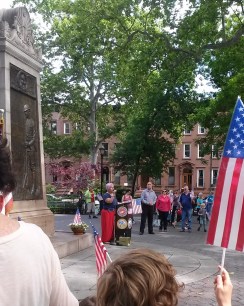
MemorialDayBrooklyn3croppedBack briefly in Brooklyn for a business matter, I took the chance to attend the Memorial Day service in our local park. It was a pleasant surprise.

A few years ago, only a dozen old-timers bothered to show up. This year there were more like 100 people, including police officers and firefighters as well as some veterans, but not (as far as I could see) any current members of the armed forces.

Many children were there too, dutifully waving flags provided by the Court Street Merchants Association rather than racing around the monument on their scooters, oblivious to its purpose. Ceremony organizer Joanie D’Amico, owner of a local coffee shop, specifically thanked parents for bringing their kids, and urged them to teach their children that Memorial Day means much more than department store discounts and trips to the beach.

No such reminder would be needed in Dubois, at least not in the lifetimes of today’s children. Its people may have always understood military sacrifice in a meaningful way. But 7 years ago, they gained national prominence for the way they paid homage to a local son fallen in Iraq.

Phelpschance
Chance Phelps

In the 2009 HBO movie Taking Chance, Kevin Bacon portrayed Lt. Col. Michael Strobl, who volunteered to accompany the body of 19-year-old Marine private Phelps Chance, returning to Dubois for his funeral. Phelps was killed on Good Friday, 2004, in Ramadi, Iraq, while manning a machine gun.

The movie  recounts Strobl’s journey to Dubois, ending with the funeral and the subsequent reception at the VFW post. Strobl himself described this all in detail in a post on the website of the San Francisco Chronicle.

“I wondered how many people would be at this funeral if it were in, say, Detroit or Los Angeles,” he wrote. “Probably not as many as were here in little Dubois, Wyo.”

DuboisMemorialDay1Sure enough, on Monday there seemed to be about as many people attending Memorial Day services in little Dubois (population less than 1,000) as in our part of Brooklyn (population about 44,000).

Chance Phelps must have been on everyone’s mind: He’s buried in that cemetery.

Among those present were numerous local veterans (some of whom offered the rifle salute), members of a motorcycle club who travel to Dubois every year specifically for this ceremony, and a woman named Shanna Muegge, 31, who currently serves in the Colorado National Guard.DuboisMemorialDay3

Ironically, the movie Taking Chance wasn’t actually filmed in Dubois. I’ve heard it said that this was partly because people didn’t want to risk disrespecting the Phelps family in any way.

But the film, and the publicity that followed it, certainly honored the actual town. A man called Thomas Stout, who attended the funeral, described in detail the respect for Phelps and his ultimate sacrifice that he perceived in the people of Dubois, even in the adolescent girls who watched the funeral parade soberly rather than opening up their cellphones.

In a letter to the Dubois Frontier, he described what he saw in Dubois as “patriotism, independence, a belief in progress through hard work, community spirit, and a bond between neighbors”–the embodiment of an “Americana” he had always revered but never before witnessed.

DuboisMemorialDay2“It is such a wonderfully powerful thing to believe in,” he added. “It was a strong enough belief for me to want to dedicate my life protecting it. Unfortunately, never did I see it until last weekend.”

“Thank you Dubois,” he concluded. “Thank you for confirming to me that Americana really exists.”

© Lois Wingerson, 2016. Thanks to Darlene Wimmer for permission to use her images from Dubois.

Want to learn more about Dubois? Follow this blog by signing up at the top of the right column.

Ghost Rodeo in Dream-Time Dubois

About a rural recreation and the way of life it celebrates, which most of us can scarcely imagine.

RodeoGrounds5It’s not the right day for an ambitious hike. So you wander out into the rodeo grounds, where the dog can sniff around and discover the ghosts of bulls and broncos.

But he probably can’t hear the inaudible echoes that haunt the surreal silence: the announcer’s calls not coming from the booth today, the imaginary whistles from the invisible crowd, the loud thump of nonexistent hooves.

What a great show the Dubois rodeo was, and will be again! But not just now.

Our rodeo is a remarkable phenomenon, one that too many people miss because they choose to approach Yellowstone through Cody or Jackson rather than coming this way. It’s a true small-town event, with some outsiders but also the same locals week after week. This is not show business. It’s rural recreation.

RodeoGrounds1On an early spring day, it’s my chance to go where I’m otherwise forbidden. Here’s where the livestock mill around, out of my view on the far side of the caller’s booth, while I’m sitting idly on my bench across the arena.

Can you see those men whipping flanks to drive the bulls into the chute?

Here’s where so much business happens, just before the gate finally opens and the rider lurches out straddling a mount that is mightily incensed and all too temporary.

RodeoGrounds2 I always wondered what it looked like for the bull or bronco riders waiting on this side of the gate. I can’t imagine what it feels like to be one of them.

But then how could I? I never was part of that strong and stoic male culture. My Dad was a professor, not a wrangler or a rancher.

“Rodeo isn’t really about roping and riding, Ranches are about roping and riding,” James Galvin wrote in his wonderful novel Fencing the Sky. which is based in this general region of Wyoming. “Rodeo is about damage and vast quantities of physical pain.”

I don’t like to dwell on this part of our charming small-town rodeo. I enjoy watching the skill of the barrel racers, and the antics of the guest-ranch guests as they compete to grab the ribbon off the racing calf and sprint back with it to the starting point. But the real point of the rodeo is the part where you hold your breath and then roar aloud with admiration and incredulity at the brave fellows who hold on for dear life and hope to beat the clock.

RodeoGrounds3“Even people who don’t know much about rodeo,” Galvin also wrote, “know that whatever happens … the cowboy has to rise from the dust into an ocean of pain and make it on his own to the rail as if nothing at all has happened.”

I’m one of those who doesn’t know much about rodeo. But I have seen that.

I noticed this crumpled beer can on the inside of the gate. If it were me on that animal, I would have been drinking whiskey to wash down the handful of Advil.

To outsiders, this may all seem like foolhardy bravado. But at base it commemorates the life that created this little settlement over a century ago, in which injury was part of the bargain–in a way probably no cowboy at work today could truly understand. People drowned crossing rivers before there were bridges, got stranded outdoors and died of exposure or an animal attack, and sustained occupational injuries as a matter of course.

“When one works with horses he is bound to get hurt,” said Dubois’ first cowboy Andy Manseau, who came to the area in 1881. He told of being kicked by a horse he wanted to break, which broke his leg in two places and knocked his knee out of joint. It took him three hours to mount his saddle horse, after which he rode a half mile to a neighbor who got him to a doctor.

“I was laid up for a while,” he said, “but as soon as I could I went back to riding again.” After that he goes on to tell about his last accident, which was even worse, the one that finally made him stop.

RodeoGrounds4

Just across the river from the rodeo grounds sits Warm Valley Lodge, the new assisted living facility. It came to be there partly so that older ranch folks who can’t get along by themselves any more can still enjoy the vistas they have always loved.

I wonder what the retired cowboys living in there think when they hear the rodeo on Friday night. Does it make them long for the roping and riding? Or does it merely make them remember ancient aches and pains? I should ask sometime.

© Lois Wingerson, 2016

You can see Living Dubois in your email every week! Sign up at the upper right.


For Our Eyes Only: Dubois April Art Show

Not too crowded at this off-season exhibit. Lucky us.

EmptyCowboyWell, that headline isn’t entirely true. Unlike some of the paintings on display, the three-man art show held last Sunday evening at a local church was not exactly invitation-only.

However, not too many outsiders are likely to turn up at an art show in Dubois this time of year, as you can see from this picture I took the following Friday morning in the Cowboy Cafe.

We’re hoping someday to see those tables just as occupied in the early spring as they will be a few months later, when we’re lucky to get a seat.

Meanwhile, feast your eyes below on a poor rendition of one of the paintings I saw last Sunday. Artist Greg Beecham calls the painting “Tween Dreams and Waking.”

That’s a good metaphor for the vision some local people have about the future of this equally beautiful valley. Things have turned down since the 2008 recession, but I think they’re looking up these days.

This swan is one of four wildlife paintings by Beecham that will be featured this summer in the invitation-only Prix de West exhibition at the National Cowboy Heritage and Western Heritage Museum in Oklahoma City. All four (including a grizzly, a wolf, and a falcon) were on view last Sunday.

Beecham_Swan

This is the third year that Greg has sponsored an exhibition of works by local painters in April, the quietest month in Dubois. They call it a gift to the community. It’s a chance for us to see some of the best art by our neighbors, up close and personal, at at time when we’re not all going loopy trying to serve the needs of our visitors.

Starting in about a month, the town will explode with returning “snowbirds,” many of whom are fine amateur or professional artists. But quite a few, like Greg, have chosen to live in Dubois year-round. He and his family have been here for 20 years.
Beecham041516
He told me that he and his wife Lu (who is the business manager for the local schools) “kept moving farther and farther away from the hubbub” in western Washington state two decades ago, but the hubbub kept chasing them. At a local art show in Ellensburg WA, he asked the husband of an artist from Casper where they could find a place in Wyoming that was not too crowded, had a good school for the kids, wasn’t too cold, and was beautiful.

Without hesitation, the man replied, “Dubois.”

They looked first in Colorado, because his parents came from Grand Junction. But even back then, he said, there were still too many people in Colorado.

So they detoured back through Dubois “to see if what the guy had said was true.” Within a few weeks, they had bought property in town.

Last weekend’s art show also featured works by Jerry Antolik and Tom Lucas. Antolik lives in the tiny nearby hamlet of Hudson, where he focuses his efforts on murals. But his portraits are also excellent, and as you see here he also does fine wildlife paintings.Antolik_MooseAntolik told me he was up on Union Pass quietly working beside this pond full of lily pads when the moose suddenly emerged with her calf.

Tom Lucas, who grew up nearby in Lander, is as much a historian as a painter. He’s well known locally for his monumental effort to research and recreate the methods by which the ancient Shoshone treated the horns of bighorn sheep, to craft the legendarily strong and supple bows that allowed them to be master hunters.

Travel_LucasOne of his bows was on display last Sunday, along with several of his masterful paintings of native crafts. As part of learning to paint them, as you can see from the beaded bag in this picture, he also recreates them.

Tom, whom I consider a good friend, told me he began to paint as a young lad because he was inspired by the work of Charlie Russell. “I never thought I could get to be that good,” he said, “and maybe I’m not.” But you can see how far he has come in that direction.

He also said that he hoped the show might inspire the same dream for some of its young visitors. If it does, they’re in a good place to find living mentors.

© Lois Wingerson, 2016

You can see Living Dubois in your email every week! Sign up at the upper right.


Dubois’ Bravest Risk Life and Limb Again

Our wonderful firefighters always stand ready to race out of their comfort zone for our sakes. But usually not just for our amusement.

The Fireman’s Dance on Saturday night was billed as an opportunity for our brave volunteers to thank the town of Dubois for its support (and ask for more). I turned out because, of course, I support our extraordinary fire-fighters but also, to be truthful, because not much else is going on just now.

Dancing aside, the chief entertainment on offer was the prospect of seeing our brave young men compete in a race on toy tricycles. I had no idea they would be racing in full fire-fighting gear including helmets! I also didn’t expect a small catastrophe …

You can read my full account of the event, in the form of a sports report, which appeared yesterday on the County 10 website (Dubois Volunteer Firefighters Rise to the Challenge Again). Here, you can enjoy the other pictures I wasn’t able to post there.

There’s nothing to tell about my dancing skills. I didn’t dance (though others did, and it was a pleasure to watch). I was too busy taking pictures.

100_0142
Firefighter Chris Sabatka tries out one of the racers in a pre-heat spin.
100_0144
Mike Franchini’s bike explodes on contact. Sabotage? Terrorism? Faulty design?
100_0163
Reassembled by his crewmates, Franchini’s bike survives a trial lap.
100_0172
Local businesses contributed and decorated the bikes. Mexican restaurant El Jarro’s came complete with sombrero and pinata.
100_0190
El Jarro’s bike on the move, complete with sombrero’ed rider.
FiremansBall5
At the starting line, ready to roll.
100_0180
Heading for one of the many collisions in the race. As I said, our guys are always ready to risk life and limb (but not usually just for our amusement).

© Lois Wingerson, 2016

You can see Living Dubois in your email every week! Sign up at the upper right.

Why Dubois, Wyoming? Look Here!

The brand-new Destination Dubois website shows in living color all the good reasons to come this way.

DDScreenshot3

I’m so pleased to draw your attention to the best view you could get of Dubois without actually being here. It’s on the new website sponsored by the Dubois Chamber of Commerce.*

Please do take a moment to go to www.duboiswyoming.org (or just click the first result when you google the search term “Dubois WY”) and feast your eyes.

Many of the stunning images have been contributed by Dubois residents. Local artist Gary Keimig took the lovely background picture of a sunrise above, and Sally Wulbrecht, curator of the Dubois Museum, took the pictures of the horses and hikers.

The first thing you see when you click on the website are four eye-popping images that rotate across the screen, starting with Molly Moore’s catch of two bighorn sheep:

DDScreenshot1

followed by Sally’s placid vision of a mountain valley:

DDscreenshot2

and concluding with the “call to action”:

DDscreenshot4

The new website lays out in one place the many compelling reasons to discover Dubois, such as those below:

DDscreenshot5

You’ll see many more by going to the page duboiswyoming.org/activities and scrolling down, or clicking on any of the labels beneath the horizontal brown bar at the top.

Please, if you already know and love Dubois, tell your friends about the new website by any means of communication you employ. Especially please notice the social media buttons at upper left and use them to “like” the site.

I’m going to start doing that right now, today. (Full disclosure: I wrote the text for the site. Please let me know if you find something that ought to be changed.)

© Lois Wingerson, 2016

You can sign up to see Living Dubois by email using the “Follow” box at upper right. Thanks!


*and funded by tourism tax dollars administered through the Wind River Visitors Council.