Time to leave town. I have to head over the pass to catch a plane. (As they say in Brooklyn, you gotta do what you gotta do.)
It’s barely light when we turn uphill to catch the 9 AM departure. In clear weather like this, we know, the drive will take about 90 minutes. The moon is still visible in the sky, and the road is silent.
Plenty of our neighbors go over Togwotee Pass to Jackson all the time, for a shopping spree, to catch a ski lift or a show, or to visit a specialist. We rarely bother to head into that tourist hot spot, except to catch a flight.
Still, the trip across the mountain is usually a delight–especially now that they’ve taken a little of it down to widen the highway.
We used to approach road cuts like the one below with trepidation. The lanes were narrow, the plunge off the far side was steep, and you couldn’t see what was barreling down on you from the other direction. Especially on a wintry day like this, the drive could be pretty nerve-wracking.
 No more. Today, the highway is smooth, fast, and (as you see from the pictures) well cared-for even in the winter. We’re going all the way over the Continental Divide here, above 10,000 feet and back down. Thanks in large part to the interests of the snowmobilers, it’s going to be an easy trip today.
The succession of vistas make you catch your breath, beginning with the monumental granite walls of the pinnacles, climbing to and passing across vast high mountain valleys, then drifting downward through a green tunnel of pines that open to views of the Tetons.
This pleasure came at a price. Not long ago, we had to endure hour-long waits to cross miles of washboard gravel, while the huge orange toys moved big chunks of rock from here to there, scooped the gravel flat and frosted it with asphalt.
Even back at home, we had nuisances to endure. Trucks burdened with boulders or tons of gravel would groan uphill past me as I finished my morning bike ride, and then growl noisily downhill using their jake-brakes on the way back down.
The reward for our patience is a smooth, wide ribbon. Thank you, Albright Sand & Gravel  and Oftedahl Construction. And thank heaven.
The heavy equipment that goes up and down the road most often this time of year, other than the logging trucks, are the snowplows. We see them out even at times when it’s bone dry where we are–a welcome sign that the snowshoeing farther uphill is still good.
In warmer months, this road becomes a scenic detour for those travelers who miss the turn at Moran Junction. Every so often a stranger pulls into our driveway and asks how far it is to Yellowstone. Told that the best option is to enjoy that same wonderful view again in the opposite direction for another hour or so, the driver often asks whether there’s another way around.
In fact, there is. It’s a great trip via Thermopolis and Cody, through a memorably beautiful canyon. But it reaches the northeast entrance to the park, and takes the better part of a day.
The driver’s next question: Is this a bed and breakfast?
Sorry, no. (But there are nice motels and good restaurants 10 minutes farther on, in town. Why don’t you take a look around and enjoy yourselves?)
© Lois Wingerson, 2016
You can sign up to see Living Dubois by email using the “Follow” box at upper right. Thanks!


 The wind is up again, driving the snow flurries sideways. It has pushed a steady bank of snow clouds across the Absarokas, and the Ramshorn peak up the valley has vanished again.
 Like the bears in summer, the wind in winter is a factor in where I choose to hike. I know there’s much less wind in the tree-sheltered back roads along the river across the highway than on the high flats of the scenic overlook in town.
 As for me, in a way I enjoy the wind (which I can hear even as I write). I’ve lasted nearly 10 years now, and it still hasn’t blown me away. Far from it.

 You hear about it again and again: Someone came to this remote town not far from Yellowstone and fell in love. How does this happen?
 3. Fascinated by the history … and the prehistory. From the mysterious carvers of the petroglyphs to the courageous and resilient Mountain Men and homesteaders, the people of the past never fail to amaze.
 7. Silenced by the snow: The noisy burdens and pressures of daily life melt away when you can get out into the soft, deep white of it, whether you’re marching on snowshoes, gliding on skis, or sailing along on your snowmobile. (It’s all good–and never too cold, as long as you stay out of the wind and wear enough layers. Don’t forget the sunglasses!)
 10. Drawn to the artists: You may not be skilled at capturing what you see on canvas (or film), but so many others are. Plenty of them have not resisted the lure of living here, and you have ample opportunities to admire their work on display at art or photography shows, or in local galleries.
 13. Captivated by the creativity: Knitters and quilters. Guitarists and fiddlers. Woodcarvers and antler sculptors. Jewelry designers and master caterers. (So what is lacking here in Dubois? Walmart.)
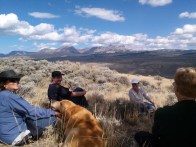
 More accurately, they’ve invited me to join them. Today I headed for the hills on snowshoes with six other women, most of whom moved to Dubois within the past few years–from Oklahoma and Louisiana, Massachusetts and California by way of Arizona, and in one case back living in Dubois again, after leaving town for a decade to explore the country by RV and considering many other locations in which to settle permanently. Here they are