


Last weekend, I heard Wyoming’s new governor delivering an address at a conference. Mark Gordon began with a virtual driving tour of the scenic wonders of our state. People would whoop as he mentioned their regions – Devil’s Tower, Thermopolis, Lander.
What better way to endear yourself to a Wyoming audience than to extol the beauties of our state? Gordon was preaching to the choir, for certain.
I waited for a mention of Dubois and a chance to call out. But on his imaginary counter-clockwise circuit, Gordon veered away and entered Yellowstone from the north.
I sat back and sampled the little fruit tart in front of me.
Eventually, near the end of the speech, I did have a chance for my shout-out and it took me by surprise. Gordon drew toward his close by alluding to his father, and it was not the history I would have imagined. Fundamentally, Mark Gordon–the epitome of a devoted advocate of the spirit of the American West– is in Wyoming because his father fell in love with the West in Dubois.
Crawford Gordon (1917-2014) was given one of those patrician East-Coast names made up of two last names joined together. He grew up on a farm in Lincoln, Massachusetts, and went to Harvard University, where he earned a degree in economics.

The young Crawford could easily have taken a bank job and stayed on out East, and his son could have been born in Massachusetts. But he chose the tougher life of ranching in Wyoming. That’s because at the age of 15, Crawford visited CM Ranch in Dubois, where he developed a passion for the cowboy spirit and for rodeos. He had begun the evolution to the “Crow” Gordon he would be for the rest of his life.
For a while, young Crow Gordon rode the rodeo circuit. He won prizes at the Johnson County Fair and Cheyenne Frontier Days. I wonder what his parents thought.
That was long before Jerry Jeff Walker recorded these lyrics:
Why does he ride for the money?
Why does he rope for half share?
He’s losing his share, and he’s going nowhere …
He must have gone crazy out there.
At the age of 30, Gordon settled with his wife and began ranching near Kaycee, Wyoming, in the northeast of the state. The new governor grew up on that ranch.

I had a brief conversation with Mark Gordon last weekend. He is urbane and engaging, but he also has the demeanor of a Wyoming cowboy – soft-spoken and easy-going. Without inquiring, I took him for a rancher, that combination of businessman and farmer that is so prevalent among Wyoming politicians.
But like his father, Mark Gordon was educated back East. He went to boarding school in New Hampshire and college in Vermont. After graduating — and I’m sure skipping his father’s dude ranch step, as he did grow up out here — he returned to Wyoming and began ranching.
When I spoke with the governor, of course I said I was from Dubois (not, strictly speaking, the truth). “You know,” he said, “my father created a silent film when he was at the CM Ranch. You should ask Twila Blakeman about it.”
I called the former Mayor yesterday, and she welcomed me to drop by for a copy of the film. When Gordon gave it to her, she uploaded it to her laptop, and then gave copies to the Dubois Museum, the CM Ranch and, yesterday, to me.

Called “Deadwood Gold,” the film shot in the 1930s is grainy and funny, impromptu and crowded with extras. Evidently Crow Gordon had inspired everyone staying at the ranch to dress up and pitch in.
It’s a 30-minute shoot-em-up Western that has all the classic features: a stagecoach, a gold find, a villain and a sassy lady, and a posse that leap into the stirrup, always galloping on the run off into the hills or back into the corral.
One of the “stars” is the founder of the CM Ranch, Charlie Moore, who was the son of a local old-timer. He went to the University of Michigan (my alma mater) for law school, hated it, and returned to open a ranch where he could impress young boys from the East with the independence and adventure of the West.
I don’t know precisely how Crow Gordon came to stay at the CM Ranch. Very likely his parents were among those whom Charlie Moore met during his business trips back east to promote his ranch.
In the case of the elder Gordon, he clearly achieved his objective. According to an obituary, Gordon’s passions were horses, ranching, rodeo – and opera. Like Charlie Moore and like so many who live out here (including his son, the new governor) he was obviously a fascinating hybrid of the rugged and the refined.
So often you find interesting little surprises as you learn about these Wyoming people. I’m still learning that lesson myself.
© Lois Wingerson, 2019
You can see new entries of Living Dubois every week if you sign up at the top of the right column at www.livingdubois.com


 The sight of tanks rolling down the main street of Dubois would be jarring if we did not know the context: the Independence Day parade. Every July, we have been seeing just a few of the tanks, trucks, and ambulances brought out for the day by a local landowner, Dan Starks, an engineer who is fascinated by the machinery and its history.
 Will it be the long-sought “draw” that lures people to stop overnight n Dubois on their way to Yellowstone? Will this all overwhelm us, as the Total Eclipse did last year (but only for a few days)?
 He has bought up a great deal of property in the area, and reportedly contributed large amounts anonymously for various charitable causes here.
 Earlier that day, Starks had welcomed the public to his property, to view at least part of the collection. Speaking in a rapid-fire monologue, and naming the vehicles by model number, he spoke about them with some passion.
 I asked about the truck standing next to it, and Starks described why a new delivery/artillery hybrid was needed in the Vietnam, where it was easy to lob a grenade at a supply vehicle. An onlooker spoke up to say that he had actually used a truck like that in ‘Nam.
 The new curator of the museum, Doug Cubbison, who comes here directly from 5 years at the Veterans Museum in Casper, has been working quietly in town since last August to begin the massive effort of creating and staffing a huge and unique institution in one of the most remote towns in the country.
 Once in a while, on a summer morning, I awaken to what sounds like cattle in the living room.
 One afternoon last week, I came home to the sound of whoops, whistles, and loud mooing in the valley. I ran over to take this picture.
 Recounted in the book Recollections of the Upper Wind River Valley, tales from the first cowboy in the area, Andy Manseau, make clear what it meant to be a cowboy in the old days. “In the fall of [18]98 I ran the J.K. Moore cattle,” he recalled. “… We were through rounding up and night herding them to be ready the next morning to drive them to the railroad at Casper.”
 She leaped out of the car, all excited, and began taking photographs. After the cattle had passed, there was no way to keep her sneakers clean when she returned to the car.
 “What happened to your hand?” friends were asking yesterday.
 For this visit, I didn’t have to take the usual 90-minute drive over Togwotee Pass to Jackson to see the dermatologist. This time (on the morning of our first snowfall, as it happens), the dermatologist and the rest of her team came to me.
 There would not have been any sunscreen available to my grandfather, who was a Nebraska farmer with fair skin. I’m guessing there were no public-health messages about the risks of the sun during the Great Depression, and as you see him standing here in the barn door, he was not wearing a hat.
 This week was the end of a six-month pilot project to see whether the practice would attract enough patients in Dubois to justify the effort. Not only have they gained new patients from our town, Storey told me; about half of their visits in Dubois are from people farther down the valley, in Lander and Riverton, who would not want to make a 3-hour trip all the way over to Jackson.
 In New York City, I left behind some of the best medical care in the world. But I don’t spend much time even thinking about that.
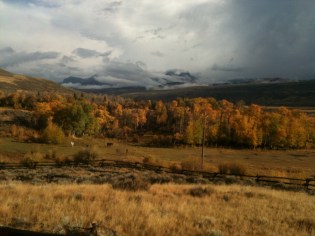 The autumn solstice passes. The days of daylight savings time are numbered.
 The wise and knowing hands of Helping Hands Massage Therapy are exploring and unwinding the knots and kinks in my muscle tissue. I have been to some of the best musculoskeletal specialists at the best hospitals in New York City, but Reenie’s exquisite skill has done more for my particular woes than all of them combined, and she is doing it now. What a blessing for me that she found her way here, before I even came.
 Somewhere there’s also the sound of trickling water, which brings me back to one reason why I’m here now: The mingled joy and stress of my last serious hike. A friend and I took the day off and clambered up to Lake Louise, a hidden glacial lake which is the splendid reward after more than an hour of trekking, much of it straight uphill on rocky ground.
 Here’s one reason I need a massage today: The hike to Lake Louise ends in a rising field of solid granite, where the trail vanishes . You’re left on your own to clamber up any way you can, on hands and feet if all else fails. At the top, it’s so windy I fear I might be pitched over the edge. My friend remembers that, years ago, they brought fishing rods but could not fish. It was too windy.
