

 “How likely are we to see wildlife on the way?” asked someone passing through on the way to Yellowstone.
“You’ll certainly see deer,” I said. “You could also see some pronghorn antelope. Some locals see grizzlies on the Pass, but I’ve never seen one there.”
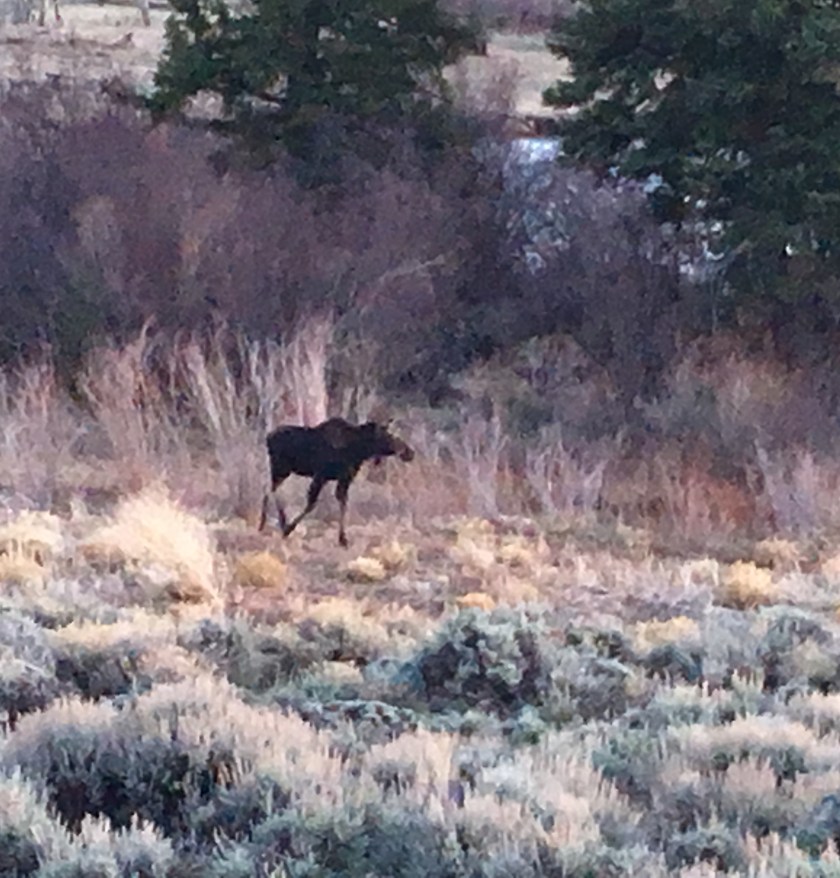
“What about moose?” he asked.
“Well, if you’re really, really lucky, and keep your eyes on the trees by the river, you might see one,” I replied. “I see them once in a while. But moose are pretty rare around here these days.”
 A recent survey of visitors to Dubois showed that wildlife viewing is their second reason for coming here, after mountains and scenery. I know from talking to visitors and reading their posts on TripAdvisor that many people come to this area hoping to glimpse wild creatures at home in the wilderness.
It has taken years for me to appreciate one privilege of living here year-round — simple time on the ground, the opportunity to encounter the animals who share this neighborhood, as an ordinary part of my daily life.
City girl that I was, I still find pleasure in seeing cattle and horses every day. Driving down the highway toward town, I enjoy watching a hawk floating on the updraft, looking for prey. We have had to relocate the dog’s walk, because the neighbor across the road has seen the moose and her calf again. She lost last year’s baby in the spring flood waters, and he says she glared at him defiantly from his back lawn the other day, as if to say, “I’m not going to lose this one!”
 Last week, I invited a friend for lunch. It being a beautiful day, we chose to sit on the back porch.
As we talked, we noticed a few white-tailed deer just across the fence. We enjoyed watching them graze on the willows as we munched on our salads a few yards away.
Walking the dog in the park behind the assisted living center, I encountered an old friend coming down the river walk. “Have you seen the goslings?” he asked.
 We rounded a corner, and there they were, being herded by Mother Goose as we approached.
This afternoon, driving toward a hike up Long Creek Road, my companion said, “There’s an antelope!”
He sat immobile, not far from the dirt road. “It’s odd to see one all alone,” she remarked.
“I hope he’s not injured,” I said.
Farther along the road, she spotted more antelope in the valley, and beyond that, a few elk. I slowed the car to look, and there they were, dark against the green of the grass.
“I wonder what they’re doing here at this time of year,” she said. You’d think they would have migrated on, and moved up-mountain.
 Driving back after our hike, we looked for the lone antelope, and argued about exactly where we had seen him before. “I guess he isn’t here any more,” I said. “That’s good.”
“There they are,” she said. A few antelope grazed on a distant hill, as a larger one stood nearby, looking out across the valley.
“I guess he’s the sentinel,” I said, glad to have come up with a reason for why we had seen him alone on the way uphill.
I may talk smart now, but to be honest, when we moved here from the city I couldn’t tell an elk from a moose. It was the landscape that compelled me, not the wildlife that live here. Later, I came to value the strong sense of community in our town.
With time, I’ve come to see these silent neighbors as an important part of that community. They may be elusive, and we rarely get to know them. Some of them (like the tourists) are only passing through. But we share a love of this place, and are glad when they return.
© Lois Wingerson, 2018
You can see new entries of Living Dubois every week if you sign up at the top of the right column at www.livingdubois.com.

 “Is that one of the geezers?” said the man at the pullout.
 yet.
yet. Only a few days into May, the northern regions of the Park were still blanketed with deep and drifting snow. A road sign just a few miles inside the entrance warned us of avalanche risk.
 On the second day of opening, it was about as crowded as you would want for a visit to a public park. We had a little company–just enough to feel pleasantly surrounded, not too isolated in the wilderness.
 Besides a chance to visit that overly popular Park minus the crowds, this was a dry run for our small RV and our Vespa motorbike. We don’t use the Vespa much near home, because it wouldn’t feel safe in the traffic that zooms past at 70 mph, much of it either hurrying toward the Park or home afterwards.
 We drove into the parking lot at Old Faithful and stopped the bike. It looked like rain, so we went inside the Lodge to get a drink and maybe wait out the weather.
 As I sipped my beer near the huge fireplace in the lobby, a decent-sized group listened to a tour guide.
 Meanwhile I turned to watch the bison grazing as I continued to wait. He lifted his head to watch me in return, as I stood silently beside the odd red object. Slowly, he turned in my direction. I caught my breath.
 I know it’s sentimental, but I fancied that, rather than being a threat, he had been guarding me.
 As night was falling, I enjoyed myself for a long time beside the campfire, looking over in the direction of the Vespa on the back of the camper–both of us sitting at rest and doing absolutely nothing at all.




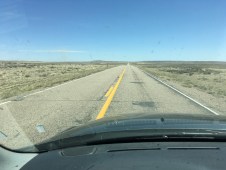 “I’ve always wanted to visit Wyoming,” said a few people I met during my road trip this month. Spoken with a sigh, as if this was some impossible dream.


 The first cage we came to held the tiger. It roared as soon as it saw the baby. (Feeding time.) We jumped, but the baby didn’t react.
 The pronghorns were wandering around a space smaller than someone’s back yard. I had never before seen one up close and personal, how its horns seem to spring directly out of its eyes. I usually see them in the near distance somewhere nearby, grazing on a plain. They sometimes hang out in the pastures around town when food is short elsewhere.
 On seeing us, this huge black bear lumbered out of its man-made cave, approached the fence, and sat down — more sociable toward the baby than my own dog is.
 We know from surveys that “wildlife viewing” is one of the main reasons people come all the way to the Dubois area for a visit. Going to the zoo for the first time in years helped me understand this better.
 Local historian Steve Banks gave another riveting talk a few weeks ago, this one about the history of traffic across this valley. Since then, I’ve been caught up in a sort of time travel.
 The brownstone is 4 stories tall, has 4 bedrooms, and originally had a dining room and a receiving room for guests waiting to be admitted to the living room. It was remarkably modern for having central heating, fired by a coal furnace at the bottom.
 According to Steve Banks, the first white man to visit the valley was probably a Kentuckian named John Dougherty. A fur trapper and trader, he fled south in 1810 from what is now Montana to escape an attack by Blackfoot Indians, crossing Shoshone Pass close to Ramshorn Peak and continuing down the Dunoir Valley to the Wind River. (This picture shows that valley.) A bullet from the attack remained in his side for the rest of his life.
 In 1811, a year after John Dougherty came down the Dunoir Valley with a bullet in his side, Wilson Price Hunt came through with a party of 68 people and 200 horses. Hunt was a co-owner of John Jacob Astor’s American Fur Company, headed toward Fort Astoria on the Columbia River in the northwest, hoping to establish fur trade with Russia and China.
 He also described our valley. “From thence across the 2d range of mountains to Wind River Valley …” he wrote in a
 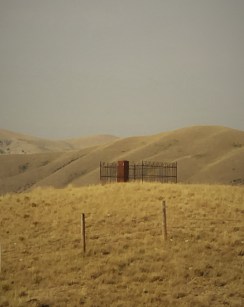 Twelve years after that, “Old Man” Clark froze to death, alone in his cabin, during a winter storm. His grave sits atop a small hill, marked by an obelisk and surrounded by a wrought iron fence.
 In March and April, the town is ours at last. We see few out-of-state license plates, except for the spring snowmobilers heading up the pass.
 Some days it’s really cold; other days it’s mild enough to go out without a coat, especially where it’s not windy. Today the thermometer reads 20 degrees, but I’m quite comfortable in a denim shirt and down vest.
 It seems a shame to call them “bad lands,” when they are so wonderful. Later in the spring, they will erupt with small wild flowers and the sage will turn green and fragrant.
 The road beyond the dump heads over the badlands and on up toward Table Mountain where at some places the scene over the edge looks like a miniature Grand Canyon. Hiking closer to the dump today, what I notice are the ever-changing colors of the soil — which is the most striking feature of the badlands in any case.
 This close to the dump (and the start of the road) you always encounter some trash in the terrain: empty beer cans, cardboard, construction debris deposited out here for free (rather than paying the fee, at the dump). The ground is cleaner farther out the road.
 Nearing the top, I encounter a very large discarded object. Someone wanting to avoid the discard fee must have pushed this over the edge just beyond the dump, driving no farther than necessary on the rutted road in order to avoid being seen.
 Back when I first lived in New York City, it really used to trouble me that there was so much violence in films set in my home town. But as time went by, I stopped caring about that.
 “So much for the image of our valley,” said my husband as the film ended.
 But the only film ever set in Dubois wasn’t a “Western,” and it wasn’t actually filmed here. I’m gratified to say that
 I found the box with my new IPhone on the drivers’ seat of my car, which I had left unlocked on a trip to town last week.
 day’s long trip into town, what with the long slog through the snow to the highway. For the most part, whatever you had by October was what you got by with until spring.
 And given crowd-sourced reviews on the Internet, I usually wind up with the best product — not whatever brand happens to be in stock in the store I’m in.
 We don’t even have to leave behind some of the best that we enjoyed in that city. There on my kitchen counter is a bag of the best coffee beans we have ever found, fresh (well, since frozen) from Sahadi’s, our former go-to Middle Eastern market on Atlantic Avenue in Brooklyn. We place an order on
 Have you ever been steered down an utterly ridiculous route in your own neighborhood by a digital navigator? Then you’ll appreciate this.

 Last evening I attended a town meeting to consider a new project to improve traffic flow through Dubois. My husband and I cast sidelong glances at each other when the consulting engineer from another town spoke about potential “loss of service” and the results of traffic monitoring, which showed little evidence of traffic jams.