

 This is Dubois. It has a new distinction this year, being recognized by True West magazine as the town with the best-preserved Western architecture.
I don’t think the award was meant to designate the oldest residential part of town. But I think it deserves recognition.
Like many new settlers from far away, I don’t actually live in Dubois, although I usually say I do. So many of us who move here choose a house that is new-built, with a view, miles outside the town limits. We don’t often venture into the original housing section.
 The main road bypasses the old part of town, which is also the low-rent district. For years, I never went over that way, except to go to the library. Unless you know someone who lives there or you have children at the school (which is also in that direction), there’s little reason to visit the original village.
I began doing so lately. At first glance it appears unkempt and unattractive. But the longer I spend there, the more I have come to appreciate it.
 “Can you help us get someone on the Town Council who will do something to clean up the town?” a friend asked me a few weeks ago. I asked her to explain what she meant by “clean up.” One thing she mentioned was the trailers.
True, there are lots of old house trailers and double-wides in the old town. Mayor Blakeman told me that you’re no longer allowed to set up a new house trailer in Dubois. The ones in the old part of town are “grandfathered in.” Today, she said, to erect a dwelling you have to put up something made of “sticks.”
 By and large, the properties with trailers are well-kept (in a dusty, not-much-will-grow-here way).
Many of the double-wides aspire to resemble suburban tract houses. Put on blinders and narrow the focus, in some spots, and you can envision yourself in a subdivision. But you’d have to ignore the fact that many of the streets are unpaved.
Notice how the mountains loom over the old village, as they do everywhere in Dubois. Here also, it’s quite possible to have a view.
 Lots of the houses are small, old, insubstantial, and have a thrown-together appearance. Many have large stacks of firewood in the yard. It’s the only source of heat for many people, because out here in the wilderness electricity is expensive and there aren’t many jobs that pay well.
Some homes also have several vehicles in the yard besides the pickup. A camper, say, and a horse trailer. This is not especially attractive, but it doesn’t mean we are trashy. It means that we like to get out into the woods, and many of us do love horses.
 A herd of deer also seems to regard the old village as home. They cross the streets with the proprietary air of homeowners out on a stroll, and sometimes lounge on porches in the sun. They like to graze in the empty lots.
Mayor Blakeman says there are still empty lots because people hold onto property in the old town as an investment, waiting for it to appreciate. She adds that some of the empty lots have begun to sell. Among the double-wides and bungalows, you also see some charming new log homes.
It’s fascinating to see the new interpretations that some people have made of their house trailers as they added on for more space. Is that what this is, in the image below? I especially like it, however it began.
 Some folks might like to spruce up the old part of town so that it looks more like a “historic district.” But as I walk these streets, I’ve come to think that the architecture of old town, if you can call it that, truly preserves the spirit of the Old West in the sense that True West magazine intended.
It’s a place founded by people without much money who intensely wanted to be here, and set up housekeeping in the best way they could, with what they had. There hasn’t been much by way of town planning and regulation, because this too is the spirit of the old West.
 If it speaks of anything, the old town speaks of individualism — and that is truly who we are.
The other day I enjoyed a movie set in a hill town in Sicily, a part of Italy that we visited a few years ago. I saw the facades of peeling stucco on a town square, glowing in that special light you get in Italy, and I grew wistful for those ancient surroundings.
Would we still seek out those old villages, I wondered, if Disney World went in and repaired the stucco and paved the cobbled streets?
Then I thought of the old part of Dubois, which we could also cherish for its very imperfections.
© Lois Wingerson, 2018
You can see new entries of Living Dubois every week if you sign up at the top of the right column at www.livingdubois.com.


 A friend from back East has graciously lent me her ski condo in the late off-season. New trails take me to unfamiliar places, with sights I will not see back home in Dubois.
 Once we took ski trips every winter, as a matter of course.
 Was that an early sign of aging? I don’t think so.
 Far better than the jostle of strangers speeding past is my own solitude, and the delight of unexpected encounters. In truth, I’m the stranger this morning, to the foxes and deer who own these slopes when there are no crowds.
 The man who had ordered the lattes was tall, patrician, lantern-jawed. He wore a fitted, aqua-blue down jacket. His female companion wore her hair cut blunt to the chin. I didn’t believe we had met.
 “Yeah,” he said. “I hear it’s nice.”
 “Tell me about yourself” usually starts a conversation well worth the time.


 I ran into Gareth a few days ago at the Cowboy Café. Over breakfast he was working on a draft of a white paper.
 The first step in investigating Dubois, Gareth told me this week, was contacting DTE, our Internet provider. This wasn’t so crucial for Sharon, the former head of a private school in Steamboat Springs. But it’s essential for Gareth, who is an information architect with a firm that provides cybersecurity services for large corporations around the world. His work demands peerless high-speed Internet, and the fact that DTE provides fiberoptic service in town was a strong selling point for Dubois.
 It’s only a six hour drive north through Baggs and Rawlins to reach Dubois, but for Gareth and Sharon, the trip took far longer. Finding their next home, Gareth said, required “a lot of traveling in our RV.”
 “Dubois has everything Jackson Hole has to offer,” Gareth told me. “You just hop into the car, and you’re in the Tetons. It’s all great.”
 Winter dropped by yesterday morning. Evidently it plans to stay for the weekend.
 Driving home, I saw large herds of antelope and deer in the fields between the houses and the highway right at the edge of town. Among them I saw a four-point buck. These game aren’t dumb, as any hunter would tell you.

 The snows are building in the mountains again, and the “snowbirds” with homes in Arizona are gone.
 The POW camp was dismantled and bulldozed after the war, although fascinating traces remain hidden in the woods up near Union Pass. Thanks to the extensive records and photos of camp commander Lieutenant Harold Harlamert, to military records, and to the prisoners’ own letters, poems, diaries (and even a Skype interview of a former inmate last April) amassed by local historian Cheryl O’Brien, Camp Dubois may be one of the best-documented “branch” POW camps in the United States.
 Although they had to wash in the stream while the enlisted men who worked as guards got hot showers, the prisoners were well treated according to the strict guidelines of the Geneva Convention. Only one POW died during the camp’s existence: 19-year-old Max Stoll was killed when a gust of wind blew down a tree he was felling.
 According to Knights of the Broadax, a book about the tie hacks, some men cried when the wife of the store manager at the civilian tie-hack village brought her infant son along on a visit. Kip MacMillan, the grandson of the President of Wyoming Tie & Timber Company, recalls being terrified when, as a young boy, he was told by his grandfather that he would be spending a night at the camp, unaccompanied. But when he got there he was treated like a long-lost member of the family. One POW even gave up his bed for Kip and slept on the floor.
 One major advantage of working remotely, of course, is that you no longer have to deal with this.
 “I think I’ll just slip into traffic,” my husband (that native New Yorker raised in Manhattan) will intone as he pulls onto the highway, with not a car in sight. It’s rarely difficult to catch a picture like this one, which I snapped from the passenger seat as we were heading toward town.
 Now and again we have to head over the pass to Jackson, where we can’t avoid contending with traffic. Some people like Jackson. I think of it as something I have to endure, now and again. The compensation is eating at a Thai restaurant for a change.
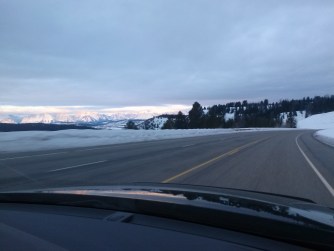 A few miles along from here, the vista opens up and you see those Tetons, which so many people travel so far to admire. (They’re the white stripe at left in the image, sunlit beneath the winter clouds.)
 1. We don’t dress this way as part of a historic re-enactment. This is really how we like to dress, and for good reason. We wear brimmed hats and long-sleeved shirts for protection against the fierce sun. We wear vests because it’s just enough to keep us warm in the high-desert cool. We wear jeans because they’re comfortable and sturdy. We wear boots because they keep the rocks out. (Here’s what I might be wearing today, if I hadn’t chosen a different shirt, vest, and jeans.)
 4. We do not “farm” deer, antelope, bighorn sheep, or other animals you may see behind fences near town. This is actually the wildlife you have come all this way to view. They come here of their own free will, probably because they like it around here as much as we do. They leap the fences, live in peace with the livestock, and like to graze our fields. (Please drive with care.)
 6. Dubois does have stop signs.“There’s not even really a stop sign in town,” Jeda Higgs said on the video “
 8. Winters aren’t brutal in Dubois (generally). Last winter may have been tough, true. But in general, temperatures here are several degrees warmer than in Jackson. Most of the snow (usually) gets dumped on that side of Togwotee Pass or on the Pass itself, giving us wonderful opportunities for snowmobiling and snowshoeing. The dry climate keeps winter temperatures surprisingly tolerable. And the air is magically clean.