

[Taking the chance for a spring break, I’m re-posting this piece of barely investigative journalism from a while ago, which inquired into a popular bit of rural mythology.]

Google “Dubois WY” and you’ll soon encounter a statement that it has been designated the most remote town (or sometimes the second remotest town) in the lower 48 states. Often this distinction is attributed to National Geographic.
When we moved to Dubois, my husband and I quickly took up calling it one of the most remote towns in the lower 48 when we described it to friends. We even trotted out some criteria, whose origin I no longer recall: Farthest from the nearest Interstate, fewest traffic lights (none), fewest number of highways that run through it (one), distance to the nearest large town (about 70 miles), or proportion of land within a 360-degree radius that is publicly owned (who knows, but lots).
But is this distinction actually deserved? How remote is Dubois, and compared to what and by which criteria? Last summer I began to study the question, with interesting results.
First, I couldn’t find any such statement about Dubois in the archives of National Geographic. And many other towns lay claim to the distinction of being most remote.
I turned to local sources, Dubois town hall and the library. Sandy Hurst at town hall offered up text from a 2011 press release about Dubois:
“A place considered by National Geographic as the most remote town in the lower 48 states… it perches on the edge of several wilderness areas and is surrounded by national forests.”
This traced back to a strategic plan for Dubois by the Foundation for Urban & Neighborhood Development of Denver, Colorado, dated 1986. The report said that Dubois had been “recently identified in national news media coverage” as the most remote location in the lower 48–the same unconfirmed designation that I was already seeing, albeit even older.
Anna Moscicki at the library turned up a wonderful quote from the memoir of Ethel Waxham, mother of the geologist David Love who defined the geological history of the Yellowstone region. Waxham wrote about her arrival in Wyoming by stagecoach in 1905:
“The other passenger beside myself was a woman of fifty or sixty, white-haired, face weather worn, bright brown eyes, Mrs. Welty. She was post mistress at Dubois, the post office farthest from the railroad of any in the U.S.”
Delightful, written when the railroads were still expanding, and perhaps an insight into the town’s perception of isolation. But not that relevant today.
In the course of promoting Living Dubois on Twitter, I was fortunate to gain the interest of Marilyn Terrell, chief researcher for National Geographic, who has also been unable to find any source for that attribution of Dubois’ remoteness by her publication (so we ought to stop using it). But she did point me to an article in Smithsonian magazine describing what truly may be the most remote settlement in the lower 48: the community of Supai, Arizona, located at the base of the Grand Canyon. At the bottom of that 3,000-foot crevasse, it is reachable only by mule train, which is how they get their mail.
But Supai isn’t really a town: It’s designated by the US Census Bureau as a “census-designated place,” which is the Bureau’s term for a populated place that is not an incorporated village and has no municipal government. So does Dubois still qualify?
 Author Henry Grabar on the website citylab.com looked into which towns were most remote by the criterion of being farthest from the nearest Interstate highway, honoring Key West, Florida, as being farthest as the crow flies, and Copper Harbor and Eagle Harbor, Michigan, (251 and 238 driving miles from the nearest Interstate), with an honorable mention to Paisley, Oregon (209 miles) due to the sheer difficulty of driving to the big highway.
Dubois is “only” about 173 miles from the nearest Interstate, at Idaho Falls, and is interestingly equidistant from Interstates at Rawlins, Casper, and Livingston MT (200, 199, and 199 miles, respectively). But considering only towns that are completely surrounded by Interstates (rather than having a national border or large body of water on at least one side), I do wonder whether Dubois might qualify as having the largest average distance to the Interstate in all 4 directions (193 miles).
If you aren’t familiar with Dubois, please be assured that you can buy plenty of groceries and hardware supplies in town, and it’s even easy to find a cafe latte. And by that other criterion of remoteness, Internet access, Dubois is marvellously well-connected. You feel the remoteness mostly by your proximity to all that wilderness.
Speaking of which, there is one remoteness criterion Dubois can legitimately claim without dispute: It is  closer than any other town in the United States to the spot in the lower 48 that is most remote from any road, and therefore reachable only on foot or by horseback. This is Two Ocean Plateau in the southeastern corner of Yellowstone Park.
This spot has been designated by the United States Geological Service as the location in the “coterminous” United States that is most distant from any road (the trailhead is at Moran, an unincorporated community). Dubois is 44.1 miles from Two Ocean Pass as the crow flies, and the plateau is farther north. Jackson is 48.8 miles away.
There is one criterion for remoteness by which Dubois fails miserably. The residents are hardly remote in their behavior toward other people. It’s one of the friendliest places I’ve ever encountered, which is one reason we go all that way to get there.
@ Lois Wingerson, 2016
You can sign up at the top of the right column at http://www.duboiswyoming.com to see new posts on LivingDubois via email.

 Dear Mr. Bezos:
 Don’t get me wrong, Jeff: I’m not suggesting that you consider Dubois for your next engagement. We couldn’t sustain another 25,000 jobs, even if we had the workforce.
 Besides, is it all about “superstars?” Countless successful people aren’t superstars (including many of your employees), but are productive and vital to our local and national economy nonetheless.
 “What happened to your hand?” friends were asking yesterday.
 For this visit, I didn’t have to take the usual 90-minute drive over Togwotee Pass to Jackson to see the dermatologist. This time (on the morning of our first snowfall, as it happens), the dermatologist and the rest of her team came to me.
 There would not have been any sunscreen available to my grandfather, who was a Nebraska farmer with fair skin. I’m guessing there were no public-health messages about the risks of the sun during the Great Depression, and as you see him standing here in the barn door, he was not wearing a hat.
 This week was the end of a six-month pilot project to see whether the practice would attract enough patients in Dubois to justify the effort. Not only have they gained new patients from our town, Storey told me; about half of their visits in Dubois are from people farther down the valley, in Lander and Riverton, who would not want to make a 3-hour trip all the way over to Jackson.
 In New York City, I left behind some of the best medical care in the world. But I don’t spend much time even thinking about that.
 Returning from a brief trip to Montana, our southward route down Interstate 15 took us straight past that other Dubois across the border, in Idaho. I couldn’t resist paying a visit.
 I’ve been curious about Dubois, Idaho, because understandably some people confuse our Dubois with this Dubois on the other side of Jackson Hole. A tourist once told me that a shop clerk in Jackson told her to stock up on groceries and gas before heading over the Pass to Dubois because there’s nothing there. I had to laugh, thinking of our large grocery store and four gas stations. In this Dubois, the one gas station is boarded up and there’s no supermarket.
 I stepped out of the car to take a photo of the water tower, and had a brief chat with two town workers who were mapping water lines, standing inside the stone traffic circle at left. (Another difference: Not being transected by a Federal highway as Dubois, Wyoming, is, I’d guess this town is free to direct traffic flow any way it chooses.)
 I noticed in passing that Dubois has its own visitor center housed in the small town library, but that was closed as we came through on a Wednesday afternoon.
 Once beyond Jackson and the construction at the new roundabout south of the airport, we were slowed only by a few out-of-state cars dawdling to look for bison or enjoy the view.
 I was in a meeting yesterday when someone texted me that the pharmacy was open. I rushed over as soon as I could. Co-owner Lisa Bailey, who was standing on the boardwalk in front of the store, smiled at me.
 When we first moved to town, you could actually buy nonprescription pills and first-aid supplies in the store where Ian and his wife sold mostly ice cream cones and souvenirs. Later, Fawn opened a sandwich shop and curio store called Serendipity at the site. When her family left town, Grandma Kathy and a friend reopened the ice cream fountain, selling all sorts of vintage items on the side (but no pills).
 It was true that Wyoming passed a law last year to allow telepharmacy — prescriptions filled by a pharm tech, working online at a satellite location, linked to a licensed pharmacy somewhere else. We know Dubois has the digital mojo to support such an operation (after all,
  Yesterday, Rob seemed to want to assure me that he has the right intentions for our old-West town: He talked about where he found that vintage “prescriptions” sign back in his home town of Palmer, Nebraska, and the charming old American Greetings display yet to appear. But when a neighbor peeked in the door to say welcome, I knew that the broad smile on her face wasn’t about greeting cards.
 I found the box with my new IPhone on the drivers’ seat of my car, which I had left unlocked on a trip to town last week.
 day’s long trip into town, what with the long slog through the snow to the highway. For the most part, whatever you had by October was what you got by with until spring.
 And given crowd-sourced reviews on the Internet, I usually wind up with the best product — not whatever brand happens to be in stock in the store I’m in.
 We don’t even have to leave behind some of the best that we enjoyed in that city. There on my kitchen counter is a bag of the best coffee beans we have ever found, fresh (well, since frozen) from Sahadi’s, our former go-to Middle Eastern market on Atlantic Avenue in Brooklyn. We place an order on
 I ran into Gareth a few days ago at the Cowboy Café. Over breakfast he was working on a draft of a white paper.
 The first step in investigating Dubois, Gareth told me this week, was contacting DTE, our Internet provider. This wasn’t so crucial for Sharon, the former head of a private school in Steamboat Springs. But it’s essential for Gareth, who is an information architect with a firm that provides cybersecurity services for large corporations around the world. His work demands peerless high-speed Internet, and the fact that DTE provides fiberoptic service in town was a strong selling point for Dubois.
 It’s only a six hour drive north through Baggs and Rawlins to reach Dubois, but for Gareth and Sharon, the trip took far longer. Finding their next home, Gareth said, required “a lot of traveling in our RV.”
 “Dubois has everything Jackson Hole has to offer,” Gareth told me. “You just hop into the car, and you’re in the Tetons. It’s all great.”
 One major advantage of working remotely, of course, is that you no longer have to deal with this.
 “I think I’ll just slip into traffic,” my husband (that native New Yorker raised in Manhattan) will intone as he pulls onto the highway, with not a car in sight. It’s rarely difficult to catch a picture like this one, which I snapped from the passenger seat as we were heading toward town.
 Now and again we have to head over the pass to Jackson, where we can’t avoid contending with traffic. Some people like Jackson. I think of it as something I have to endure, now and again. The compensation is eating at a Thai restaurant for a change.
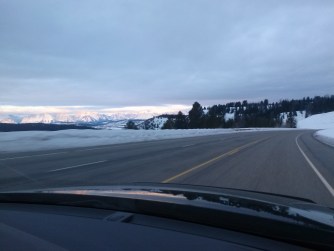 A few miles along from here, the vista opens up and you see those Tetons, which so many people travel so far to admire. (They’re the white stripe at left in the image, sunlit beneath the winter clouds.)
 1. We don’t dress this way as part of a historic re-enactment. This is really how we like to dress, and for good reason. We wear brimmed hats and long-sleeved shirts for protection against the fierce sun. We wear vests because it’s just enough to keep us warm in the high-desert cool. We wear jeans because they’re comfortable and sturdy. We wear boots because they keep the rocks out. (Here’s what I might be wearing today, if I hadn’t chosen a different shirt, vest, and jeans.)
 4. We do not “farm” deer, antelope, bighorn sheep, or other animals you may see behind fences near town. This is actually the wildlife you have come all this way to view. They come here of their own free will, probably because they like it around here as much as we do. They leap the fences, live in peace with the livestock, and like to graze our fields. (Please drive with care.)
 6. Dubois does have stop signs.“There’s not even really a stop sign in town,” Jeda Higgs said on the video “
 8. Winters aren’t brutal in Dubois (generally). Last winter may have been tough, true. But in general, temperatures here are several degrees warmer than in Jackson. Most of the snow (usually) gets dumped on that side of Togwotee Pass or on the Pass itself, giving us wonderful opportunities for snowmobiling and snowshoeing. The dry climate keeps winter temperatures surprisingly tolerable. And the air is magically clean.
 We knew beforehand that a Google team was coming to Dubois to watch the Eclipse. But only weeks afterwards, when I saw their
  But they also wanted to watch the eclipse together in just the right location, “not so much for the project as for the experience,” said astronomer Laura Peticolas of University of California-Berkeley, one of those who dreamed up the project in the first place. (That’s Johnson and Peticolas in the image, watching with wonder from the top of the Scenic Overlook, as totality was fading.)
 I asked Johnson whether the ride over from Denver had been boring, after he got this side of Rawlins. “It may be boring for you-all that live there,” he replied, “but it was beautiful for all of us. Much more beautiful than Boston [where he lives and works]. I would love to spend unlimited time there.”