The Lady and Her Knight

It’s her birthday, so she gives a gift to Dubois. A very large one.

john_and_knightIt was her 92nd birthday, so Leota Didier gave Dubois a present: a life-sized bronze statue of a cowboy. He now stares steadfastly off to the north from the front of the log-hewn Dennison Lodge, one of our favorite gathering places.

So typical: It’s Leota’s birthday, so she gives a big present to the town. The sculpture is an enlargement of the knight figure from a chess set that her former neighbor, artist John Finley, created in 1979, using Western-themed characters.

“I wanted to be sure to get this done while I still had time,” Leota said, in her deep, gruff voice. “I saw a statue like this in a town somewhere else, and I said: Dubois needs something like that.”

Like what? “Something that represents the spirit of the town.”

John is a diffident fellow, but also an old friend. Somehow she persuaded him to undertake the arduous task of recreating a chess piece as a monument.

chess-setLeota has already given much to her hometown. In fact, she was important to the historic Dennison Lodge itself, throwing herself into the effort to bring it to town when it was threatened with demolition in the 1990s. Out in the wilderness where she used to ride, it had been part of a dude ranch where notables such as Clark Gable and Carole Lombard once stayed.

Like so many others devoted to Dubois, Leota is a transplant. She was born in Iowa, and first came to town in 1970 when her husband Bernard, a Presbyterian minister, diverted them here from Denver during a vacation.

“Bernard was a funny man,” she told me recently. “He would get these urges. We came to Wyoming and he fell in love with it.”

She had thought they would be traveling on to California, but Bernard changed his plan. He had read somewhere that dilapidated ranches were going for marvelous prices in Wyoming. They came here instead, and a week laterlazylb they owned a ranch.

For many years, they ran the Lazy L&B Ranch (the “L” is for Leota) just down the East Fork valley from the Finleys. Two owners later, it’s still a very successful guest ranch.

(I owe my presence in Dubois to Leota, as I love to remind her. We stayed at the Lazy L&B nearly 30 years ago, and never stopped coming back to this area. I was delighted to see her still here when we finally moved to town.)

When Bernard passed away, Leota sold the ranch. As she aged, she slowly gave up her beloved horseback riding and moved to town. You see her often, always elegantly dressed and wearing one of her signature cowboy hats, whether at the rodeo, at church, or checking guests in at the weekly square dance in town (which devotes its earnings to charity).

leotaIt seemed like the whole town had turned out at the Dennison yesterday, to celebrate with Leota and join in as Reverend Melinda Bobo gave a blessing.

I was late for the ceremony. “What did you bless?” I asked Melinda.

“The statue,” she said. “The town. The community.”

One of its great blessings sat on a folding chair near the door, evidently enjoying her birthday celebration, and wearing her signature smile.

© Lois Wingerson, 2016
You can see new entries of Living Dubois every week if you sign up at the top of the right column at www.livingdubois.com.

Another Hero Epic from Dubois: The 21 Lifesavers

A life-and-death challenge faced us yet again. People stepped up quickly to conquer it.

One day last spring, I stopped into Mayor Twila Blakeman’s office to chat about some business.

“Please excuse me,” she said calmly. “I’m a bit distracted. The county has just decided to shut off our ambulance service.”

I couldn’t believe my ears. “What? Can they do that?” I asked.

TwilaZimmerThey could, and they tried.

It seemed the ambulance system was getting too costly for the county budget. Compared to the other towns in Fremont County, Dubois was just too small. We didn’t use the services often enough to justify the cost of emergency care.

Thus began a long series of trips down-county for our fearless Mayor, who is 80-something, nearly always good-humored, and definitely a force to be reckoned with.

My husband and I headed back to New York for our annual spring break, much downhearted. While away, we came up with several ideas that might help the situation. Once back, I stopped by Twila’s office to propose them.

“Oh, that’s all solved,” she responded, airily. “We’ve appealed for volunteers to train as first-responders, and 21 people stepped up.”

I just had to smile, and cheer inwardly. In a village that runs on volunteerism, where most regulars are already tapped out, 21 people had agreed to go the extra mile (in the middle of the night, or interrupting dinner) to deal with God only knows what disasters.

Within  6 weeks of the appeal, 3 people had been fully certified as EMTs. By last June, 18 had completed the course and graduated as qualified first responders

DuboisRisingIs it any wonder that one float in last year’s July 4 parade bore the title “Dubois Rising”? The metaphor  was obvious–rising from the ashes of the January fire. But the ambulance crisis was more recent, and was doubtless on everyone’s mind a year ago.

Today, July 1 one year later, is the official start of an important new era for Dubois. The town will now be staffed with full EMS service, featuring two full-time emergency personnel (one first responder and one advanced EMT or paramedic) at all times, 24/7.

Guardian Air Medical Services, which also serves remote areas in Alaska and other states, will be assuming responsibility for emergency services throughout Fremont County. How well this five-year contract to privatize EMS will succeed in the long run is anybody’s guess, but the current arrangement certainly beats having no ambulance service at all.

I will spare you all of the political and administrative maneuvering that has accomplished this, except to say that the person originally brought in to solve the EMS financial crisis,  Joseph Zillmer, was summarily dismissed without explanation in May 2015.

Besides Dubois’ debt to the volunteers who have served so effectively for the past year, we owe immense gratitude to part-time residents Daniel and Cynthia Starks, who put up the funds to keep emergency services in effect in the Dubois area while the problem was being ironed out.

AmbulanceMatt Strauss, Guardian’s program director for flight and ground emergency services in Fremont County (where many calls require airlifting), said that services will be much easier and quicker when ambulance calls no longer bring volunteers away from home. Paid staff on call from a permanent base will be answering emergencies from the center of town.

Before, Strauss said, it could take 15-30 minutes for responders to collect their equipment and arrive at the scene. Now “you will have the ambulance rolling out of the garage in 2 minutes, and they will be on the scene within 5-10 minutes,” he said, at least for people who live right in town.

What’s more, this brings 3 new full-time positions to Dubois for qualified emergency personnel, Strauss told me, and some volunteers have expressed interest. The objective is to have the service “fully staffed with people living there,” Strauss said.

“Oh, yes,” Twila added when we spoke about it recently. “We need ambulance staff who know the community, and know the people.”

… if only, I might add, to assure that they treat our townspeople with the respect they so richly deserve.

© Lois Wingerson, 2016

Want to see more of Living Dubois? You can sign up at the top of the right column (on the website version of this blog) to see every new post by email.


Save

Dubois Loves Cyclists, and One in Particular

Many pass through town along the main highway. She’s gone off to pedal the wilderness alone.

cyclists073115It’s that time again. The cyclists begin laboring up the hill along the highway in front of our house. For those pedaling westward, this slope is the first real hint of the challenge that faces them in the Rockies.

We see them all summer, in pairs and in groups, in the heat and the chill and, almost always, the headwind. Dubois is a well-known way station for cycle trekkers heading in both directions on one of the favorite cross-country bicycle routes.

BikeVanWhy do they go through this ordeal? Some of them are cycling for a cause: a cure for cancer, or houses for the homeless. Others are doing it for the challenge.

Whatever their reason, Dubois clearly loves the cyclists. Many of them know, through word of mouth or the Web, that they can find a place to spread out their sleeping bags overnight at St. Thomas Episcopal Church. We leave the wifi password on the whiteboard, and sometimes prepare meals for charity cycle groups.

BikeRepairStationLast summer, someone installed this bike repair station in the center of town, in the parking lot in front of the Opportunity Shop.

I once asked a cycle trekker what went through his mind when he was passed (as regularly happens) by one of those fume-spewing RVs as large as a railway carriage. The answer was not what I expected. “I wish I was riding inside,” he said.

I’ve called it an “ordeal,” but as I chat with them over dinner we’ve cooked up in the church kitchen, it’s clear they’re been having fun. These groups tend to be young folks in their gap year, finding a good way to spend time while deciding what they mean to do with themselves next.

For our very own hometown cycle trekker, a 40-ish mother of two, a much different experience awaits. She will be more likely to encounter a grizzly bear than a huge RV when she launches off tomorrow, alone, on Tour Divide 2016.

It’s a 2,745-mile race on “the world’s longest off-pavement cycling route.”  Participants travel solo and care for themselves along a trail that runs in back country, unmarked and circuitous, from Banff, Alberta, to southern New Mexico along the Continental Divide.

beckiI’m a bit worried about Becki, who is not only my yoga instructor but a dear friend from way back. I shouldn’t be.

In her pre-Mommy days, she used to cycle to work from the east side of town all the way to the top of Uphill Road 10 miles to the west. That was her commute to her job as head of the Dubois branch of SOAR, a wilderness adventure program for young people with learning disabilities. Camping out in the back and beyond was in her job description.

TourDivide 2016 is no mere cycle tour for Becki. Nor is she actually racing to win. Another cyclist called it her “once-in-a-lifetime.” Becki told me the inspiration for this dream was the sight of sheer joy on the faces of some cyclists she saw crossing Togwotee Pass on the same tour several years ago.

She writes that a bicycle was her best wedding gift, “the best piece of marriage advice i received, and … it brought me the joy that i knew was possible.” Her training for today’s challenge actually began years ago, cycling from Steamboat to Boulder through Rocky Mountain National Park, when she was one year married and newly pregnant with her first child.

“I had 4 days alone … on my bike over high mountain passes in some Rocky Mountain fall weather to process and reconstruct my world into one that had a baby in it,” she wrote, “a wee taste before my world was rocked into smithereens.”

She has been training for this challenge with “consistent inconsistency” ever since then, in all conditions, just by the way she lives and where she goes with her children, on skis and snowshoes, on foot, on a hunt. And also of course on her bike.

beckiartShe raised funds for the trip by selling her art, hand-appliqued T-shirts, and block-printed cards. (Who knew she is also an artist?)
I imagine her waiting now at the top of the trail, one foot on a pedal.

“can i do this?” she wrote recently on her blog. “i can’t do this, but i’m gonna say out loud that i can…to participate in the trajectory i set for myself, i must give it a whirl at impossible things.”

You go girl! And come back home to us, safe and triumphant.


Why the Definition of Memorial Day is Dubois WY

Thanks to a fallen son, and a powerful movie, the town has become a symbol of its true meaning.

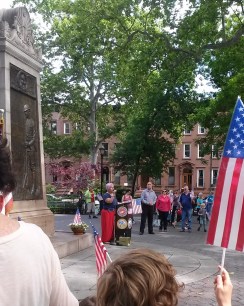
MemorialDayBrooklyn3croppedBack briefly in Brooklyn for a business matter, I took the chance to attend the Memorial Day service in our local park. It was a pleasant surprise.

A few years ago, only a dozen old-timers bothered to show up. This year there were more like 100 people, including police officers and firefighters as well as some veterans, but not (as far as I could see) any current members of the armed forces.

Many children were there too, dutifully waving flags provided by the Court Street Merchants Association rather than racing around the monument on their scooters, oblivious to its purpose. Ceremony organizer Joanie D’Amico, owner of a local coffee shop, specifically thanked parents for bringing their kids, and urged them to teach their children that Memorial Day means much more than department store discounts and trips to the beach.

No such reminder would be needed in Dubois, at least not in the lifetimes of today’s children. Its people may have always understood military sacrifice in a meaningful way. But 7 years ago, they gained national prominence for the way they paid homage to a local son fallen in Iraq.

Phelpschance
Chance Phelps

In the 2009 HBO movie Taking Chance, Kevin Bacon portrayed Lt. Col. Michael Strobl, who volunteered to accompany the body of 19-year-old Marine private Phelps Chance, returning to Dubois for his funeral. Phelps was killed on Good Friday, 2004, in Ramadi, Iraq, while manning a machine gun.

The movie  recounts Strobl’s journey to Dubois, ending with the funeral and the subsequent reception at the VFW post. Strobl himself described this all in detail in a post on the website of the San Francisco Chronicle.

“I wondered how many people would be at this funeral if it were in, say, Detroit or Los Angeles,” he wrote. “Probably not as many as were here in little Dubois, Wyo.”

DuboisMemorialDay1Sure enough, on Monday there seemed to be about as many people attending Memorial Day services in little Dubois (population less than 1,000) as in our part of Brooklyn (population about 44,000).

Chance Phelps must have been on everyone’s mind: He’s buried in that cemetery.

Among those present were numerous local veterans (some of whom offered the rifle salute), members of a motorcycle club who travel to Dubois every year specifically for this ceremony, and a woman named Shanna Muegge, 31, who currently serves in the Colorado National Guard.DuboisMemorialDay3

Ironically, the movie Taking Chance wasn’t actually filmed in Dubois. I’ve heard it said that this was partly because people didn’t want to risk disrespecting the Phelps family in any way.

But the film, and the publicity that followed it, certainly honored the actual town. A man called Thomas Stout, who attended the funeral, described in detail the respect for Phelps and his ultimate sacrifice that he perceived in the people of Dubois, even in the adolescent girls who watched the funeral parade soberly rather than opening up their cellphones.

In a letter to the Dubois Frontier, he described what he saw in Dubois as “patriotism, independence, a belief in progress through hard work, community spirit, and a bond between neighbors”–the embodiment of an “Americana” he had always revered but never before witnessed.

DuboisMemorialDay2“It is such a wonderfully powerful thing to believe in,” he added. “It was a strong enough belief for me to want to dedicate my life protecting it. Unfortunately, never did I see it until last weekend.”

“Thank you Dubois,” he concluded. “Thank you for confirming to me that Americana really exists.”

© Lois Wingerson, 2016. Thanks to Darlene Wimmer for permission to use her images from Dubois.

Want to learn more about Dubois? Follow this blog by signing up at the top of the right column.

The Lay Minister, the Library, the Luddite, and Linux

How some lucky people in Dubois WY learned to understand computers, and got a free one in the bargain.

MaryEllen041516_1 Mary Ellen Honsaker creates beautiful paintings of wildlife. She also feeds the hungry, helps the homeless, rescues abandoned animals, and sometimes delivers sermons.

Now she can tinker with the guts of her computer as well.

“I have held my motherboard in my hand,” she told me proudly. Coming from Mary Ellen, this evokes an oddly comforting image.

Mary Ellen retired recently as secretary of St. Thomas Episcopal Church, and this presented a problem. She continues to manage the food bank, the community garden, the farmers market, the backpack program that provides school lunches for needy families, and Salvation Army services in Dubois. She needs to write grant applications and homilies. Of course she needs email.

But her computer was very old and dying. Now on a fixed income, she couldn’t afford a new one.

At the risk of putting words in her mouth, she might call this the grace of God: She saw an ad in the newspaper that the local library was giving computers away for free, just for the cost of attending a few classes.

All she had to do was learn how to give her new computer a brain.

At the risk of amusing him, let’s consider John McPhail the angel who made that possible. I won’t include a picture of John, who calls himself a “closet Luddite” even though he is an IT guy with the local phone company, DTE.

cardcatalogJohn was the one who helped the Fremont County Library System with another problem: The libraries were upgrading their computers. Their IT director didn’t want to simply put the old ones in the landfill, but she couldn’t just give them away loaded with the Windows operating system, either. That would violate the license agreement.

He met the director of the Dubois branch for lunch at the Cowboy Cafe. “I said, why not give a class on how to install a new operating system, from scratch?” he recalled. (He was thinking of the open-source software Linux, which mirrors Windows but is totally free.)

Many people over the age of 50 are threatened by computers, John knew. Before sending them home with one, he suggested, he’d teach them how to “take it apart and get to know it. There’s nothing inside there but copper, steel, silicon, and plastic.”

“Cool!” she replied. “Would you do that?” He has now completed classes for all three libraries in the county, and the computers have gone home with new “brains”.

MaryEllen041516_2In the first of the two half-day classes, Mary Ellen said, John taught his students how computers work and how to care for them. They took the machines apart and put them back together. In the next class he taught them how to install the new Linux operating system, Ubuntu. She says it’s almost like the Windows she was familiar with, and works well.

One of the last things he did in class: He demonstrated how to google.

Like many of his students, John can remember the day when he went to the library to look things up in a card catalog. “Here,” he said, “the local library just sent people home with a whole set of encyclopedias, for free.”

How cool is that?

© Lois Wingerson, 2016

You can see Living Dubois in your email every week! Sign up at the upper right.


For Our Eyes Only: Dubois April Art Show

Not too crowded at this off-season exhibit. Lucky us.

EmptyCowboyWell, that headline isn’t entirely true. Unlike some of the paintings on display, the three-man art show held last Sunday evening at a local church was not exactly invitation-only.

However, not too many outsiders are likely to turn up at an art show in Dubois this time of year, as you can see from this picture I took the following Friday morning in the Cowboy Cafe.

We’re hoping someday to see those tables just as occupied in the early spring as they will be a few months later, when we’re lucky to get a seat.

Meanwhile, feast your eyes below on a poor rendition of one of the paintings I saw last Sunday. Artist Greg Beecham calls the painting “Tween Dreams and Waking.”

That’s a good metaphor for the vision some local people have about the future of this equally beautiful valley. Things have turned down since the 2008 recession, but I think they’re looking up these days.

This swan is one of four wildlife paintings by Beecham that will be featured this summer in the invitation-only Prix de West exhibition at the National Cowboy Heritage and Western Heritage Museum in Oklahoma City. All four (including a grizzly, a wolf, and a falcon) were on view last Sunday.

Beecham_Swan

This is the third year that Greg has sponsored an exhibition of works by local painters in April, the quietest month in Dubois. They call it a gift to the community. It’s a chance for us to see some of the best art by our neighbors, up close and personal, at at time when we’re not all going loopy trying to serve the needs of our visitors.

Starting in about a month, the town will explode with returning “snowbirds,” many of whom are fine amateur or professional artists. But quite a few, like Greg, have chosen to live in Dubois year-round. He and his family have been here for 20 years.
Beecham041516
He told me that he and his wife Lu (who is the business manager for the local schools) “kept moving farther and farther away from the hubbub” in western Washington state two decades ago, but the hubbub kept chasing them. At a local art show in Ellensburg WA, he asked the husband of an artist from Casper where they could find a place in Wyoming that was not too crowded, had a good school for the kids, wasn’t too cold, and was beautiful.

Without hesitation, the man replied, “Dubois.”

They looked first in Colorado, because his parents came from Grand Junction. But even back then, he said, there were still too many people in Colorado.

So they detoured back through Dubois “to see if what the guy had said was true.” Within a few weeks, they had bought property in town.

Last weekend’s art show also featured works by Jerry Antolik and Tom Lucas. Antolik lives in the tiny nearby hamlet of Hudson, where he focuses his efforts on murals. But his portraits are also excellent, and as you see here he also does fine wildlife paintings.Antolik_MooseAntolik told me he was up on Union Pass quietly working beside this pond full of lily pads when the moose suddenly emerged with her calf.

Tom Lucas, who grew up nearby in Lander, is as much a historian as a painter. He’s well known locally for his monumental effort to research and recreate the methods by which the ancient Shoshone treated the horns of bighorn sheep, to craft the legendarily strong and supple bows that allowed them to be master hunters.

Travel_LucasOne of his bows was on display last Sunday, along with several of his masterful paintings of native crafts. As part of learning to paint them, as you can see from the beaded bag in this picture, he also recreates them.

Tom, whom I consider a good friend, told me he began to paint as a young lad because he was inspired by the work of Charlie Russell. “I never thought I could get to be that good,” he said, “and maybe I’m not.” But you can see how far he has come in that direction.

He also said that he hoped the show might inspire the same dream for some of its young visitors. If it does, they’re in a good place to find living mentors.

© Lois Wingerson, 2016

You can see Living Dubois in your email every week! Sign up at the upper right.


Volunteers Help Free Sheep Caught by Muggers

Guest columnist Karen Sullivan recounts a unique adventure, her reward for being in the Dubois area during the “shoulder season.”

BighornSheepStudyRecently, I had the unforgettable opportunity to help study some of the bighorn sheep and mule deer in the Dubois area, up close. It was an incredible experience!

Along with several other volunteers, I assisted in a joint project of the National Bighorn Sheep Center, the University of Wyoming, and the state Game & Fish Department to monitor the body condition and migration patterns of these wonderful animals. Our job as volunteers was to help collect the sheep delivered by helicopter, and to protect both the biologists and the animals by holding them still while they were being examined.

Last year, several ewes were collared in order to track their movements and recapture them annually for physical examinations. A helicopter crew from New Zealand was hired to capture the sheep and bring them to the exam area near Dubois.

BighornSheepStudy1The crew used a helicopter and net gun to catch the sheep. Once the sheep were caught in the net, two muggers (yes, that is what they are called!) jumped from the helicopter to blindfold and hobble the sheep. They also wrapped them in a sturdy tarp for transport to the exam area.

The helicopter pilot’s skills were impressive, to say the least! He very gently laid the sheep on the ground, where volunteers picked them up and carried them to the biologists who would examine them. Each animal had an extensive examination, which included measuring their body fat, checking for pregnancy using an ultrasound, and collecting blood, ear, nose, and throat swab samples to test them for disease.

BighornSheepStudy2Most of the sheep were surprisingly calm throughout the process, especially considering that no tranquilizer was used.

The collars were then adjusted or replaced as needed. After this, the sheep were moved to an open area, where their blindfolds and hobbles were removed and they were set free. Volunteers were also able to help with freeing the ewes.

Once released, the ewes did not waste any time running to rejoin their herd. They are amazingly fast runners.

BighornSheepStudy3The collars on the ewes allow the biologists to track them and their lambs throughout the year and to monitor their health as well as their migration patterns.

As a new part of this ongoing statewide project, several mule deer in the Upper Wind River Valley have also been caught, examined, and collared with the same objective.

I would not have imagined that I would ever be able to get so close to bighorn sheep or be able to actually help with a project like this. I hope that the long-term results from this research will help ensure the health of these magnificent animals, and increase their population.

© 2016 Karen Sullivan. Image credits: Karen Sullivan (top), Nick Dobric (remainder)

Want to see more of Living Dubois? Sign up at upper right to receive new posts by email.

Dubois K-12: A Hidden Gem

Two substitute teachers tell what they’ve found. It’s remarkable.

© Lois Wingerson, 2016

You can sign up to see Living Dubois by email using the “Follow” box at upper right. Thanks!

SchoolHouse
Schoolhouse cabin at the Dubois Museum

Think of a schoolhouse in Wyoming, in the middle of nowhere. Drafty logs and a sod roof, maybe? One room, full of kids who have dirty faces and scraped knees, most of them destined for a life of pitching hay? Maybe one headed for college?

I didn’t ask my teacher friends, Karen and Lori, what they expected to find when they volunteered to substitute at the Dubois school. I asked what they found. It was nothing at all like Little House on the Prairie.

They started with the basics: the stuff. Not only is the K-12 school building brand new, everything else is state of the art, said Lori, who previously taught elementary school in a “fairly affluent town” south of Boston.

100_0105
The actual K-12 school in Dubois

In Dubois, every student has a portable computer of some kind. Elementary-school students were taking Chromebooks to art class, she told me. Back in Massachusetts, “each kid there didn’t have his own computer.”

My friend Karen has taught junior-high school biology in Dubois, and she’s waiting to teach more classes. She also still has her appointment as an assistant professor of microbiology at Louisiana State University, and she teaches online courses for a Louisiana college, working from her home just outside Dubois. (See “Best Internet Anywhere” and “Consultant’s Dream Come True.”)

“The science labs [in Dubois] were incredible,” she told me. “The fume hoods were better than we had at LSU. I’ve never seen microscopes that advanced in high school.”

Not only do they have the high-tech microscopes; the students know how to use them. She found they also knew a surprising amount about the bacteria they could see through the lens.  They had learned to extract DNA from strawberries.

The equipment, of course, is only the sizzle. The meat of the issue is the class size, which in a town of 1,000 is very small.

100_0085
Lori teaching. (Why the funny hats? It was Dr. Seuss Day.)

The kids at primary level are “sweet and eager to learn,” Lori told me, but as anywhere, there are always a few “who need extra attention. With only 7 or 9 kids in a class, it’s easier to do that.”

The junior high classes are about the same size. Karen spoke about the pleasure of being able to interact with each student in the lab, to get each of them excited and motivated. “Also, I was surprised at the level of respect in the classroom,” she said. “They’re all so polite. It was amazing.”

Clearly this is an environment that takes teaching seriously, and gives it latitude.

In Massachusetts where Lori taught full-time, she told me that basically all a substitute teacher had to do was show up in the morning. To substitute here in Dubois, not only did she have to fill out an application, she had to document her certification to teach, to be fingerprinted, and to take a course on the Wyoming and US Constitutions.

100_0102
Sign in the corridor outside a classroom.

When she arrives early in the morning, a lesson plan is waiting for her. “I’m not just going in to babysit,” Lori said. “I’m teaching them.”

The full-time teachers seem happy, she told me, not overloaded or stressed. “You get to think up the curriculum design and plan your own courses,” she added. “It’s amazing. Wonderful.”

Another advantage occurred to me recently: For a high school student with good grades in this remote little town in the least densely populated state in the lower 48, getting into college outside Wyoming must be a slam-dunk, because all colleges want to optimize their “mix.” A good applicant from Dubois must be unusually interesting and attractive compared to one from Boston or New York City. (What’s more, I’ve heard that there are more college scholarships available around here than applicants to receive them.)

I mentioned the college-admissions benefit to a good friend whose high school-aged son went to Oxford, England, for a summer program last year. “I know,” he said with a smile.

© Lois Wingerson, 2016

You can sign up to see Living Dubois by email using the “Follow” box at upper right. Thanks!


Dubois WY: Consultant’s Dream Come True

Is the ability to work from Dubois a stroke of genius, or just a stroke of incredible good luck?

As the owner of Recreational Resources LLC of Dubois, Rick Collignon putters away all day on his computer, fax, and cell phone. What the folks on the other end of the line may not realize is that during a conference call he may be on horseback at an altitude of around 10,000 feet, nowhere near the rest of the office.

CollignonThis avid outdoorsman has the best of both worlds. He spends his free time fishing, hiking, and hunting in Wyoming, in the Wind River Valley, but spends some of his working hours as a consultant to the Fish and Game Department for a different state–South Dakota.

Rick is a great example of how the high-quality Internet service in Dubois allows residents here to succeed as consultants and business owners from what looks on the map like the middle of nowhere.  Like so much else about living in Dubois, this arrangement suits only a specific kind of personality.

“Telecommuting requires a certain type of person to be successful,” says Rick. “A tremendous amount of self-discipline and drive, good organizational skills, and the ability to work alone a vast majority of the time.”

As with any job, he adds, you must make your work time accommodate your clients’ hours. So you can find yourself talking to DC in the early AM and the West Coast late into the evening. It’s also about your creativity, he adds: The ability to not only think outside the box but also to create a marketable product—yourself. What can you offer that beats the next guy?

Another important key factor is to maintain your network of business relationships, to assure that you’re in the right place at the right time to win the deal, even if that place is one of the most remote in the lower 48 states.

And place is important to the mix. Another key to successful telecommuting is to locate yourself in an area–be it city or country, mountains or beach—that will put you in the most productive frame of mind, whatever that means for you. If you can’t maintain the focus of your thoughts in the city, then perhaps solitude is the key.

It certainly has been for Rick. After months of hard work (predominantly over the phone or email), he successfully negotiated the Missouri River Land Transfer for the State of South Dakota. His success enabled Rick and his wife to purchase the KOA campground in Dubois and revamp the facility–something they are both enjoying.

cid_836“Dubois is one of those places,” as he put it, “where a consultant has all the quality access and communication links to the world through the Web needed to successfully compete in today’s markets, while providing an outstanding life space which stimulates those invaluable creative talents needed to excel in this line of work.”

I also telecommuted from Dubois for 8 years before I retired last June, and obviously I continue to take advantage of the great Internet here. Everything Rick says rings true, and he and I are hardly the only people around here who are taking advantage of the opportunity.

The cost of living is low, the quality of life high. Just a few weeks ago, the financial website bankrate.com designated Wyoming the best state to retire for the second year in a row. The factors it cited (low taxes and prices, low crime rates, beautiful environment) are just as important to self-employed individuals who work on the Internet as they are for retirees. And the Internet here, as I keep saying, is second to none.

For people whose hearts sing at the thought of mountain peaks, open skies, and true solitude and serenity right out the back door, is the ability to work from Dubois a stroke of genius or just a stroke of incredible good luck?

I don’t know how Rick would answer. As for me, I put it down to the grace of God, and give thanks every morning when I look out the window.

© Lois Wingerson, 2016

You can sign up to see Living Dubois by email using the “Follow” box at upper right. Thanks!