As a mother, I can’t help wondering how Mr. and Mrs. Leslie of Madison, Wisconsin, felt in 1911, when their 20-year-old daughter Elsie decided to take a job teaching school in a small village in northwest Wyoming. My own grandmother did much the same in 1919 when she moved from Michigan to Scottsbluff, Nebraska. She took along my beloved Aunt Luella, who got her teaching certificate in Laramie and took her first job at a sod-roofed schoolhouse on a ranch somewhere in the wilds of Wyoming.
Thus my own real experience connects weirdly to a history of Dubois that seems, from this week’s new perspective, rather fantastic.
 The journey to Dubois in 1911 “must have seemed like a trip to the end of the world,” wrote the late Dubois artist Mary Back, in her 1955 brief biography of Elsie. The new schoolteacher traveled by train to Lander, then by a one-horse buckboard stagecoach to Fort Washakie, changed to another buckboard stage that took her (and the mail) to a ranch on the Wind River where she spent the night.
The next morning, she took a third stagecoach “clear to Dubois.” The driver was a man named Jim Locke. In that alien landscape, Jim must have been quite a spectacle himself: his face “long and tanned to a high color from the wind and hard weather…. a hooked nose and small blue eyes which sparkle like fire and bore like an auger,” as described by Frederick Studebaker Fish, in his account of a 1913 hunting trip near Dubois. (The guide for that trip was Elsie’s soon-to-be husband, Floyd Stalnaker.)
Jim had “a reputation of being a cranky old fool when sober, but rather genial when well seasoned with whisky,” Fish wrote, adding that “his gaze is startling until one becomes accustomed to it.” You wonder whether Jim was sober or seasoned when Elsie met him.
At the time Elsie arrived, Dubois was “a little straggling string of log houses” (as Mary Back put it), with about 60 inhabitants, two stores including Welty’s (still in operation), a hotel, a bank, and St. Thomas Church (still very active). Elsie took up rooms with the Weltys and, schooled with a certificate in home economics from the Stout Institute in Menominee, Wisconsin, began teaching nine pupils.
 She was a school teacher without a school: Classes were held in the saloon dance hall, up against the cave across from Welty’s Store. The cave was used for wine storage and as a jail. (The cave entrance is near the center of this photo, with the saloon at far left, which is also still in operation.) Elsie had to clear away the classroom any time the saloon held a dance.
“No one, either students or parents, seemed to think school was very important,” Back wrote. “There was often something else to be done, rounding up cattle, hunting or fishing, helping mother.” There were two other schools nearby, she said, one of them taught by a former Dubois student despite “irregular attendance at Dubois [and] lack of educational credits.”
Elsie taught for less than a year, and never taught again. She met rancher and hunting guide Floyd Stalnaker, married him in December, and in due course had their first child. Mary Allison’s Dubois Area History says she brought her sister to Dubois to take over the class. (Again, I wonder how her parents felt, and think of my own Aunt Luella, who was also lured out west by her older sister, also a schoolteacher.)
Although she quickly became a ranch wife and busy mother, Elsie kept up a strong interest in the Dubois school, serving on the school board for many years. In 1939, when she joined the board, the students ate lunch in the Legion Hall, Back wrote, where there was no water, no sewer, and no stove. The children were kept warm with a wood-burning heater, and a wood-burning cookstove was put in for the lunches. “Wood had to be split and carried in, water had to be carried in buckets, dish-water carried out in buckets.”
Before that, Bernice Welty had been making lunches at home, carrying them in baskets to the school along with the dishes, serving the 25 children at their desks, and then carrying the dirty dishes home again.
 I’ve been reading this week about Elsie and Floyd’s world, thanks to two unexpected gifts that dropped into my Inbox from their great-granddaughter, Gabby Cook. She was kind enough to scan and send me Mary Back’s typewritten biography, as well as the century-old account of a hunting trip that Floyd guided, as told in great detail by Fish.
Thus, in the middle of a busy, mundane week, I was thrust suddenly and vividly back into Dubois of a century ago, a place so like the old Westerns that it gave me the dizzying feeling of being in reality and unreality at once.
Fish describes a visit to that saloon next to the cave during his first evening in Dubois:
“The place was crowded with cow punchers and hangers-on. Everyone seemed to be having a good time for the liquid was flowing fast…One old man kept cussing at the proprietor much to the enjoyment of his drunken friends who were anxious for a fight. It did not take long to start the fracas. Slim, the proprietor, finally lost his temper and came around from behind the bar to throw the offender out. … As soon as they were parted a few hot words were exchanged and then it was decided that the drinks were on the house.”
A dance was on for later that evening, but Fish and friends decided to leave before it started. The next morning, they learned that they had missed “a terrible shooting that almost took place … over the affections of a fair lady.”
The hunters went out shortly after their elk, and for one night stayed at the Stalnaker ranch.
“Floyd has a comfortable and cosy home,” Fish wrote, “a very pretty and exceedingly nice wife and a six month old son.”
“After our delicious meal,” he went on, “Mrs. Stalnaker played the piano. Hers is the third to be bought in this vicinity so it is a very great treasure.” Later that evening, two visitors came by, one of them “a rather odd looking person who put on the appearance of being very important and business-like. He immediately called Mr. Stalnaker into another room and spent several hours in earnest and serious conversation. I afterwards learned that he … spends most of his leisure moments bothering his neighbors with trivial matters of little or no importance.”
 The hunting party had to sleep outdoors next to the shed, because the Stalnakers took in lodgers and the rooms were all occupied. (Mary Allison wrote that Elsie was a great housekeeper who often ironed her lodgers’ clothing, if they were bachelors.)
“It was a beautiful cold, starlight night,” Fish wrote, “so sleeping out was much more appealing than in a stuffy room.” This was October. Fish had changed his tune by the next morning, after a bad night during which his friend stole all the blankets.
But that didn’t sour his enthusiasm for the Wind River Valley. An heir to the Studebaker fortune, he was one of those who fell in love with Dubois during a visit, and later returned to live here. He became one of the biggest ranchers in the area.
 Floyd worked for many years as a guide and ranch manager. Elsie and Floyd survived the great flood of 1919 despite great losses, briefly became mail carriers (Elsie also drove the Jeep), and then purchased the drug store, which they operated until after World War 2. Their son, Dean, was Gabby’s grandfather. Floyd was working as a carpenter in Riverton when he died of a heart attack in 1948. Elsie died in 1965, ten years after Mary Back wrote her biography.
Many of the town streets in Dubois bear the names of old families. I will probably never again pass the street that leads to the Headwaters and the Visitor Center without smiling inwardly, as I think of the Stalnakers whose name it bears, and all their adventures.
(Thanks so much again for the emails, Gabby! They were a trip.)
© Lois Wingerson, 2017
You can see new entries of Living Dubois every week if you sign up at the top of the right column at www.livingdubois.com.
Please share LivingDubois with your friends


 It could go without saying that Wyoming is not the garden state. We’re high and dry, which is a fabulous climate for people to enjoy in the late spring and summer, but not so much for garden vegetables.
 Hooray! The Community Garden supplies the Farmers Market, which funds the Food Bank. Now the Farmers Market, which opens in June, will be able to offer produce that is larger, more abundant, and presumably also more fresh.
 Proudly, on a gray day in late April, Mary Ellen showed me around the greenhouse, which was warm and already showing many signs of green. Use of the greenhouse is the generous gift of Debbie Phillips, who acquired it with the house she and her husband bought when they moved to Dubois last year.


 I met “Jack” in the park on Saturday evening because our dogs wanted to play together. Otherwise I’m sure he would have left me alone.
 “It’s really nice in Dubois,” Lynn volunteered.
 There are several dozen people working remotely around Dubois, according to DTE, but of course DTE won’t share their identities. I already knew about a few; now I’ve stumbled on two more.
 “I just fell in love.” I can’t count how often the story ends in those four words, when I ask people how they came to be in Dubois. Sometimes “we” is substituted for “I.”
 I know not one but two couples who traveled the entire nation in their RVs looking for a place to settle, and wound up living in Dubois. One of the couples had lived here before, looked everywhere else, and then came back.
 When I went home I took along cuttings of sagebrush, which I kept in an envelope. Now and again I’d open it to sniff the fragrance, which always made me wistful.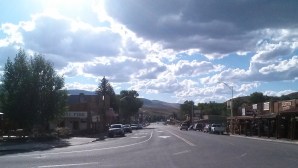

 If you want to sell stuff in Brooklyn, you’d put it on Craiglist and hope somebody legit would be interested.
 You can put a little notice in the For Sale section, on the tightly packed front page, for free. Or you can make a flier about your tag sale, drop off 402 copies at the VFW (why 402? Don’t ask), and for a small fee it will be distributed to stores and offices around town along with everything else stapled to the front page.
 What’s really going on, I mean. Not just what you see in the Frontier.
 “Need a fix!”
 I dropped into Tammy’s new salon again for a manipedi. (I’m the daughter of a Nebraska farm girl; I learned the term only a few years ago in New York City. It means manicure and pedicure.)
 I would wait till I got back to New York, where manipedis are essential to normal grooming if you don’t want to feel like white trash. Back in our Brooklyn neighborhood, there’s literally one nail salon per block. They’re even more prevalent than Starbucks.
 Given the ugly smashed nail (it makes Tammy’s tummy hurt to look at it), we decide on wacky dark teal polish that looks close to black. As she works, we discuss how she came to open the salon.
 After three days of whiteout and steady snowfall, we woke up this morning to a crystalline vista beneath blue skies–just as the forecast promised.
 To the old homesteaders like Clark, this was just the way it was in winter. They had no weather apps to warn them of what was coming, either.
 Meanwhile, they might have to dig their way out of the cabin each morning to get to work and school. (This shows what remained of one tie-hack cabin last summer.)
 At work one day in the middle of a very cold winter, Boedeker was trapped under a rolling log and injured so badly he couldn’t mount his horse. Cassidy came along the trail and helped him back to his cabin, Boedeker said. Cassidy stocked the cabin with food and firewood, cooked the meals, and stayed until Boedeker was well enough to work again.
 “I don’t know what it is,” Andrea said to me the other day. “There’s just something about it. You get out there and you just feel happy.”
 I have been known to remark that Dubois resembles the kingdom of heaven, because so many of our entertaining events take place for the benefit of charity.
 “waters shall break forth in the wilderness, and streams in the desert; the burning sand shall become a pool, and the thirsty ground springs of water; the haunt of jackals shall become a swamp, the grass shall become reeds and rushes … No traveler, not even fools, shall go astray [I heard a few chuckles at these words]. No lion shall be there, nor shall any ravenous beast come upon it; they shall not be found there, but the redeemed shall walk there.”
 We never kept any horses, even though our daughter fell seriously in love with them at the Lazy L&B Ranch here, many years ago. You simply can’t keep a horse in the tiny back garden of a Brooklyn townhouse.
 We generally stay out of each other’s way, but not last week.
 Later, I walked over to the fence to take a picture of the corral in the valley, to text on over to my Philadelphia friend. One of my neighbors trotted up and poked her nose at me over the fence.
 That same evening, I took the dog for a walk on the back road across the highway. He wandered over to sniff at something near Billy’s barn door, and leaped aside when it began to open.
 “If I get this one, the others will follow,” Billy said, walking toward one of the three.
 “I’ve had enough of small towns,” said our dinner guest last Tuesday, a friend of a friend. “I know what they’re like. I grew up in one. Small-minded people with boring lives.”
 One day later, invited to dinner at someone else’s home, we noticed the photos of Italy rotating on the digital frame on her kitchen’s island. And then a few from somewhere in eastern Europe.
 Those who have always lived here are just as worth engaging in many long conversations: The orphan wrangler who married the debutante from out east, and happily settled down on the ranch. The logger who kept on lumbering and built a life after the sawmill closed, because leaving was just not an option. These are just the first two who come to mind.
 As I expected, the event was packed, with people spilling out from his gallery onto the sidewalk and lined up inside to buy the book. I can’t wait to read it, even though I know Tom well and count him a good friend. There must be lots I still don’t know.