


The strolling tourists depart. Town is quiet, the summer houses are dark and empty, and the Thanksgiving turkey is all gone. Nighttime sets in during late afternoon.
I resign myself to the thought that the slow, sleepy period has begun. Then, with surprising speed, another busy season is upon us.
Back East in the city, it arrived like an invasive weed. At some point, and far too soon, I’d be aware of background music with the sound of jingle bells. Before long, it was everywhere on the shopping streets. The sound made me literally agoraphobic: afraid of the market. Shoppers seemed stressed out. Carols intended to make me reverent made me want to flee.

The holidays are also busy in Dubois, but with a notably different feel. This is, after all, a town of 1,000 permanent residents with a reputation for friendliness, and about 50 nonprofit organizations, many of them devoted to charity.
My first sound of the season this year was the barely perceptible strain of classical background music in the Opportunity Shop (which raises many thousands of dollars each year, all of it given back to the community).
“Oh, yes,” I thought. “Christmas is coming.” And then quickly forgot about it.
Songwriter Skip Ewing, who used to hold workshops here and moved to town last spring, took it upon himself to open the season formally with a concert in the Dennison Lodge on December 1.
I wasn’t in the spirit at all when I bought tickets–not to celebrate the season, but to listen to Skip.

The Dennison was decked out for the event, and was packed for both performances. Here, we are waiting for him to start the first one.
Skip began by saying that he had brought us there to get us into the Christmas spirit, and warned that eventually, like it or not, we would all be singing too. After a long series of his county favorites (some of them top of the charts in their day), he segued into his new holiday songs — some silly, some sentimental, others solemn.
“In the meadow we can build a snowman,” he croons,
“and pretend he’s Santa bringing toys.
When he asks us ‘Are you naughty?’ we’ll say No, man,
’cause everybody’s nice here in Dubois.”
His last was “Silent Night.” Skip began simply and quietly, and sure enough some of us began to sing along. Gradually his voice grew softer and ours louder, until all that came through the microphone was the sound of his guitar. Then that fell away too, leaving nothing but our voices–and the spirit.

It’s the season of open houses now, at the bank, the phone company, the museums and the community centers. There’s no need to go far to find Christmas cookies.
People don’t speak of being stressed out by the shopping. We can gift shop online, of course, and the FedEx and UPS guys are visibly busy. We can find Western-themed gifts at Olsen’s, or a handmade item at the Christmas extravaganza in the Headwaters or at Anita’s shop, Wyoming Wool Works. Or we can treasure-hunt at the Opportunity Shop, which is actually fun.
The other day I sat on a stool in Superfoods wearing a silly elf’s hat and now and again ringing a little bell. At that very moment, some unlucky folks were certainly standing in front of Bed, Bath, and Beyond next door to my former office building in Manhattan, ringing their bells without a pause. In that context, it was another irritating noise of the season.
Just one particle in a floodstream of pedestrians, I used to pass by without paying them any attention at all. They rang like automatons, and looked cold and miserable. I didn’t know them or the people they helped. I supported other causes.

Superfoods graciously allows us to sit indoors next to the shopping carts. Most of the Salvation Army bell-ringers here are volunteers affiliated with other nonprofits.
This year I’m ringing on behalf of the Dubois Museum. Shoppers pass me one by one as they enter the store. I greet them all, and many are personal friends.
About half of the people drop something into the bucket on their way out, and now and again a rather large bill. I love their generosity. Almost everyone greets me again upon leaving the store. A few apologize for not contributing, or say they donated last time. The sum of donations seems to increase every year.
As the sign beside me says, all the funds remain in Dubois. I know the person who runs Salvation Army here, and I have met some of the people that it quietly helps: Cross-country backpackers who have had a turn of bad luck in this remote location. Travelers stranded after a breakdown without enough funds for a motel. Impoverished old folks without the skills to navigate the social networks.

My favorite part of this gig, other than the obvious charitable benefit, is watching the banter and chatter that goes on in Superfoods.
“The way you mumble and with my hearing problem, we could probably start World War III,” jokes one guy.
“Let’s leave that to the oligarchs,” says the other.
Fortunately, the oligarchs are very far away. What we have is peace on this small part of the earth, and plenty of good will to go around.
© Lois Wingerson, 2018
You can see new entries of Living Dubois every week if you sign up at the top of the right column at www.livingdubois.com.


 The sight of tanks rolling down the main street of Dubois would be jarring if we did not know the context: the Independence Day parade. Every July, we have been seeing just a few of the tanks, trucks, and ambulances brought out for the day by a local landowner, Dan Starks, an engineer who is fascinated by the machinery and its history.
 Will it be the long-sought “draw” that lures people to stop overnight n Dubois on their way to Yellowstone? Will this all overwhelm us, as the Total Eclipse did last year (but only for a few days)?
 He has bought up a great deal of property in the area, and reportedly contributed large amounts anonymously for various charitable causes here.
 Earlier that day, Starks had welcomed the public to his property, to view at least part of the collection. Speaking in a rapid-fire monologue, and naming the vehicles by model number, he spoke about them with some passion.
 I asked about the truck standing next to it, and Starks described why a new delivery/artillery hybrid was needed in the Vietnam, where it was easy to lob a grenade at a supply vehicle. An onlooker spoke up to say that he had actually used a truck like that in ‘Nam.
 The new curator of the museum, Doug Cubbison, who comes here directly from 5 years at the Veterans Museum in Casper, has been working quietly in town since last August to begin the massive effort of creating and staffing a huge and unique institution in one of the most remote towns in the country.
 “I’m so sad to see the end of summer,” friends will say, as the fields turn to gold and the air grows crisp. Not I.
 The text and look-and-feel of their poster said it all: Live. Jam. Funk. (Free.) Nothing like our usual laid-back country music band strumming away as a few old-timers shuffle around the dance floor doing the two-step. This looked promising.
 Allie and Noah were briskly selling brisket from a food van at the back, which quickly ran out — but nobody seemed to care. There was plenty of the crucial element: beer.
 For a brief few hours, we all shared a remarkable sense widespread exhilaration. This is not something I’ve experienced before in Dubois. I may witness others’ joy in beauty, often a sense of relaxation or the peace of rest after hard work, the pleasure of a good, hard hike–but never anything quite like this. Not here.
 What this town needs, my husband has been saying for years, is a really good burger.
 The Moose Outpost replaces an ice cream and coffee stand that failed last summer. The reasons why the Outpost ought to succeed say a lot about our town. It’s a commercial venture, sure, but it’s more.
 Unbelievable, she said. She added that even the Sysco people are surprised at how much meat and produce she is ordering. But it’s also, predictably, crazy.
 Inbetween, Kerrie told me, he’s has been shot at, stolen (and returned), inappropriately painted, and driven to Utah to oversee Christmas tree sales. Now he’s challenging the jackalope down the street as our town mascot.
 Local historian Steve Banks gave another riveting talk a few weeks ago, this one about the history of traffic across this valley. Since then, I’ve been caught up in a sort of time travel.
 The brownstone is 4 stories tall, has 4 bedrooms, and originally had a dining room and a receiving room for guests waiting to be admitted to the living room. It was remarkably modern for having central heating, fired by a coal furnace at the bottom.
 According to Steve Banks, the first white man to visit the valley was probably a Kentuckian named John Dougherty. A fur trapper and trader, he fled south in 1810 from what is now Montana to escape an attack by Blackfoot Indians, crossing Shoshone Pass close to Ramshorn Peak and continuing down the Dunoir Valley to the Wind River. (This picture shows that valley.) A bullet from the attack remained in his side for the rest of his life.
 In 1811, a year after John Dougherty came down the Dunoir Valley with a bullet in his side, Wilson Price Hunt came through with a party of 68 people and 200 horses. Hunt was a co-owner of John Jacob Astor’s American Fur Company, headed toward Fort Astoria on the Columbia River in the northwest, hoping to establish fur trade with Russia and China.
 He also described our valley. “From thence across the 2d range of mountains to Wind River Valley …” he wrote in a
 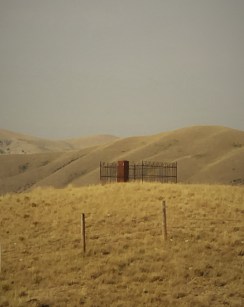 Twelve years after that, “Old Man” Clark froze to death, alone in his cabin, during a winter storm. His grave sits atop a small hill, marked by an obelisk and surrounded by a wrought iron fence.
 Here, it’s more like the fading of bands in the rainbow, a loss of our brilliance. In recent weeks, our light has dimmed with the sudden absence of several townsfolk — a beloved young man lost too soon to cancer, an elderly businessman important to the town’s growth, and now Leota Didier.
 “He heard there were marvelous buys on dilapidated ranches in Wyoming,” she recalled. Having formerly run church camps, Bernard got an idea. “Before the week was over,” she went on, “we owned a ranch.”
 The “L” in Lazy L&B, Leota was hardly lazy. Among many other blessings, she helped to move the historic
  Even last summer, after she had moved to Warm Valley, she would never miss this duty as long as someone would pick her up and take her home after.

 The man who had ordered the lattes was tall, patrician, lantern-jawed. He wore a fitted, aqua-blue down jacket. His female companion wore her hair cut blunt to the chin. I didn’t believe we had met.
 “Yeah,” he said. “I hear it’s nice.”
 “Tell me about yourself” usually starts a conversation well worth the time.
 I ran into Gareth a few days ago at the Cowboy Café. Over breakfast he was working on a draft of a white paper.
 The first step in investigating Dubois, Gareth told me this week, was contacting DTE, our Internet provider. This wasn’t so crucial for Sharon, the former head of a private school in Steamboat Springs. But it’s essential for Gareth, who is an information architect with a firm that provides cybersecurity services for large corporations around the world. His work demands peerless high-speed Internet, and the fact that DTE provides fiberoptic service in town was a strong selling point for Dubois.
 It’s only a six hour drive north through Baggs and Rawlins to reach Dubois, but for Gareth and Sharon, the trip took far longer. Finding their next home, Gareth said, required “a lot of traveling in our RV.”
 “Dubois has everything Jackson Hole has to offer,” Gareth told me. “You just hop into the car, and you’re in the Tetons. It’s all great.”
 The snows are building in the mountains again, and the “snowbirds” with homes in Arizona are gone.
 The POW camp was dismantled and bulldozed after the war, although fascinating traces remain hidden in the woods up near Union Pass. Thanks to the extensive records and photos of camp commander Lieutenant Harold Harlamert, to military records, and to the prisoners’ own letters, poems, diaries (and even a Skype interview of a former inmate last April) amassed by local historian Cheryl O’Brien, Camp Dubois may be one of the best-documented “branch” POW camps in the United States.
 Although they had to wash in the stream while the enlisted men who worked as guards got hot showers, the prisoners were well treated according to the strict guidelines of the Geneva Convention. Only one POW died during the camp’s existence: 19-year-old Max Stoll was killed when a gust of wind blew down a tree he was felling.
 According to Knights of the Broadax, a book about the tie hacks, some men cried when the wife of the store manager at the civilian tie-hack village brought her infant son along on a visit. Kip MacMillan, the grandson of the President of Wyoming Tie & Timber Company, recalls being terrified when, as a young boy, he was told by his grandfather that he would be spending a night at the camp, unaccompanied. But when he got there he was treated like a long-lost member of the family. One POW even gave up his bed for Kip and slept on the floor.