

“Be open and honest about the gun culture in your region,” urged a comment to one of my posts to a remote workers’ group on LinkedIn. It came from a manager with a global retail company.

“When we travel internationally, to European or Pacific locations, the first question we are asked when we say we are American is: Does everyone really walk around with a big gun?”
This inspired me to look at our small Wyoming town with a different set of eyes — the eyes of a stranger passing through, or perhaps my own eyes of 20 years ago, long before I left New York City to move here.
If we want to attract more remote workers to Dubois — and we should — it’s crucial to address this issue. I won’t discuss gun control here. I want to talk about the culture and the facts beyond the first impressions.
Guns are sold at auctions here and raffled off at charity benefits. You grow accustomed to the sight of rifles lined up on tables. One of the motels has a gun shop.
For someone who spent her whole life in New York City, this was somewhat disquieting at first.
These days I might not even notice someone wearing a gun in a holster. But I don’t think I ever see that, except for the sheriff. To be frank, I have no idea who’s walking around with a gun, because concealed weapons are allowed in Wyoming.
I do know that many people here own guns. Lots of my friends hunt. For some of them, that’s how they can afford meat.

Judging from some statistics, you might think I have moved from the safest place in the country to the most dangerous. Per capita gun ownership in Wyoming is far and away the highest in the entire nation. (That’s the tall bar at left in the graph.) My former state of New York ranks at the farthest right end of the scale.
Although it’s difficult to discredit the source of the data, that 230 per capita for Wyoming is astonishing and difficult to believe. Other studies show that barely half of Wyoming residents are gun owners. The figure is 53%, nearly the same as for neighboring Montana which is 16th from the left on that graph. So who has all those guns? Did they count the firearms museum in Cody?
The firearm mortality rate for Wyoming is also sobering at first glance. Wyoming ranks 8th among the 50 states. Alaska is first and Montana is third.

But the homicide mortality rate for Wyoming is so low it falls off the map. See that range from 0-26 on the image? Wyoming is the zero, with a rate that rounds to nil.
Wyoming also gets a score of zero on the database of mass shootings in the US, which is maintained by the nonprofit organization Mother Jones. Here’s what happened when I searched for mentions of Wyoming on its downloadable spreadsheet:

So what accounts for the difference between firearm mortality and homicide mortality in our state? Suicides, alas, which would justify another article. Like many rural regions, Wyoming has a high rate of self-inflicted death as well as firearm ownership, and the correlation is obvious. The reasons must be complicated and tragic, but I don’t feel personally threatened here.
Compared to New York City, Dubois is a very friendly place. It’s also laid-back and low-stress. I think this may explain why there is so little actual aggression here, despite the high rate of gun ownership.

I’ve never seen anyone brandish a firearm anywhere in Wyoming, except at a target range. I’ve never heard of anyone being robbed in this town, at gun point or any other way.
To be frank, the prevalence of guns probably deters a lot of crime. And in the state with the second-lowest population density in the country (below Alaska) it’s not surprising that we don’t expect to dial 911. Law enforcement is spread thin, and people need to be self-reliant. That’s the character and the reality of the West.
There are no street brawls here these days, and I can’t recall hearing a loud argument in public. It’s the kind of place where people leave their cars unlocked with the ignition running on a cold day (but probably not in high tourist season).

Obviously, the classic Western films are implicated in giving this region a falsely dangerous and badly outdated image for violence. The same kind of problem affected my former home town: Some tourists arrive (or never go to New York City at all) fearing a Mafia shootout or a rampage in the subway.
I guess if you base your decisions on what you see in the movies, you get the result you deserve.
© Lois Wingerson, 2020
Thanks for reading! You can see new entries of Living Dubois every week if you sign up at the top of the right column at www.livingdubois.com.
Who’s writing? Check out About Me.


 The man who had ordered the lattes was tall, patrician, lantern-jawed. He wore a fitted, aqua-blue down jacket. His female companion wore her hair cut blunt to the chin. I didn’t believe we had met.
 “Yeah,” he said. “I hear it’s nice.”
 “Tell me about yourself” usually starts a conversation well worth the time.
 Local historian Steve Banks gave another riveting talk a few weeks ago, this one about the history of traffic across this valley. Since then, I’ve been caught up in a sort of time travel.
 The brownstone is 4 stories tall, has 4 bedrooms, and originally had a dining room and a receiving room for guests waiting to be admitted to the living room. It was remarkably modern for having central heating, fired by a coal furnace at the bottom.
 According to Steve Banks, the first white man to visit the valley was probably a Kentuckian named John Dougherty. A fur trapper and trader, he fled south in 1810 from what is now Montana to escape an attack by Blackfoot Indians, crossing Shoshone Pass close to Ramshorn Peak and continuing down the Dunoir Valley to the Wind River. (This picture shows that valley.) A bullet from the attack remained in his side for the rest of his life.
 In 1811, a year after John Dougherty came down the Dunoir Valley with a bullet in his side, Wilson Price Hunt came through with a party of 68 people and 200 horses. Hunt was a co-owner of John Jacob Astor’s American Fur Company, headed toward Fort Astoria on the Columbia River in the northwest, hoping to establish fur trade with Russia and China.
 He also described our valley. “From thence across the 2d range of mountains to Wind River Valley …” he wrote in a
 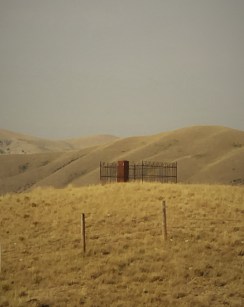 Twelve years after that, “Old Man” Clark froze to death, alone in his cabin, during a winter storm. His grave sits atop a small hill, marked by an obelisk and surrounded by a wrought iron fence.
 I ran into Gareth a few days ago at the Cowboy Café. Over breakfast he was working on a draft of a white paper.
 The first step in investigating Dubois, Gareth told me this week, was contacting DTE, our Internet provider. This wasn’t so crucial for Sharon, the former head of a private school in Steamboat Springs. But it’s essential for Gareth, who is an information architect with a firm that provides cybersecurity services for large corporations around the world. His work demands peerless high-speed Internet, and the fact that DTE provides fiberoptic service in town was a strong selling point for Dubois.
 It’s only a six hour drive north through Baggs and Rawlins to reach Dubois, but for Gareth and Sharon, the trip took far longer. Finding their next home, Gareth said, required “a lot of traveling in our RV.”
 “Dubois has everything Jackson Hole has to offer,” Gareth told me. “You just hop into the car, and you’re in the Tetons. It’s all great.”


