A Brief History of the History of Dubois

We’re rightly proud of our history and our Museum. Both need attention to stay alive.

DMAlogo5In a sense, our history goes back eons, to the time when the mountains in our backyards were being pushed up and carved out.

In another sense, it’s only 40 years old–dating to the time of the bicentennial, when a group of Dubois residents decided it to create a museum to document it all.

MuseumDay2015_CrosscutSawDemoForty years ago, in 1976, a group of Dubois villagers began to collect interesting artifacts, from vintage household items and old tools to remnants of Native American culture. They fretted about how to decide which items were worth keeping. They planted trees and shrubs, and made arrangements to move buildings such as an old post office and a forestry cabin to the site of the new museum on the main street.

“Possibility was discussed of acquiring some old cabins in the area and moving them to the museum,” read the very first recorded minutes of the Dubois Museum Association.  Today, the Museum’s collection of historic cabins is one of its best features.

HomesteadCabin Exterior

The result of these efforts is one of the best spots in Dubois. The displays reach from ancient geology to the history of a landmark guest ranch, with a long stop midway to portray the distant and recent history of Native Americans. The Museum also sponsors regular treks to the remnants of history hidden in the landscape nearby.

“My favorite part was the historical cabins that were brought in from around the area,” wrote a visitor last month on TripAdvisor. “They highlighted local historical figures and gave a great overview of the tie hack industry. Really worth seeing!”

“Great museum for a small town,” reads the most recent review on TripAdvisor. “It is small but a very nice surprise.”

MainBldgInteriorI’ve never understood why everyone in town isn’t a member of the DMA, because the heritage of Dubois is so fascinating, so fragile and precious (and easily lost), and so crucial to our identity and future as a community.

There’s so much to preserve, document, and celebrate: The creators of the petroglyphs and sheep traps, the courageous Mountain Men, the hunters and trappers, indomitable homesteaders, the hardy and heroic tie hacks, the cowboys and painters and quilters.

In its cabins and its tiny main building (the prospect of a new and better one always seems to recede into the distance), the Museum somehow captures it all.

There’s often confusion about the difference between the administration of the Museum, which is owned and run by Fremont County, and the Dubois Museum Association, the volunteers who created it in the first place and still provide regular support. We pay for the purchase of important items such as cameras for documenting acquisitions and IPads for interactive displays, and we recently provided supplies and manpower to replace the rotting boardwalk that leads between those charming cabins.

We also sponsor a popular annual community event, Museum Day, in the middle of July.

EstherWellsLately, we’ve also been carrying out oral histories of local residents. For instance, we videotaped an interview with centenarian Esther Wells recalling her life as a child and young wife homesteading up one of the mountain valleys, and another with Kip Macmillan as he recounted a childhood visit to the camp where German prisoners of war were serving as tie hacks during World War II. The originals are housed, of course, at the Museum.

If you haven’t seen the Museum lately, please visit. The exhibits change all the time.

If you haven’t thought much about supporting it, please consider joining the Dubois Museum Association. The dues are an affordable $10, although many people contribute more.

This Saturday, the Dubois Museum Association celebrates 40 years of serving the community, at its 2016 annual meeting at the Dennison Lodge. I am a proud member of its Board of Directors.

Boardwalk (2)“You only need to sit in at meetings,” said my neighbor Dorothy when she asked me to replace her on the Board years ago. It’s been so much better than that, because we are a vital and dedicated group with a mission that we feel to be extremely important.

Our history is always there, but it isn’t permanent. It will only stay alive as long as we continue to pay attention to it.

Happy 40th anniversary, DMA! Here’s to a long and fruitful life ahead.

© Lois Wingerson, 2016

You can see new entries of Living Dubois every week if you sign up at the top of the right column at www.livingdubois.com.

Summer and Smoke

Adjusting to the reality of wildfire in the National Forest nearby.

It’s high season again in Dubois. There’s almost too much going on: Museum Day, the art show, the Day of the Cowboy, the square dance, the rodeo. The town is packed with strangers, there’s lots of traffic, and the joint is jumping.

But the one event on nearly everyone’s mind is …

IncidentBase

… the Lava Mountain fire. To fire officials, it’s another “incident”, which seems far too benign a word. Nearly 600 acres have burned so far, not far from all those ranches about 30 miles west of town, on the way to the pass. And there’s no end in sight.

It began with a lightning strike 4 days ago. The first flames were too remote to reach in that forest wilderness. It’s too dense and hot for firefighters on the ground to approach the epicenter, so they’re hitting the edges from the air, while the ground-based firefighters focus on protecting structures that might be in harm’s way.

We see helicopters every afternoon, trailing buckets of water on very long lines, and fixed-wing aircraft that circle and drop orange clouds of retardant. (Why wait until afternoon? Because that’s when the wind blows up and the fire starts to move again.)

There’s no rain in the forecast.

FireCommand071916

Here’s the camp they have set up in the town park for the firefighters. The experts have descended from Montana and other places.

I saw a truck for rodent control, and wondered why it was there among the emergency vehicles. Do they try to protect the ground squirrels as well? The poor ground squirrels …

Smoke has already been a feature of our lives for part of every summer. Even fires from Idaho and Oregon send yellow clouds our way and make our noses tickle. This year, it’s closer.

In New York City, people adjust their lives to avoid crime. In California, they worry about earthquakes. Many people in other places somehow going on living with the fact of war or terrorism. Here, amid beautiful historic forests, we have to expect wildfires. This is our reality.

What effect does this have on us?

Last year, we pulled a lot of weeds and laid gravel around the house. Yesterday, we ordered 2 air purifying machines on the Internet.

DumpHike1We’ll need to adjust our schedule to account for the smoke that hangs in the valley in early morning, clears in late morning, and billows again in mid-afternoon.

Among other inconveniences, the fire has ruled out some of my go-to hiking trails west of town. I’ve always hiked in late afternoon, when the air cools. I’ll have to rethink that.

Yesterday morning, I had errands in town (miles farther east, away from the fire). Afterwards, the dog and I set off for one of my other go-to hiking haunts: Behind the town dump.

I believe the plateau beyond the landfill has the most spectacular views in the area. Turn in any direction, and the view is fabulous. You feel you’re on top of the world.

DumpHike4

Someone told me that somewhere Dubois has been granted the distinction of having the nation’s best road to the dump. The road beyond, although rutted, is even better. It leads on and on for many miles. I’ve been briefly lost up there.

Here you see my dog in the foreground with some long-dead nonhuman remains. The landfill is in the background, at center. (It’s not really visible in this picture, but that’s where I saw it when I took the shot.)

Way out beyond the landfill you can see teepee rings, evidence of people who lived there many centuries ago. They circles are hard to identify among all the other rocks lying around. It was years before I could persuade a friend to take me up there and point them out.

DumpHike6

I found yet another promising trail behind the dump. It led over the knife-sharp top of a ridge, and sank promisingly into the folds of the badlands. I couldn’t spare time to follow it very far yesterday. (A tempting prospect for the future.)

The badlands are always fascinating to explore. I love to follow the draws to the top, and to rest in the shade in the overhangs.

How I wish there was a way to capture depth in these images! You can’t see how  high I am, and how far we will clamber down someday to reach the bottom.

My route  home took me right toward the location of the fire (though not anywhere near it). From the highway, you’d have no idea there was a raging conflagration somewhere out there, dead ahead. Just billowy summer clouds, and that beautiful valley. This was at 1:45 PM.

Hwy26_071916

© Lois Wingerson, 2016

You can see new entries of Living Dubois every week if you sign up at the top of the right column at www.livingdubois.com.

Save

Nabokov and Lolita: Another Dubois Love Story?

He visited Dubois while taking notes for the novel. What entered his mind?

Back briefly in New York City on a lazy Sunday afternoon, I’m doing what I always do: Browsing the trivial special sections of the Sunday New York Times to read about, say, homes of the rich and famous and travel to places I’ll probably never see.

I idly turn to the inside page of the travel section, and–what???

Nabokov

Spread out across the fold is a huge picture of those familiar, fabulous red rock formations east of town. Not east of New York City, of course. East of Dubois.

Naturally I turn back and begin reading the article about Vladimir Nabokov, author of Lolita (not my usual choice in reading). The author of the travel article and his wife have driven West, following the footsteps of the controversial 20th century Russian-born novelist. And those footsteps led them right to Dubois.

Landon Y. Jones informs me that Nabokov and his own wife Vera road-tripped across the American West from 1948 to 1953, during which the author took copious notes for his novel Lolita, which itself describes the protagonist’s road trip across America (including parts of the West) with his pubescent heart-throb.

Officially Nabokov, who was also an expert on butterflies (who knew?) was traveling Wyoming in search of interesting lepidoptera, not female human “nymphets.” He hunted for butterflies along the “gorgeous Wind River,” Jones writes in the New York Times, and they stayed in what is now the Longhorn Ranch Lodge and RV Resort.

RamshornThe Joneses stayed there as well, and remained in town long enough to notice the oversized jackalope and eat at the Cowboy Cafe. “On the way,” he adds, “we found ourselves on a busy, motel-strewn street called Ramshorn — the name Nabokov modified into Ramsdale, the name of Lolita’s fictional hometown.”

For the second time: what????  Our town’s favorite landmark was the inspiration for the home of the little sexpot in that classic bumpy-covered novel?

This sent me scurrying off to my Kindle to (improbably) download Lolita, in search of references to Ramsdale. Not much like Dubois: He described it as a leafy town with languid, humid summers, a lake, and a street named Lawn Street.

Next stop: Google, to find the basis for Jones’ assertion. I could find none. There doesn’t appear to be any town anywhere with the name of Ramsdale. Nabokov’s biographer, Dieter Zimmer, spent a fair bit of time speculating about the identity of the town that “Ramsdale” might actually represent, which he placed somewhere in New England.

So I tracked down and emailed Lanny Jones, who had said at the start of his article that he and his wife have road-tripped from New Jersey to Montana for the past 15 years (nearly double our own track record taking basically the same jaunt). Like us, they’re baby boomers. In fact, Jones himself is the originator of the term “baby boomer,” in his book Great Expectations: America and the Baby Boom Generation.

Thus began a fairly lengthy and interesting exchange. If he Googled me in return, he learned that we have still more in common: We have both worked for Time Inc.

“My linking of the names of your main street and Lolita’s home town is basically a speculation on my part,” he confessed. “It’s just hard to avoid. I probably should have qualified it as ‘may have modified’ or even ‘surely modified’ … What do you think?”
I demurred about the last question, finding it extraordinarily difficult to be objective. But I did answer a later question: In pronouncing Dubois, the accent is on the first syllable, not the second as he wrote in the Times.
Brooks082815_2In the end, I’m not sorry I scanned through Lolita. The story left me cold, or much worse, but Nabokov does write quite beautifully about my favorite haunts: “red bluffs ink-blotted with junipers, and then a mountain range, dun grading into blue, and blue into dream.”
I agree with Jones that he may have had Togwotee Pass in mind when he wrote of “heart and sky-piercing snow-veined gray colossi of stone.”
I was also amused to read that, 60 years ago, he described Jackson as “construction hell.”


Why the Definition of Memorial Day is Dubois WY

Thanks to a fallen son, and a powerful movie, the town has become a symbol of its true meaning.

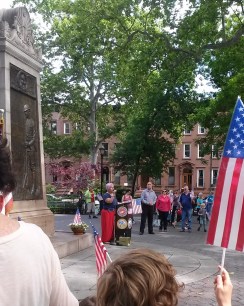
MemorialDayBrooklyn3croppedBack briefly in Brooklyn for a business matter, I took the chance to attend the Memorial Day service in our local park. It was a pleasant surprise.

A few years ago, only a dozen old-timers bothered to show up. This year there were more like 100 people, including police officers and firefighters as well as some veterans, but not (as far as I could see) any current members of the armed forces.

Many children were there too, dutifully waving flags provided by the Court Street Merchants Association rather than racing around the monument on their scooters, oblivious to its purpose. Ceremony organizer Joanie D’Amico, owner of a local coffee shop, specifically thanked parents for bringing their kids, and urged them to teach their children that Memorial Day means much more than department store discounts and trips to the beach.

No such reminder would be needed in Dubois, at least not in the lifetimes of today’s children. Its people may have always understood military sacrifice in a meaningful way. But 7 years ago, they gained national prominence for the way they paid homage to a local son fallen in Iraq.

Phelpschance
Chance Phelps

In the 2009 HBO movie Taking Chance, Kevin Bacon portrayed Lt. Col. Michael Strobl, who volunteered to accompany the body of 19-year-old Marine private Phelps Chance, returning to Dubois for his funeral. Phelps was killed on Good Friday, 2004, in Ramadi, Iraq, while manning a machine gun.

The movie  recounts Strobl’s journey to Dubois, ending with the funeral and the subsequent reception at the VFW post. Strobl himself described this all in detail in a post on the website of the San Francisco Chronicle.

“I wondered how many people would be at this funeral if it were in, say, Detroit or Los Angeles,” he wrote. “Probably not as many as were here in little Dubois, Wyo.”

DuboisMemorialDay1Sure enough, on Monday there seemed to be about as many people attending Memorial Day services in little Dubois (population less than 1,000) as in our part of Brooklyn (population about 44,000).

Chance Phelps must have been on everyone’s mind: He’s buried in that cemetery.

Among those present were numerous local veterans (some of whom offered the rifle salute), members of a motorcycle club who travel to Dubois every year specifically for this ceremony, and a woman named Shanna Muegge, 31, who currently serves in the Colorado National Guard.DuboisMemorialDay3

Ironically, the movie Taking Chance wasn’t actually filmed in Dubois. I’ve heard it said that this was partly because people didn’t want to risk disrespecting the Phelps family in any way.

But the film, and the publicity that followed it, certainly honored the actual town. A man called Thomas Stout, who attended the funeral, described in detail the respect for Phelps and his ultimate sacrifice that he perceived in the people of Dubois, even in the adolescent girls who watched the funeral parade soberly rather than opening up their cellphones.

In a letter to the Dubois Frontier, he described what he saw in Dubois as “patriotism, independence, a belief in progress through hard work, community spirit, and a bond between neighbors”–the embodiment of an “Americana” he had always revered but never before witnessed.

DuboisMemorialDay2“It is such a wonderfully powerful thing to believe in,” he added. “It was a strong enough belief for me to want to dedicate my life protecting it. Unfortunately, never did I see it until last weekend.”

“Thank you Dubois,” he concluded. “Thank you for confirming to me that Americana really exists.”

© Lois Wingerson, 2016. Thanks to Darlene Wimmer for permission to use her images from Dubois.

Want to learn more about Dubois? Follow this blog by signing up at the top of the right column.

On the Boardwalk in Dubois

You could gain fame if not fortune by buying a small piece of downtown Dubois.

MonopolyFor most of my life back East, this was the only thing that used to come to mind when I heard the word “boardwalk.” The hottest property on the Monopoly board. High rent district!

You could gain a little fame, if not fortune, by owning a piece of a different kind of boardwalk in Dubois: the one that acts as a sidewalk in the tiny downtown business district.

I love to look at the names on the boards to see which I can recognize. I don’t know when they were laid down, but the names on many of the boards have faded considerably under the pressure of countless feet over the years.

Quite a few of the boards disappeared recently, either torn or burned away as a result of the great New Year’s fire of 2014. What’s going to happen to those historic planks? I asked property manager Reg Phillips last January.

“We are planning on putting the boardwalks back,” he replied.  “The names that are still legible will be noted and when the new boards go in, those names will be re-branded.  Any boards that are not legible will be available for sale.”
Boardwalk082615Presumably, this will offer an attractive new opportunity for newbies like us who would like the privilege of literally putting our brand down in downtown Dubois.

Back when the boardwalk was first created downtown, you could have had your name inscribed on one of the boards for a mere $75 donation to Dubois Volunteers Inc. (which uses part of the funds for routine repairs). But that honor had long been sold out when we moved to town.

Instead, we got the family name on the bridge that crosses the river in the town park. For some reason having my last name there made me feel more like part of the town.

I wonder whether there will be competition for the available boards when the new building is complete, and how and whether DVI will manage that. It’s fun to speculate.

This past week, volunteers coordinated by the Dubois Museum Association have been busy fixing the a different damaged boardwalk–the one that connects the charming historic cabins across the parking lot from our equally charming museum. They will have completed the project just in time to assure the safety of the visitors at the start of the summer season, which begins this weekend.

MuseumBoardwalk2The DMA and museum staff provided the sweat equity. Funds for the pressure-treated lumber and screws came from a Wyoming Community Foundation grant.

Here you see the old boardwalk being removed, on a beautiful spring day. The new boardwalk is nicer than the old one, Visitor Services Coordinator Johanna Thompson told me, because instead of zigging and zagging, it winds like a stream.

No names are inscribed on the new museum boardwalk, at least not yet. What would you like to see inscribed there? Might be fun to add dates of important events in local history.

© Lois Wingerson, 2016

Want to see every new post about life in Dubois WY? Enter your email address into the box at the top of the right column, and click “Follow”.

Property Rights and Wrongs, WY and NY

On forgiveness for excessive borrowing, or for wandering out of bounds …

St.Thomas1I’m quietly amused every time I say the Lord’s prayer, which is at least once a week.

At St. Thomas in Dubois, we say “Forgive us our trespasses, as we forgive those who trespass against us.” It is, by the way, the oldest congregation in Dubois, established in 1901 by the Episcopal priest who came to the area as a missionary to the Native Americans.

OFRAt Old First Reformed Church in Brooklyn (established by order of Peter Stuyvesant in 1654, so that Brooklynites didn’t have to cross the river every Sunday just to get to church), the oldest congregation in town doesn’t talk to the Lord about trespassing. They say “Forgive us our debts, as we forgive our debtors.”

Get the chuckle?

IMG_0140How bizarrely appropriate that in the world capital of financial markets we worry about monetary obligations,  while in Wyoming we are fretting about venturing wittingly or inadvertently onto terrain we are unauthorized to enter.

But is it really any wonder? The most important property in New York City is money. The most important property in Wyoming is property.

TrespassingSignFortunately for those of us who love to hike, there’s so much wilderness about Dubois that there’s really no need to wander out of bounds.

What a pity that both versions of the prayer seem to reduce God almighty to the role of a mediator in property disputes.

I much prefer the version I learned as a child in Iowa (shall we call that the middle ground?): Forgive us our sins, as we forgive those who sin against us.

That’s more open to self-interpretation than the other versions, it seems to me. Less politically or theologically correct, perhaps, but much more clear.

We don’t all trespass. We’re not all in debt. But we’re all sinners, and we all need to forgive each other for something.

Amen.

© Lois Wingerson, 2016
You can see
Living Dubois in your email every week! Sign up at the upper right.


Ghost Rodeo in Dream-Time Dubois

About a rural recreation and the way of life it celebrates, which most of us can scarcely imagine.

RodeoGrounds5It’s not the right day for an ambitious hike. So you wander out into the rodeo grounds, where the dog can sniff around and discover the ghosts of bulls and broncos.

But he probably can’t hear the inaudible echoes that haunt the surreal silence: the announcer’s calls not coming from the booth today, the imaginary whistles from the invisible crowd, the loud thump of nonexistent hooves.

What a great show the Dubois rodeo was, and will be again! But not just now.

Our rodeo is a remarkable phenomenon, one that too many people miss because they choose to approach Yellowstone through Cody or Jackson rather than coming this way. It’s a true small-town event, with some outsiders but also the same locals week after week. This is not show business. It’s rural recreation.

RodeoGrounds1On an early spring day, it’s my chance to go where I’m otherwise forbidden. Here’s where the livestock mill around, out of my view on the far side of the caller’s booth, while I’m sitting idly on my bench across the arena.

Can you see those men whipping flanks to drive the bulls into the chute?

Here’s where so much business happens, just before the gate finally opens and the rider lurches out straddling a mount that is mightily incensed and all too temporary.

RodeoGrounds2 I always wondered what it looked like for the bull or bronco riders waiting on this side of the gate. I can’t imagine what it feels like to be one of them.

But then how could I? I never was part of that strong and stoic male culture. My Dad was a professor, not a wrangler or a rancher.

“Rodeo isn’t really about roping and riding, Ranches are about roping and riding,” James Galvin wrote in his wonderful novel Fencing the Sky. which is based in this general region of Wyoming. “Rodeo is about damage and vast quantities of physical pain.”

I don’t like to dwell on this part of our charming small-town rodeo. I enjoy watching the skill of the barrel racers, and the antics of the guest-ranch guests as they compete to grab the ribbon off the racing calf and sprint back with it to the starting point. But the real point of the rodeo is the part where you hold your breath and then roar aloud with admiration and incredulity at the brave fellows who hold on for dear life and hope to beat the clock.

RodeoGrounds3“Even people who don’t know much about rodeo,” Galvin also wrote, “know that whatever happens … the cowboy has to rise from the dust into an ocean of pain and make it on his own to the rail as if nothing at all has happened.”

I’m one of those who doesn’t know much about rodeo. But I have seen that.

I noticed this crumpled beer can on the inside of the gate. If it were me on that animal, I would have been drinking whiskey to wash down the handful of Advil.

To outsiders, this may all seem like foolhardy bravado. But at base it commemorates the life that created this little settlement over a century ago, in which injury was part of the bargain–in a way probably no cowboy at work today could truly understand. People drowned crossing rivers before there were bridges, got stranded outdoors and died of exposure or an animal attack, and sustained occupational injuries as a matter of course.

“When one works with horses he is bound to get hurt,” said Dubois’ first cowboy Andy Manseau, who came to the area in 1881. He told of being kicked by a horse he wanted to break, which broke his leg in two places and knocked his knee out of joint. It took him three hours to mount his saddle horse, after which he rode a half mile to a neighbor who got him to a doctor.

“I was laid up for a while,” he said, “but as soon as I could I went back to riding again.” After that he goes on to tell about his last accident, which was even worse, the one that finally made him stop.

RodeoGrounds4

Just across the river from the rodeo grounds sits Warm Valley Lodge, the new assisted living facility. It came to be there partly so that older ranch folks who can’t get along by themselves any more can still enjoy the vistas they have always loved.

I wonder what the retired cowboys living in there think when they hear the rodeo on Friday night. Does it make them long for the roping and riding? Or does it merely make them remember ancient aches and pains? I should ask sometime.

© Lois Wingerson, 2016

You can see Living Dubois in your email every week! Sign up at the upper right.


Who Owns This Valley? Hey, Ya

In which I discover the serene beauty of the Rez, the foreign territory next door.

Eastbound5I needed to run some errands “down county” in Riverton, about an hour away. It was almost balmy spring, and a different experience altogether from the wintry drive over the mountain pass to Jackson a few weeks ago.

I was driving alone. With no conversation to distract me, I had time to discover that this route has a serene beauty of its own.

Almost all of the drive is on the Wind River Indian Reservation, home of the Eastern Shoshone and Northern Arapahoe people. This is not a desolate, barren desert of windblown sand, like the Hopi reservation we saw in Arizona last year. It’s as fertile as the rest of the valley. As you drive, you see cattle, horses, and lots of hay.

Eastbound3I’ve met a few of these distant neighbors, but I don’t have any friends among them. “The Rez” feels like foreign territory, which I suppose it actually is.

In Dubois, we maintain a cautiously respectful and distant regard for the people on the reservation. They do not hasten to engage us, for understandable reasons.

The Shoshone knew this temperate valley from ancient times. For many generations, they migrated through it and occupied seasonal villages around here, long before their descendants were forced to settle here permanently. Their revered leader Chief Washakie and his advisors astutely negotiated the Wind River Valley as a reservation for their people 1868.

Eastbound6The most prominent landmark on the drive is Crowheart Butte. You can see it in this picture, rising from the valley floor. I have no idea how the butte came to be on that flat plain, but nearly everyone here knows how it got its name.

The Shoshone and their enemies the Crow were in constant battle. Chief Washakie proposed ending the conflict with a man-to-man fight with the Crow leader on top of the butte. Legend says that Washakie won the fight, killed the foe, and ate his heart–hence “Crowheart.” I read somewhere that when someone asked old Chief Washakie if this was true, he chuckled and replied, “It sounds like something I might have done when I was young.”

There’s no cellphone signal on the drive across The Rez, and radio coverage is spotty. I kept pushing the scan button and finally came across a strong signal. The melody was repetitive, supported by a drum. The lyrics were at once strange and familiar: Hey-ya-ya-ya. Hey-ya-ya-ya. The music carried me along for a few miles.

Eastbound2

I found myself imagining a woman standing in her kitchen, listening to the same music and looking at this austerely beautiful vista as she cooks. She is not a symbol or a character from geopolitical history. She is part of a real community that occupies this land as surely as I occupy our few acres, cooking her dinner as surely as I cook mine. Of course her tie to the valley that I have come to love would be vastly stronger than mine, who first saw it only a few decades ago.

Maybe she appreciates this gold and blue landscape on a far deeper level than the way I enjoy the view out my own window, I thought.

The DJ announced a new song, with a similar lilting melody and drum rhythm, but this one had words whose meaning I could understand.

Like I told you before
I don’t love you any more.
Stay away from me.
I don’t need you any more.
Hi-yo-yo. Hi-yo-yo.

Her family isn’t locked up in the history I keep in my mind along with the images of petroglyphs and the sheep traps, I thought. Their culture evolves as ours does, but I will probably never know who they are. We slide past one another in Riverton or on the highway, aliens to each other for reasons still too deep to resolve.

Eastbound1My mother, who grew up in Scottsbluff, Nebraska, often lamented the travesty our ancestors had done to the Native Americans. But I was a child growing up in the Midwest when she raised me. I never saw a Native American (to my knowledge), or a reservation. Her words meant almost nothing to me then. I understood them, but I did not.

Gradually the road returning to Dubois begins to dip and rise, winding toward the striped and wrinkled backdrop of the badlands. It slides you gently around a huge curve, and then the other huge landmark suddenly rises in front of you: the red rocks.

RedRocks

On a midsummer day, backed by a jewel-bright blue sky, they are even more arresting than this.

They are the western end of this part of The Rez. Chief Washakie wisely insisted on holding onto these fabulous formations. On any of our long journeys back from somewhere farther to the east than Riverton, I see them as the finale.

Beyond the red rocks, I am at home.

© Lois Wingerson, 2016

You can sign up to see Living Dubois by email using the “Follow” box at upper right. Thanks!

Not Just Humans Migrate to This “Banana Belt”

Four-footed creatures also seek the milder climate of Dubois to avoid severe winters. They’re about to be tracked.

DuboisEastbound030116On our return trip through Antelope Flats this side of Jackson a few days ago, we encountered ice and cold winds. But over the pass and back in Dubois, we found the weather milder and dry.

That’s no particular surprise. When we left home early in the morning to catch a plane in Jackson last week, we had noticed that the temperature was 27° F. The car registered  15° at the top of Togwotee Pass, and then a frigid 7° farther west in Jackson, 90 minutes later.

People here sometimes refer to the Upper Wind River Valley as the “banana belt.” The four-footed wild critters, who are are at least as smart about the climate as we humans, have been migrating through and to Dubois for at least as long as we have (if you include in “we” the Native Americans).

Later this month, wildlife biologists will begin documenting these animal migrations around Dubois, using the latest tracking technology. Next week, they will be fitting 15 mule deer in the Dubois area (among a total of approximately 90 in the general area over a period of several years) with GPS collars. They will then watch remotely in real-time as the critters relocate each year from Yellowstone, across the Wind River Valley toward the Bighorn Basin, and back.

This is part of an evolving series of studies. Last year, when biologists reported that the mule deer’s annual trek along the south side of the Wind River range is one of the longest land-based migrations in the lower 48, the story made the New York Times.

deerMaybe they travel even farther on this side of the mountains. Who knows? We’ll find out soon, thanks to the collaboration between the Nature Conservancy, the Wyoming Game and Fish Department, the Wyoming Migration Initiative, and numerous other partners.

Last week at the Bighorn Sheep Center in Dubois, a member of the migration studies listened with interest as local hunters and biologists in the audience told what they know about game animals here on the north side of the range.

Retired biologist Mark Hinschberger revealed that he had been surprised to see mule deer heading uphill toward the Continental Divide in the autumn while the elk were heading downhill toward Jackson. This was in the late 1970s, when he was part of a US Forest Service study monitoring the effects of logging on elk migration patterns.

Mark told me he began to understand the “backward” uphill migration of the deer after he moved to Dubois. “There are areas on the leeward side of the Continental Divide at the south end of Lava Mountain that are part of the Wind River range,” he said. “They travel over that lower elevation and head into this country and parts east. Some of the deer also hang around here.”

(This is no surprise at all, because we have to watch carefully for them all winter, even on routine daytime trips into town. You often see herds of deer and antelope grazing a respectful distance apart from the cattle in the pastures on both sides of the road. Some of them even seem to know how to watch for traffic. The problem is, you never know which ones those are.)

JacksonView022516“After spending the winter of ’78 and ’79 in Jackson Hole, seeing the snow and the weather, I’m not surprised to see the deer and the antelope coming this way,” Mark said. “The elk used to leave too, but we started intercepting that with fences [which they can’t jump]. So we have diverted those elk to the feed ground [in Jackson] at extremely high numbers.”

Pity the poor elk, standing in the snowfields over there all winter, grazing from bales of hay. I thought of them last week as I looked out the airplane window, ascending eastward over the Gros Ventres and away from Jackson.

Just look at the snow in those mountains beneath the plane and on the flats behind them, with the Grand Tetons to the West in the background. Over the pass in the “banana belt” of Dubois, I knew, whatever snow might land over the coming weekend would quickly blow away. And I was right.


14 Reasons to Love Dubois, Wyoming

Again and again, people come to this remote town not far from Yellowstone and fall in love. How does this happen?

DuboisWYValentineYou hear about it again and again:  Someone came to this remote town not far from Yellowstone and fell in love. How does this happen?

Let me count the ways. Those lucky folks who discover Dubois are:

1. Stunned by the scenery: A too well-kept secret. Granite peaks that rival the Grand Tetons for their splendor. The fascinating, slowly melting red desert. The quiet forests and mountain streams. The vistas never fail to astonish.

2. Seduced by the climate:  The weather is most often pleasant and dry. The sun shines most of the time. Days are generally mild in winter, and cool in summer.

Petro 93.  Fascinated by the history … and the prehistory. From the mysterious carvers of the petroglyphs to the courageous and resilient Mountain Men and homesteaders, the people of the past never fail to amaze.

4.  Charmed by the people of the present:  The welcoming instincts of Dubois’ townspeople and their impulse to help themselves and each other make it difficult to resist loving the whole community, once you get to know it.

5.  Awed by the animals:  The other beautiful residents of this valley appear unexpectedly, and leave you catching your breath in awe. You’d surely be poorer if you never saw an eagle fly–or watched an elk bound away, or glimpsed a mighty moose in the willows.

6.  Healed by the hikes (or the horseback rides):  Whatever the little misery that clouds your vision, it will vanish as soon as you can step outdoors, pause for a deep breath, and take the first few strides.

wintertrail.7.  Silenced by the snow: The noisy burdens and pressures of daily life melt away when you can get out into the soft, deep white of it, whether you’re marching on snowshoes, gliding on skis, or sailing along on your snowmobile. (It’s all good–and never too cold, as long as you stay out of the wind and wear enough layers. Don’t forget the sunglasses!)

8.  Romanced by the remoteness: It takes about an hour’s drive to find yourself in traffic or in a crowd. What does surround you? The beauty of nature, most of it accessible as public land. That said, there are plenty of good places to buy a meal or even an espresso.

9.  In love with the location:  Smack-dab in the middle of the great American West. It’s about an hour’s drive to Yellowstone in one direction and to a restored ghost town and gold mine in the other, stopping to visit Sacajawea’s grave on the reservation along the way. You’re a few days easy driving from Las Vegas, the Grand Canyon, Glacier National Park … I’ll stop there, for now.

1200px-US_map_-_geographic10.  Drawn to the artists:  You may not be skilled at capturing what you see on canvas (or film), but so many others are. Plenty of them have not resisted the lure of living here, and you have ample opportunities to admire their work on display at art or photography shows, or in local galleries.

11.  Overcome by events:  Did you think there would be nothing to do out here in the middle of so much wilderness? I find I actually welcome a quiet evening at home, after last night’s lecture on animal migrations, the jam session the night before, my neighbor’s dinner party followed by cards, and on and on. I must be sure to be rested up before the Soupenanny next weekend! I’m so sad I was closed out of that free course on early Native American art and elected to miss the hike about animal prints in the snow. Thank heaven it’s still midwinter, when not much is going on. So many choices, so little time!

12.  Beguiled by the benevolence:  There are at least 30 nonprofit organizations in a town that has not quite 1000 residents, as of the last census. Nearly every event is a benefit for one cause or another, and when we run into a true crisis — a catastrophic fire in the middle of the business district, the threatened cancellation of our ambulance service — the way Dubois pulls together to rise and recover is almost beyond descriptions.

DuboisQuiltShow080815_213.  Captivated by the creativity: Knitters and quilters. Guitarists and fiddlers. Woodcarvers and antler sculptors. Jewelry designers and master caterers. (So what is lacking here in Dubois? Walmart.)

14.  Finally, found by new friends:  I heard someone recently describe meeting people in this town as like opening a box of chocolates and finding that they’re all truffles. Among the good friends I have met here are a nuclear physicist, a retired cowboy, a Parisian photographer, a Swedish schoolteacher-turned-wrangler, a great hairdresser (“Excuse me, where do you get your hair cut? Oh, Wyoming. Where’s that?”), a computer wizard, several lawyers and a dentist, numerous artists (of course), and a microbiologist. My hiking buddy grew up in Singapore and Pakistan. Our newest neighbors have moved here from Baton Rouge.

So different, yet we all get along remarkably well. Why? We all share our love for this one remarkable place.