


“Can you do better than this?” somebody posted on LinkedIn. There was an image of a beach, and text about going out to surf in the morning before starting work at a home office.
“Sure, I can,” I wrote. “How about this?”
… and then I clicked away to find exactly the right previous post from this blog, intending to add a link to it. Surely, many times I have written about my custom of signing off and shutting down at 3 PM to go for a hike in the nearby national forest.
I couldn’t find what I was looking for, and by clicking away from his post, I lost it and could not complete my reply. Oh, well.
The sun was beaming through the window over my shoulder, moving slowly down toward the back side of the ridge. I noticed that it was about 3 PM.
These heavenly mild autumn days will not last forever, I said to myself. I signed off from LinkedIn, shut down, called the dog, and headed outdoors.
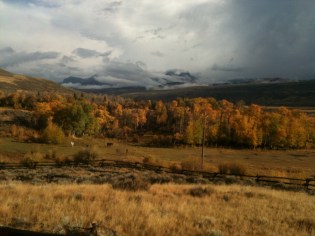
The aspen are going out in a blaze of color, the same hue as the stripe down the middle of the highway, the leaves like fragments of the sun quaking in the breeze. Out there, my worries slip away.

“Work From Home is more accurately titled Work From Anywhere,” wrote Jocelyn Kung in Entrepeneur, “a cafe, a beach, a different country. People can choose where they live based on their desired quality of life without sacrificing career opportunities.”
The pandemic has made this option ever more obvious and appealing. Survey after survey has shown that a large majority of the people allowed (or forced) to work from home want to continue doing so.
And many of them are reconsidering where “home” is going to be. If they don’t need to go into headquarters, then why must they live nearby?
“The allure of the city has been eroded by technology,” wrote remote-work advocate Chris Herd on LinkedIn, listing observations based on his recent survey of about 1,000 companies. “You can easily spend time there without living there … Cost of living has made [cities] irrational.”
Under the heading “Rural living” he added that “world-class people will move to smaller cities, have a lower cost of living & higher quality of life.”
These advantages came up in conversation a few weeks ago, during the first online meetup sponsored by Wind River Remote Works, our new organization dedicated to promoting remote work in this area. But with a local population that tops out at about 3,000 in the height of summer, Dubois is hardly what he would call a “small city.”

How can we ever hope to attract new residents if we don’t (yet, at least) provide the amenities so many remote workers expect from urban life, like microbreweries and communal work spaces?
The remote workers who live here already offered some fresh ideas at the meetup.
We should “own” our lifestyle differences, suggested one.
Make the challenge of finding and living in Dubois an advantage, agreed another. (He had just been contending that it was not much of an inconvenience to drive 80 miles to the airport.)
“It’s not an easy place to live,” he added, “and if you live here, you’re in the club.”
He’s one of countless residents who, once he got to know this out-of-the-way village, couldn’t get Dubois out of his mind. He and his family moved here two months ago.
I was one of those as well. But I’ve lived here so long now that the special-ness of achieving that goal has faded. I’d never thought to describe living in Dubois from his perspective, as a community of independent spirits who can recognize a diamond in the rough and then embrace isolation and inconvenience in order to obtain it.
He’s very right: Dubois is an exclusive club. Those of us who live here do recognize that, even if we don’t describe it as such.
The membership criteria include first understanding and then embracing our unique culture and our lifestyle. This goes far beyond the mere pleasures of effortless access to beautiful wilderness.
But how can we ever convey that elusive reality to others–deliver to them such a vision of an authentic Western village (quite different from so many “tourist traps”) that they will be compelled at least to visit and begin to discover it? That’s our challenge now.

“It is too bad … that America knows the West from the roadside,” wrote the great chronicler of the West, Wallace Stegner, in The Rocky Mountain West, “for the roadside is the hoked-up West, the dude West, the tourist West ….”
“I have taken to traveling whenever possible by the back roads, and giving up the comforts along with the billboards,” he went on. “That is one way of getting behind the West’s roadside face.”
“Another is to live in some part of it for a while, sample it as a human dwelling place, as the formative stage of a unique civilization, as a place to go to, not through.”
(Digital nomads: Are you listening?)
© Lois Wingerson, 2020
Thanks for reading! You can see every new entry of Living Dubois by email if you sign up at the top of the right column at www.livingdubois.com.
Who’s writing? Check out About Me.



 The autumn solstice passes. The days of daylight savings time are numbered.
 The wise and knowing hands of Helping Hands Massage Therapy are exploring and unwinding the knots and kinks in my muscle tissue. I have been to some of the best musculoskeletal specialists at the best hospitals in New York City, but Reenie’s exquisite skill has done more for my particular woes than all of them combined, and she is doing it now. What a blessing for me that she found her way here, before I even came.
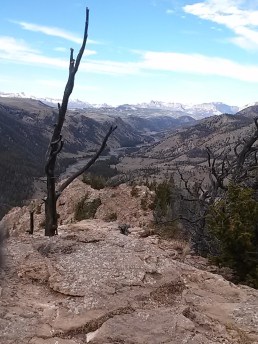
 Somewhere there’s also the sound of trickling water, which brings me back to one reason why I’m here now: The mingled joy and stress of my last serious hike. A friend and I took the day off and clambered up to Lake Louise, a hidden glacial lake which is the splendid reward after more than an hour of trekking, much of it straight uphill on rocky ground.
 Here’s one reason I need a massage today: The hike to Lake Louise ends in a rising field of solid granite, where the trail vanishes . You’re left on your own to clamber up any way you can, on hands and feet if all else fails. At the top, it’s so windy I fear I might be pitched over the edge. My friend remembers that, years ago, they brought fishing rods but could not fish. It was too windy.


