


Dear friends and readers,
Thank you, one last time, for joining me here. The time has come for a farewell.
I’d like to explain.
I sometimes say that this blog is about a city girl moving to the wilderness. Only half of that is true.
For most of my life I was a city girl, but since coming here I never actually lived in the wilderness.
I look at that wilderness every morning, and dream about going back in there again. I’ve hiked up there and ridden in on horseback. I’ve camped in a valley beneath those magnificent buttes, and gone in as far as possible behind those crags on an all-terrain vehicle.
But actually I live in a comfortable house with all of the modern conveniences, less than 500 feet from the highway that leads to Yellowstone. The drive into town takes 15 minutes. Day to day, except for my hikes, my life is just about like anyone else’s.
Like countless others, I came west for an adventure and to reinvent myself. I was lured by the endless space, the soul-restoring mountain and desert landscape, and a fascination with the legacy of those who came here long ago.

Everything I saw was fresh, remarkable, and full of wonder, and I have tried to share that.
Indeed, I did reinvent myself. I never did a moment’s work on a ranch, never even split a log, but I am certainly no longer a city girl. My perspective and my predilections have changed. Also the way I dress.
Along the way, I gradually became attuned to some common misconceptions about the nature of this part of the country. For instance, the romance of the cowboy mystique doesn’t accurately convey the brutality and struggles of that life. These days, a cattle ranch is often a hobby for the super-rich and seldom a viable economic enterprise.
The legendary “rugged independence” of spirit in the West often goes hand in hand with near-suicidal loneliness and desperation. And yet the irony is that many people in this situation would have it no other way.
A hundred and fifty years ago, this type of area attracted many for the opportunity to work incredibly hard and build something of lasting value. Many did (and many others did not, and either left or died trying). Today, it is a challenge to relocate here and find decent housing and a life-sustaining permanent job. I was fortunate to have one already, and to be able to work remotely, but many long-time time locals struggle mightily to stay afloat financially in an economy dominated by seasonal tourism.

I know that over the past 8 years this blog has been read by others who were curious about moving to this remote little valley. In fact, that was its original intent, back 8 years ago when Dubois seemed like the best-kept secret in the West.
Eventually I began to wonder whether that was a good thing to do, whether big-city sensibilities might slowly erode what Dubois residents had come to cherish. This is one reason I have posted less and less. I began to face the prospect of writing any new post with apprehension.
Then, while I was preparing to post this farewell, I received a comment to my original post from a man whose small Colorado farming community has suffered exactly what Dubois hopes to avoid. It is a cautionary tale worth reading. (Scroll down to read the words by Rick.)
For those who want to read other people’s reflections about the American West, there are many great writers, among them Wallace Stegner (the best of all), Willa Cather, Kent Haruf, Cormac McCarthy, Annie Proulx (mentioned with reservations; many people feel she does not portray Wyoming fairly), and Mark Spragg. Wyoming Public Media posts a great podcast called The Modern West.

Or you may want to enjoy the songs on the album “Wyoming” by another skillful storyteller (and a fellow migrant to Dubois), singer-songwriter Skip Ewing. In the title track, his character says, “I didn’t stop to think out problems, I just headed west. I thought I’d get where I was going, but I haven’t yet.” It’s so true, for so many.
Fundamentally, and fittingly, living in Dubois is no longer an adventure for me, because it has become the familiar, and therefore I can’t write as if it is still an adventure. I have always known that there are other equally satisfying places to live. But as Skip Ewing sings, “my heart’s inclined to stay” in Dubois.
Fundamentally, I am very glad that I took my “leap” West, and would never want to live anywhere else. If you are still deciding about yours, I wish you an adventure of your own, and a journey that leads you home.
Thanks for sharing mine.
© Lois Wingerson, 2023


 “I’m so sad to see the end of summer,” friends will say, as the fields turn to gold and the air grows crisp. Not I.
 The text and look-and-feel of their poster said it all: Live. Jam. Funk. (Free.) Nothing like our usual laid-back country music band strumming away as a few old-timers shuffle around the dance floor doing the two-step. This looked promising.
 Allie and Noah were briskly selling brisket from a food van at the back, which quickly ran out — but nobody seemed to care. There was plenty of the crucial element: beer.
 For a brief few hours, we all shared a remarkable sense widespread exhilaration. This is not something I’ve experienced before in Dubois. I may witness others’ joy in beauty, often a sense of relaxation or the peace of rest after hard work, the pleasure of a good, hard hike–but never anything quite like this. Not here.
 Entering the annual quilt show at the Headwaters, I used to pick up my ballot and dutifully try to choose my favorite. But I’ve given up on that.
 The sponsors of the show, and creators of many of the quilts, are the good women of the Never Sweat Quilt Guild. Making one probably doesn’t entail sweat, but it is certainly labor.
 My husband bought this simple blue patchwork as a gift for me during our first year of marriage, knowing I wanted a quilt. It’s faded and rumpled, and the edges are frayed. I believe he paid $10 for it.
 The quilt on the guest bed came from a tag sale at our former church in Brooklyn, where I was working as a setup volunteer and therefore entitled to purchase items ahead of the sale. I had wanted a larger, finer quilt for our guest bed in Dubois.
 Some years later, a friend of mine who is a quilter pointed out what I and my fellow parishioner never noticed in our ignorance: It is entirely hand-stitched. (I sent a substantial additional donation to the Brooklyn church.)
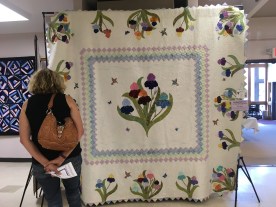 At the quilt show, I’ve begun to inquire about some of the quilts that are marked “NFS” (not for sale). Are they being reserved for someone in particular?