

As a former science writer with a special interest in genetics, I hardly expected to find something of professional interest in my tiny, remote home town of Dubois, Wyoming. My hearfelt thanks to the Riverton friend who sent me a document someone left on the photocopy machine in her workplace. This gives me a rare and unexpected opportunity to revive my old skills.
I have traced the document to Steven J. McAllister, a biology professor at Central Wyoming College. It contains a description of the genetic characteristics of “the rarely seen and little studied Dubois Jackalope.” I was aware that the elusive jackalope is sighted throughout the state of Wyoming, but not that there is a specific Dubois variant—let alone that it has been the subject of scientific study.
 The Dubois Jackalope is beloved of tourists, who like to take selfies on a statue of the creature, which has stood for years outside a small private museum dedicated to the animal. In fact, my own husband recalls passing through on vacation as a child and begging his parents to stop and let him ride the jackalope.
“Don’t be ridiculous,” he says they told him. “That’s just a tourist trap.”
Not so! Described as a hybrid between an antelope and a jackrabbit, the creature had an illustrious history long before biologists began to document its genetic characteristics. Accounts by cowboys describe a fearless and ferocious “warrior rabbit” that fought with its horns and could imitate the songs they sang around the campfire.
Kathy Weiser writes in Legends of America that the “antlered species of rabbit” are “brownish in color, weight between three and five pounds, and move with lighting speeds of up to 90 miles per hour.”
 According to Weiser, our esteemed local explorer John Colter, who passed through here en route to what is now Yellowstone Park, was the first to report sightings of the antlered rabbit in North America. But it has a much longer history in Europe. The Flemish painter Joris Hoefnagel included the image at right in his book Animalia Qvadrvpedia et Reptilia (Terra) [Terrestrial Quadrupeds and Reptiles], published around 1575.
I have discovered information about jackalope genetics in three college tests, which we can assume refer to reports that the students have read in preparation for the tests. Unfortunately, none of these quizzes offer journal citations to the relevant publications.
However, they do provide a fascinating glimpse of this esoteric field.
As always in science, there is considerable controversy about the genetic qualities of the jackalope – especially with regard to coat color, as I will describe later.
Inheritance of other jackalope characteristics seems to follow the simplest rules of Mendelian genetics: Each parent possesses two genetic factors (known as “alleles”) for a property, of which one is passed on to offspring. Inheriting one from each parent, the young have two copies of each allele. “Dominant” alleles always win out over “recessive” alleles; the only way to inherit a “recessive” characteristic is by getting a recessive allele from both parents.
A document from the Missouri University of Science and Technology describes this phenomenon in mating experiments between long-horned and short-horned variants of the jackalope. The inheritance patterns suggest that the gene for long horns is dominant. Therefore long horns will be far more common among jackalopes than short horns. (This makes sense, as long horns would help them to be fierce fighters.)
 The Wyoming report also describes a quality that follows this pattern: ear length. The Dubois jackalope has long-eared and short-eared variants, it says, with short ears being recessive (and therefore much less common). For whatever it’s worth, both jackalopes represented in the museum in Dubois appear to have long ears.
Controversy has arisen about the inheritance of coat color. A test question from the American School of Warsaw says that the fur color of jackalopes is inherited through “incomplete dominance,” in which an animal that inherits one dominant and one recessive allele winds up with a color that is a mix of the two. In this case, it says, the alleles are for red or white, but the heterozygote (which inherits both) turns out pink.
Another document about jackalope genetics, this one from North Central College in Napierville IL, concurs that coat color is inherited through incomplete dominance, but describes the colors differently. Jackalopes can inherit alleles for either brown or white, it says, and animals with one brown and one white allele have gray fur.
Descriptions of color are always subjective; one wonders whether these two reports describe different subtypes or just use different words for the same thing. Of course “red” and “brown” can sometimes be conflated (note that Weiser described the color as “brownish”.)
However, it is difficult to see how gray and pink can be confused as the same color. Most likely, heterozygous jackalopes in Poland are indeed pink and those in Illinois are actually gray. These kinds of geographic variations are common in nature, as Charles Darwin himself recognized.
 The Dubois test, not available online, describes a different system for inheritance of coat color: Orange as recessive and gray as dominant. Is “orange” equivalent to the “pink” of Warsaw jackalopes? Or is the evidence behind the Dubois report in error?
Do the “orange” jackalopes in Dubois actually represent incomplete dominance, not recessive inheritance? Or is it just that, like so much else in Dubois, the Dubois jackalope is unique? One hopes the scientists involved can reconcile these issues.
In the interests of completeness, I must report that alternative theories for the origins of the jackalope have been reported elsewhere. These arguments hold that horns arising on the head of ordinary jackrabbits are the result of a disease (appropriately called “jackalopism”) caused by a papilloma virus, which induces tissue to harden on the top of a rabbit’s head.
In his book A Planet of Viruses (University of Chicago Press, 2011), my fellow science journalist Carl Zimmer described experiments in the 1930s that validated this theory. A scientist ground up the horns of a creature with this condition, dissolved them and filtered the solution so viruses could get through. He applied the liquid to the heads of other rabbits which, sure enough, grew horns.
Are there genetic factors that determine susceptibility to this virus? How do they relate to ear length and, more importantly, coat color? I will end with the conclusion common to so many scientific reports: Further research is necessary.
© Lois Wingerson, 2018
You can see new entries of Living Dubois every week if you sign up at the top of the right column at www.livingdubois.com.


 When I came down the steep, snowy slope a few minutes later, leaning on my walking stick, I could see why she had started to run.
 There she was, huge and beautiful. She skidded to a halt, and I stopped too. We looked at each other, motionless.
 After several heart-pounding moments (my heart, I mean), she moved slowly toward me on the trail, then stopped and stared again. She turned hugely around and paced back uphill a ways. Then she reversed course and came slowly toward me.
 I stopped to take a picture of her huge hoofprints at full gallop in the snow.
 A friend from back East has graciously lent me her ski condo in the late off-season. New trails take me to unfamiliar places, with sights I will not see back home in Dubois.
 Once we took ski trips every winter, as a matter of course.
 Was that an early sign of aging? I don’t think so.
 Far better than the jostle of strangers speeding past is my own solitude, and the delight of unexpected encounters. In truth, I’m the stranger this morning, to the foxes and deer who own these slopes when there are no crowds.
 Winter dropped by yesterday morning. Evidently it plans to stay for the weekend.
 Driving home, I saw large herds of antelope and deer in the fields between the houses and the highway right at the edge of town. Among them I saw a four-point buck. These game aren’t dumb, as any hunter would tell you.

 One major advantage of working remotely, of course, is that you no longer have to deal with this.
 “I think I’ll just slip into traffic,” my husband (that native New Yorker raised in Manhattan) will intone as he pulls onto the highway, with not a car in sight. It’s rarely difficult to catch a picture like this one, which I snapped from the passenger seat as we were heading toward town.
 Now and again we have to head over the pass to Jackson, where we can’t avoid contending with traffic. Some people like Jackson. I think of it as something I have to endure, now and again. The compensation is eating at a Thai restaurant for a change.
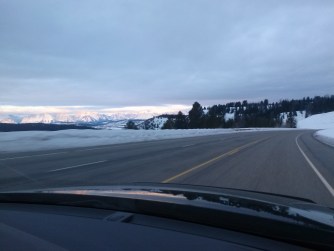 A few miles along from here, the vista opens up and you see those Tetons, which so many people travel so far to admire. (They’re the white stripe at left in the image, sunlit beneath the winter clouds.)
 1. We don’t dress this way as part of a historic re-enactment. This is really how we like to dress, and for good reason. We wear brimmed hats and long-sleeved shirts for protection against the fierce sun. We wear vests because it’s just enough to keep us warm in the high-desert cool. We wear jeans because they’re comfortable and sturdy. We wear boots because they keep the rocks out. (Here’s what I might be wearing today, if I hadn’t chosen a different shirt, vest, and jeans.)
 4. We do not “farm” deer, antelope, bighorn sheep, or other animals you may see behind fences near town. This is actually the wildlife you have come all this way to view. They come here of their own free will, probably because they like it around here as much as we do. They leap the fences, live in peace with the livestock, and like to graze our fields. (Please drive with care.)
 6. Dubois does have stop signs.“There’s not even really a stop sign in town,” Jeda Higgs said on the video “
 8. Winters aren’t brutal in Dubois (generally). Last winter may have been tough, true. But in general, temperatures here are several degrees warmer than in Jackson. Most of the snow (usually) gets dumped on that side of Togwotee Pass or on the Pass itself, giving us wonderful opportunities for snowmobiling and snowshoeing. The dry climate keeps winter temperatures surprisingly tolerable. And the air is magically clean.
 As a volunteer, I’ve been helping the Chamber of Commerce to survey visitors to Dubois about their vacation plans. What, asks the questionnaire, have you come here to experience?
 As we had suspected from the color and the contents: Bear scat. Probably a small bear, said our expert. All week, everyone who drives that back road has been detouring around this specimen, as if the evidence itself is dangerous.
 Every once in a while, I scare up a female in the sage–usually in the spring, when she flits about protecting a nest I haven’t seen. This one was a resplendent male.
 I watched with some concern as the small herd headed up the drive toward that highway. Traffic is light this time of year and that time of day, but it is also fast — especially the semi trucks racing downhill toward town. And the light was fading.
 It’s time to wear orange when we hike: Me in my vest and the dog in his kerchief.
 And I’m very interested in the people who were hunting here as early as people arrived here in the first place. I’ve hiked up to the remains of ancient hunter’s blinds. I’ve visited sheep traps where they presumably bludgeoned wild sheep for their tribe’s dinner.
 I like the way his eyes crinkle when he smiles.


