

 Back when I first lived in New York City, it really used to trouble me that there was so much violence in films set in my home town. But as time went by, I stopped caring about that.
In decades of living there, I never personally witnessed gun play or other violence (setting aside 9/11, of course). The French Connection was released way back in 1971, the same year I fell in love with my husband and his home town. Starting then, I grew accustomed to ignoring the bad rap about violence and crime that frightens so many tourists about New York. So what? I know better.
These days, I really enjoy watching films set in New York. It’s fun to recognize the intersection the cops are running through or the exact spot where the lovers are kissing. I enjoy trying to figure out whether the housing project on the screen is in the Bronx or on the Lower East Side. For absolutely nothing, I can get a free trip back to the city.
A few days ago, trolling around Netflix, I gave a little gasp. “There’s Wind River,” I said, seeing the icon for a film I always wanted to watch but never ran across in a cinema. (Well, I don’t “run across” films in a cinema any more. I have to travel an hour and a half to visit one. With Netflix, YouTube, and TCM, why bother?)

I vaguely recalled someone telling me not to bother with that film. But there I sat in front of the TV. Why not?
It was off to an interesting start, with a woman’s voice reciting a poem as what seems to be a Native American woman runs across the snow. But the fact that the film is set in our beautiful valley in the dead of winter, always with whistling winds and deep snow, should have tipped me off: This was not going to end well.
The scenes are a snowmobilers’ dream, because our protagonists in law enforcement get to sled everywhere at high speed, passing spectacular stands of evergreens. They remind me of the footage our winter visitors like to put on YouTube after their trips to Togwotee Pass.
But the plot entirely robs the landscape of its beauty. A story of brutality against women by ignorant drunken men (not drunken Native Americans, I hasten to add), it ends in a shootout with high-powered weapons. The cinematographer revels in the contrast of the bloodbath against the pure white snow.
 “So much for the image of our valley,” said my husband as the film ended.
This isn’t actually our valley, because the film was set down-county in the reservation. But the river that runs through our town has the same name, and if you Google “Wind River” today the top results, of course, link to pages about the film.
As to our town of Dubois, my son (who still lives in New York) commented in a recent visit that the village looks like a movie set. True West magazine endorses that view, having given Dubois its 2018 award for the best architecturally preserved Western town.
 But the only film ever set in Dubois wasn’t a “Western,” and it wasn’t actually filmed here. I’m gratified to say that Taking Chance, starring Kevin Bacon, was the deeply affecting true story of the return of a fallen Iraq soldier to Dubois and his burial in our local cemetery.
This image is not from the film. It’s an actual honor guard at the actual Dubois cemetery, on Veterans Day. Even though locals including Chance Phelps’ family worked hard to bring production here, the Western scenes were filmed in Montana.
The business incentives in Wyoming weren’t as good as elsewhere. But also, the costs of bringing the production to this remote area were too high to be practical.
This used to trouble me, but as time goes by, I have changed my view. Dubois was extraordinarily fortunate that the one film to feature it gave an accurately positive image of its character–even though the images didn’t actually show our town or our landscape. But it may be a blessing that it is a challenge to bring film producers here.
There are many reasons to value our remoteness in this valley. That it discourages the media that might send the wrong message about us is one of them.
© Lois Wingerson, 2018
You can see new entries of Living Dubois every week if you sign up at the top of the right column at www.livingdubois.com.

 This is Dubois. It has a new distinction this year, being recognized by True West magazine as the town with the best-preserved Western architecture.
 The main road bypasses the old part of town, which is also the low-rent district. For years, I never went over that way, except to go to the library. Unless you know someone who lives there or you have children at the school (which is also in that direction), there’s little reason to visit the original village.
 “Can you help us get someone on the Town Council who will do something to clean up the town?” a friend asked me a few weeks ago. I asked her to explain what she meant by “clean up.” One thing she mentioned was the trailers.
 By and large, the properties with trailers are well-kept (in a dusty, not-much-will-grow-here way).
 Lots of the houses are small, old, insubstantial, and have a thrown-together appearance. Many have large stacks of firewood in the yard. It’s the only source of heat for many people, because out here in the wilderness electricity is expensive and there aren’t many jobs that pay well.
 A herd of deer also seems to regard the old village as home. They cross the streets with the proprietary air of homeowners out on a stroll, and sometimes lounge on porches in the sun. They like to graze in the empty lots.
 Some folks might like to spruce up the old part of town so that it looks more like a “historic district.” But as I walk these streets, I’ve come to think that the architecture of old town, if you can call it that, truly preserves the spirit of the Old West in the sense that True West magazine intended.
 If it speaks of anything, the old town speaks of individualism — and that is truly who we are.
 Pretty worn out when the last of our guests for the Great Eclipse of 2017 departed last Thursday, I determined to take it easy and stay home. We had skipped church on Sunday to take everyone out into the wilderness. Thus, sadly, I learned only from an obituary in the Frontier that Esther Wells had passed away and that I had missed her funeral.
 I first met Esther after she had stopped coming to church because she’d moved into assisted living. She must still have had some vision at that time, because she asked to come to our open house for one last look up that valley. I remember men carrying her up the front steps in a wheelchair, and setting her down facing out the window.
 Thank goodness the Dubois Museum Association has preserved on videotape an interview with Esther about those early days when you couldn’t get down the valley all winter. We have learned that she was not bored as a child with no store-bought games, because old Mrs. Burlingame loved making toys. We also heard that geraniums were everywhere back then, because they were the only flowers that could survive the climate.


 For a long time I have been hoping to see two new kinds of shops in town, and here they are. Maybe this came about because I finally got around to reading a Harry Potter book, and some magic rubbed off. (Or maybe it’s not about me at all.)
 As I told Sandy yesterday, this answers my dream that Dubois would have what I’ve seen in so many other small towns on my road trips: A shop that features art and craft items by local designers.
 As the official host for the many cyclists who spend a night at St. Thomas church while passing through town on cross-country bike treks, John quickly saw potential in the idea.
 Like two famous Wright brothers a century ago, Chris Wright was attracted to mechanics early in life. Growing up in a small California town, he and his friends built bikes from trash parts left in alleys. They saw to it that no kid in town was without a bike.
 The bike shop opened in early May. John said they made 11¢ on the first day. (I didn’t ask what on earth had that price tag.) Not many touring cyclists reach Dubois in mud-and-slush season, and the startup was scary. But by the third week, he told me, “the floodgates opened.” (I don’t think he intended a metaphor; the
  Chris pointed out a vintage red-and-yellow model sitting outside the shop, waiting to be picked up. Its owner got it as a present for her ninth birthday. She wanted it tuned up so she could ride it again — at the age of 75.
 Who knew that I had chosen to down tools and leave town during
  “Yeah, we upgraded your broadband, and your old modem won’t work any more,” she said. “Can you drop by to pick up the new one? Just give me a name and a password and we’ll set it up for you.”

 “I just fell in love.” I can’t count how often the story ends in those four words, when I ask people how they came to be in Dubois. Sometimes “we” is substituted for “I.”
 I know not one but two couples who traveled the entire nation in their RVs looking for a place to settle, and wound up living in Dubois. One of the couples had lived here before, looked everywhere else, and then came back.
 When I went home I took along cuttings of sagebrush, which I kept in an envelope. Now and again I’d open it to sniff the fragrance, which always made me wistful.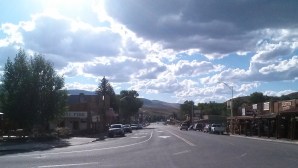

 Driving up-mountain this morning, my husband mentioned an article he had just seen in the Wall Street Journal. Nothing about executive orders this time–unless (and I’m dreaming now) it’s an order from executives to their direct reports to get outdoors and take a walk at lunch hour.
 We ambled through a silent forest. The view ahead was a palette of four colors. The trees that waved above us were, of course, forest green. Beyond them, the sky was an uninterrupted swath of deep periwinkle–except for a contrail high above, which the wind had spun into a ribbon of lace. Each step drew us into the shadows of deep purple and the snow, which was of course pure white.
 Back when I worked in an office in Manhattan, it was my habit to spend lunch hour at the gym whenever I could. I’m a firm believer in the
  The benefits of exercise and exposure to nature aren’t the whole story. Numerous studies have shown that
 Here’s our first Christmas tree in Dubois.
 Here’s the last tree we had in Brooklyn. It looks like a fashion model in comparison to the rangy, lanky specimen we have in Dubois. But it dropped needles like crazy. This year’s tree sucks it up from the tree stand like beer and holds on like a cowboy at the rodeo.
 When we got our less-than-perfect tree into the Wyoming house, snow was still falling from the branches and there was ice on the trunk. Of course we had to re-cut the trunk. I got on the other side of the saw, and pulled ineptly, holding onto the trunk as we sawed through about four inches of sticky, sappy wood.
 The house looks and smells wonderful inside, and there’s a winter wonderland outside. Since we put up and decorated the tree, I have seen through that back window behind it two moose, a rabbit, many deer, the usual cattle, and a lone wolf crying out to find a mate.