

 We knew beforehand that a Google team was coming to Dubois to watch the Eclipse. But only weeks afterwards, when I saw their video on YouTube, did I hear what I had thought was too good to be true.
Our hometown was actually the base of operations for the great Eclipse Mega-Movie project.
Thousands of people around the country took pictures during the total eclipse, and Google has melded them all into one video. The eclipse images submitted by volunteers will offer astronomers unprecedented views of the corona, the edge of the sun, that will vastly increase our knowledge about the sun’s activity.
But the real action took place right here.
“It was part happenstance, part location,” project manager Calvin Johnson told me today. “We were looking for a place that was on totality, where the weather was predicted to be good and where we could hang out beforehand and not spend a lot of time getting ready.” It was important to be in one place in case something went wrong.
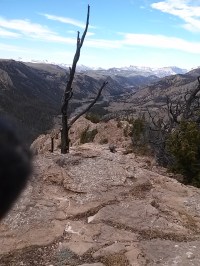
 But they also wanted to watch the eclipse together in just the right location, “not so much for the project as for the experience,” said astronomer Laura Peticolas of University of California-Berkeley, one of those who dreamed up the project in the first place. (That’s Johnson and Peticolas in the image, watching with wonder from the top of the Scenic Overlook, as totality was fading.)
Lucky for Dubois (and for Google), just as the Google team began looking for the right location, Lisa Bivens was opening the newly remodeled Chinook Winds Motel, and was hoping to fill all the rooms during Eclipse Week. She had the initiative to reach out to astronomers by emailing places like NASA and Sky & Telescope Magazine. The listing made it into an astronomy listserve, where another member of the Google team saw it.
So they took over the entire motel: An engineer, an astronomer, the project manager, some camera operators, a few undergraduates, and some family members. The team stayed in constant contact with engineers at Google’s offices in Mountain View CA during the eclipse, checking to make sure the pictures were uploading and formatting properly and dealing with any technical issues.
If you haven’t done so already, do log onto YouTube and set aside 15 minutes to watch “Chasing Totality: Making the 2017 Eclipse Megamovie,” if only for some of the best images of the total eclipse crossing our valley. About 90,000 other people have already seen it, and they have had a huge dose of what’s wonderful about our town.

They hear Johnson describing it as a “tiny little cowboy town” about an hour from Jackson, and see Jeda welcoming visitors with her customary enthusiasm. “We still have that old-West mentality of everybody’s welcome at the campfire,” Monte says, and you see him at his piano. Twila talks about the Eclipse as an exciting time for the town.
Meanwhile, the team sits around a campfire. You see some of them throwing horseshoes.
To tell the truth, they actually spent much of their time scouting for locations before settling on the obvious: the top of the Overlook. Some of them went to the Museum. A few rode the jackalope. They all went to the rodeo. Peticolas called it “amazing, so crazy!” She said she had worried a lot for the riders, but then she added, “I guess they sign up for this.”
The team also drove across the pass to the Tetons, which gave everyone a chance to see more of what we love about our location.
 I asked Johnson whether the ride over from Denver had been boring, after he got this side of Rawlins. “It may be boring for you-all that live there,” he replied, “but it was beautiful for all of us. Much more beautiful than Boston [where he lives and works]. I would love to spend unlimited time there.”
“I fell in love with Dubois,” said Peticolas, “the painted hills, the valley, the beautiful mountains. It was so serene at the time of the eclipse.” A “small-town” girl who grew up in Oregon and spent several years in Alaska, she describes her current home town of San Francisco as “all cement and cars.” She says she will definitely return to explore more around Dubois.
“I can’t imagine having found a better place,” she added. “There are a handful of places I want to go back to. Dubois is one.”
© Lois Wingerson, 2017
You can see new entries of Living Dubois every week if you sign up at the top of the right column at www.livingdubois.com.

 It’s time to wear orange when we hike: Me in my vest and the dog in his kerchief.
 And I’m very interested in the people who were hunting here as early as people arrived here in the first place. I’ve hiked up to the remains of ancient hunter’s blinds. I’ve visited sheep traps where they presumably bludgeoned wild sheep for their tribe’s dinner.
 I like the way his eyes crinkle when he smiles.


 “Have you noticed how the sun and the moon are getting closer in the sky?” Johanna asked yesterday.
 A team from Google and Berkeley will be here, crowd-sourcing images of the eclipse. A reporter from National Geographic will be live-streaming the events. Untold numbers of travelers will want to nip over from Yellowstone. All these people will descend on our extraordinary little town starting about two weeks from today, all waiting to witness the total eclipse of 2017.
 I fervently hope the people of Dubois can retain the friendly good nature that our visitors enjoy.


 It could go without saying that Wyoming is not the garden state. We’re high and dry, which is a fabulous climate for people to enjoy in the late spring and summer, but not so much for garden vegetables.
 Hooray! The Community Garden supplies the Farmers Market, which funds the Food Bank. Now the Farmers Market, which opens in June, will be able to offer produce that is larger, more abundant, and presumably also more fresh.
 Proudly, on a gray day in late April, Mary Ellen showed me around the greenhouse, which was warm and already showing many signs of green. Use of the greenhouse is the generous gift of Debbie Phillips, who acquired it with the house she and her husband bought when they moved to Dubois last year.

 “Seriously? You only had to go 10 more feet for a layup!”
 “That donkey has longer legs than you do!” Joe calls out to someone on the students’ team. “How you gonna get on?” The donkey stands patiently, thank heaven, for what seems an eternity, as she tries to jump on its back. A referee walks over and gives a boost. The student blushes. The first game begins.
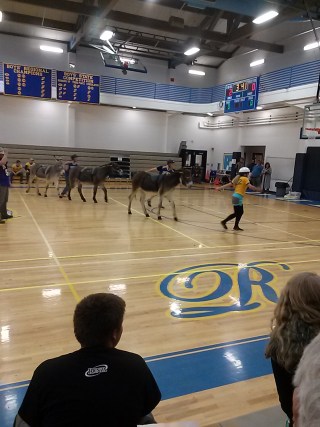 You may dismount to catch a loose ball, but you must always take the donkey with you, keeping a hand on a rein, and you must return the ball and re-mount the donkey within 15 seconds or get a penalty.
 The school-teacher Donkey Kongs kicked the phone-company DTE Assets 14-8 in a last-minute surge, to win the championship.
 The journey to Dubois in 1911 “must have seemed like a trip to the end of the world,” wrote the late Dubois artist Mary Back, in her 1955 brief biography of Elsie. The new schoolteacher traveled by train to Lander, then by a one-horse buckboard stagecoach to Fort Washakie, changed to another buckboard stage that took her (and the mail) to a ranch on the Wind River where she spent the night.
 She was a school teacher without a school: Classes were held in the saloon dance hall, up against the cave across from Welty’s Store. The cave was used for wine storage and as a jail. (The cave entrance is near the center of this photo, with the saloon at far left, which is also still in operation.) Elsie had to clear away the classroom any time the saloon held a dance.
 I’ve been reading this week about Elsie and Floyd’s world, thanks to two unexpected gifts that dropped into my Inbox from their great-granddaughter, Gabby Cook. She was kind enough to scan and send me Mary Back’s typewritten biography, as well as the century-old account of a hunting trip that Floyd guided, as told in great detail by Fish.
 The hunting party had to sleep outdoors next to the shed, because the Stalnakers took in lodgers and the rooms were all occupied. (Mary Allison wrote that Elsie was a great housekeeper who often ironed her lodgers’ clothing, if they were bachelors.)
 Floyd worked for many years as a guide and ranch manager. Elsie and Floyd survived the great flood of 1919 despite great losses, briefly became mail carriers (Elsie also drove the Jeep), and then purchased the drug store, which they operated until after World War 2. Their son, Dean, was Gabby’s grandfather. Floyd was working as a carpenter in Riverton when he died of a heart attack in 1948. Elsie died in 1965, ten years after Mary Back wrote her biography.