On Learning How to Be

I had so much else to do! And then I saw this sign.

It was Saturday, the last day of November. The next day would be the start of Advent, that season of penance which, in the words of my favorite spiritual guide, is meant “to get you better fit for what’s to come, by cleaning you and trimming you and training you.”

Winter had arrived suddenly, like an unwelcome in-law, dropping nearly a foot of snow. It was difficult to see the lines on the highway as I drove toward town.

This was not what I had planned for the day. I had emails to respond to and documents to prepare. But I found myself diverted, to help a snowbound friend whose car was stuck in her driveway.

I had volunteered to help, but I was rebelling. I had so much else to do!

And then I saw this sign. The complete message used to read “Be alert. Deer on highway.” I don’t know why, but for several days it had been conveying this truncated, existential message. That morning, it gave me pause.

Simply be. That brought to mind the words of author Eckhard Tolle, whose focus is on the meaning of being, and especially of being in the moment.

“Whatever the present moment contains,” he wrote, “accept it as if you had chosen it. Always work with it, not against it.”

Maybe I sighed. Anyway, I drove on in a new frame of mind towards Superfoods, to do what my friend had scheduled for that time. I put on the apron and began to greet people coming in the door, to thank those who slipped something into the slot in the bucket and then to ring the little red bell.

Perhaps echoing the next word that was missing from that electronic highway sign, I felt unusually alert.

Neighbors stamped snow off their boots and opened heavy scarves as they passed my stool. There was lots of chatter with the cashiers.

All roads east and southbound, I heard, had been closed by snow on this morning two days after Thanksgiving. Not only was my friend snowbound in her own home; some people who had come to visit our town for the weekend were now trapped here, and kept away from theirs.

There were various responses to this predicament. I overheard one young man who came to visit his parents, and would now have to miss something important back at work. I wished he could have seen that sign. “Worry pretends to be necessary,” Tolle has written, “but serves no useful purpose.”

Someone else inquired how to get a permit to cut a Christmas tree in the forest. “You’ve come all the way from Casper to get a Christmas tree?” I asked, and then realized: Being trapped, he’d decided to make the best of it. I wished him a tree full of good memories.

That day I never did get to those other things I had meant to do. Instead, we tried to dig my friend’s car out of the snow. The drifts were soft as powdered sugar; the snow sparkled as I tossed it off the shovel. Our effort was doomed to failure; her car spun endlessly on a patch of ice concealed by the white.
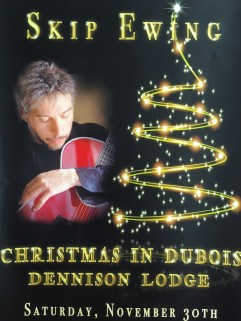
As the light waned into evening, we made room for her in our own back seat and drove off toward town to enjoy the Christmas concert by songwriter Skip Ewing. Skip and his wife Linda made Dubois their home town last year. Once again, he had decided to welcome the season in our company, among his new friends.

As he introduced his songs, Skip sometimes bragged about the famous people who had recorded them or the famous places they had been performed. He’s so likeable that we are willing to overlook this, because he surely knows his way around a guitar, and something about his manner makes us feel like neighbors rather than an audience. If anything could make me live in the moment that evening, it was his unspoken invitation to add our own voices to his in singing “Silent Night.”

Welcome, Advent. The snow has returned, and with it the long quiet evenings in my home several miles outside a remote small town in Wyoming. As the frantic holiday season approaches, I can mentally rebel against these realities of winter. Or (constitutionally A-type ex-urbanite that I am) I can use them as reminders that there are realities more important than my constant busy-ness.

Like the snow, I can drift sometimes. Perhaps exactly when I feel I have too much to do, I will remember to emulate the brilliant stars in the dark sky outside, and simply be.

© Lois Wingerson, 2019

Thanks for reading! You can see new entries of Living Dubois automatically if you sign up at the top of the right column at www.livingdubois.com.

Who’s writing? Check out About Me.

Bouquets for Dubois

Another city luxury pops up here in the wilderness.

One thing I will miss about Brooklyn (sometimes) are the masses of colorful cut flowers that that spill out from buckets in front of nearly every deli, all year round.

As there is about one deli per block on a shopping street in Brooklyn, that was plenty of opportunity to be tempted by flowers. And I succumbed, nearly every week.

I took this photo just before we began packing to move out of the house. (How different this looks than the rough-hewn charm of our Wyoming home!) If there wasn’t a bouquet on this dresser in the entryway, that probably meant I was sick or away on a trip.

Every Mother’s Day in Brooklyn, I could expect a bouquet like this from my son. Being on a budget, he would always choose a selection from a nearby deli and make it into an arrangement, rather than paying for a bouquet from a high-end New York florist.

I cropped an image of another one of his Mother’s Day bouquets, and I use it for the lock screen on my laptop.

So I would still see “fresh” flowers nearly every day, but I have not bought many bouquets in Dubois. The supermarket sells a few, but they are mostly carnations and daisies — nothing varied or exotic.

The flowers in my living room look nice, but they’re artificial. This is grass and sage country, I thought. Who needs flowers?

Besides, they’re so easy to find outdoors. I saw these masses of lupine among the sage up on Union Pass last week. It’s my favorite color combination. Someday I will paint a bathroom in those colors.

Nature grows flowers by the armful here in a dazzling array of colors, but that task is beyond me. To keep flowers alive in a garden near my house would mean constant watering, carrying them inside overnight when the weather is cool, and unyielding defensive efforts in the war against deer and ground squirrels. Simply not worth the effort.

So I gasped the first time I stepped out the side door last month, after returning from our final stay in Brooklyn. Arising from my years of sheer neglect was this utterly perfect iris.

I had seen the blade-like leaves for several years and not pulled them, because they looked too elegant to be a weed. I can’t even recall when, in a burst of naive enthusiasm, I must have planted that bulb.

That wasn’t the last of the pleasant surprises. Among the new storefronts that are springing up in the middle of town, I was pleased to find the Wilderness Flower Company.

Casey is new to Dubois. She worked for a while at Western Bouquet, the flower shop far up a side street in the old part of town. I rarely patronized it because it was out of the way. To be frank, I tended to forget that it existed.

The owner retired while I was away. Casey bought the business and relocated it to a prominent spot along the boardwalk in the center of Dubois, right next to the new old-fashioned drugstore. There she holds court with her two small children over the large refrigerator and its stock of tall, proud blossoms.

I need refrain from indulging myself no longer. Why should I not have my bouquet of fresh flowers each week, just because I’ve decamped to the remote high mountain desert?

I make it a practice to buy the oldest and least attention-grabbing of the blooms.. I want to leave the showier flowers there for other customers, because I want The Wilderness Flower Company to survive.

Just like the sage, the lupine, and my lovely, lone iris.

© Lois Wingerson, 2019

You can see new entries of Living Dubois every week if you sign up at the top of the right column at www.livingdubois.com.

Who’s writing? Check out About Me.

Previous entries are listed in the Archives at the bottom of the right column.

Masterworks by Dubois’ Lesser-Known Artists

Danita Sayers bustles about the rooms of the Dennison Lodge, tacking treasures to the folding screens and carefully placing the pieces of artfully painted furniture.

“We paint on whatever we can find to paint on,” she says, as I pause to admire the portrait of a horse standing in a swale. It has greatly elevated  the status of an ordinary TV tray the artist found at the Opportunity Shop.

A giant glider, a sliding bench made from horseshoes and wagon wheels, dominates the room. It’s the creation of a 6th grader.

Danita has spent the month transporting these artworks and displaying them statewide, bringing back the honors and the ribbons that prove their worth. Of 40 pieces submitted to the State Art Symposium this year, 21 won awards.

The Governor’s wife picked 2 from our little school for the First Lady’s Choice Awards. This year, Danita told me, the Dubois school got Congressional Artistic Discovery awards in both the 2D and 3D categories, and one was for a photograph, which is rare. These will go on tour for a year, and then hang in a gallery in Cheyenne.

Now she’s putting them on display, 166 artworks chosen by herself and her pupils (except for those award winners that have been held back elsewhere), during the annual school art show.

The owner of a local curio shop is helping out, while scoping the show for items she might be able to purchase resell in her shop. In other years, Danita says, art dealers and art professors have come from far away to look for acquisitions at this show.

The annual Dubois K-12 Youth Art Show has gone on for decades. This was the first time I saw it–someone who, like most parents, once thought her own young children were truly exceptional artists. What most takes my breath away here are the works by children who are just learning to read.

Dubois has more than its fair share of top-ranked artists and photographers, but its youngest don’t get much publicity and have no commercial websites. Danita, who is the art teacher in our school, bursts with pride in her students and the passion to share how special they are.

The student who created this sculpture was blind, she tells me. Would I believe that?

This peacock was the seventh-grade artist’s first oil painting. “She doesn’t even know it’s good,” Danita says with a smile, and repeats herself.

Slowly, I come to realize why so many locals like to point out the works by their favorite school-aged artists at the national art show that comes to the Headwaters in mid-summer.

These artists are growing up in one of the most remote towns in the lower 48. Some of them go home to ranch chores after school. and think the biggest event of the year is branding the calves.  The  parents are contractors and bank clerks and restaurant owners — precious few with a strong history in the liberal arts. Their home town is a place where kids waste time on a lazy summer Sunday by tooling around the main street on their bikes doing wheelies.

Unlike my children’s classmates three decades ago in New York City, some of these artists may find the thought of even visiting a city a bit frightening. Many have ridden a horse, shot a gun, been to a rodeo, and camped out overnight, but very few if any have seen a renowned painting by a great artist in an art museum.

What they do see every day is the mountain landscape and the wildlife. Instead of visiting galleries, they go on camping trips with botanists to study wildflowers.

In the primary and middle school my children attended, a short distance from the Brooklyn Bridge, the distinctions between the tough guys, the future CEOs, and the arty kids were clearly defined.

Walking past these panels, it is clear that it’s not an issue. Everyone does art, and many do it exceedingly well.

“A lot of our best artists are ranch kids, wrestling club guys,” Danita says.  She points across the room to a landscape. “The guy who made that painting was in wrestling and football. He won a blue ribbon [for the painting], but he also excels in sports.”

My guess is he knows the terrain quite well because he probably goes hunting up there in the fall.

As Danita puts it, at this school art is not placed in a “gentle” category alone. The school mascot is a ram. Clearly they can paint them as well as they can butt helmets on the field.

© Lois Wingerson, 2019

You can see new entries of Living Dubois every week if you sign up at the top of the right column at www.livingdubois.com

The Baffling Mystery of Our Dying Lambs

An entire community faces a tyranny of options.

SheepRidgeThey call it Sheep Ridge, the one you can see from the main street in Dubois, but no bighorn sheep have grazed there for a long time.  The herd is still around, but its population is plummeting. Why?

Back in the 1870s, I’ve heard, hunters could find a bighorn sheep in these mountains any time they wanted. Most bighorn sheep in the West came from that original herd as transplants, moved out by the hundreds to other regions of the Rockies during the last century.

Some of those relocated herds have been threatened by the same basic problem, but have bounced back. Not so the bighorns that stayed here.

It’s not that there isn’t any explanation. There are too many. That’s the problem.

Our high school sports teams are called the Rams, and you see their image on logos all over town, but the rams themselves are fragile.  Local taxidermists say some of their skulls are too light to hold screws, and the curly horns are no longer as big as before.

Unlike the herds in Cody and Jackson, Whiskey Mountain sheep keep their weight stable in the winter, but lose weight when they move up to summer range. Is there something wrong with the local wild grasses, forbs, and brush that are central to their summer diet?

Predators like wolves or eagles might play some role in the animals’ deaths. But in those cases they may be only the final blow — not the root cause.

Sheep060816_3The greatest concern is that these bighorns are extraordinarily prey to respiratory infections common among sheep. They harbor a half-dozen strains of the relevant bacteria, while wild sheep elsewhere in the West seem to be hosts to only two or three. Enough lambs are born to this herd each year, but only a handful reach maturity. Many of the ewes live on, chronically ill, to infect again and again.

The infection traces to domestic sheep, which were raised here for four decades starting in 1890, but dwindled as the cattle ranchers prevailed. In 2015, the US Forest Service formally banned domestic sheep from the local bighorns’ range—decades after their decimation began.

It can’t go on. But what to do?

About a year ago Sara Domek, executive director or the National Bighorn Sheep Center in town, approached two experts (wildlife biologist Daryl Lutz of Game & Fish and Steve Kilpatrick, head of the Wyoming Wild Sheep Foundation) to plan a strategy. The outcome is a series of summits now under way in Dubois, where absolutely anyone who is interested is welcome. I didn’t take an actual count, but scores of my friends and neighbors, have turned up, bringing with them an astonishing wealth and depth of knowledge on the subject.

The biggest challenge is the complexity of the problem. “You came up with 170 issues, so we had a lot of fun categorizing them all,” said Jessica Western of the University of Wyoming at the last session. A soft-spoken, genial person, she is shepherding a large flock of biologists, land managers, outfitters, hunters, environmentalists, ranchers, and other interested residents, toward recommendations to help the Wyoming Game & Fish Department decide what it can and should do next.

BighornDrawing_croppedThe Wyoming Game and Fish Department has won grants from four organizations to support the summits, and commitments of time and expertise from bighorn sheep specialists all over the West. One of the grants brought a panel of eight specialists on the bighorns to Dubois last month, where they shared their knowledge, listened to ours,  and brainstormed.

They brought insights about  bighorn sheep and their habitats in Alaska, California, Idaho, Montana, Nevada, Oregon, Washington (the state) and, of course, Wyoming. The scientists truly seemed to enjoy themselves, having a rare opportunity to hide away in the wilderness as a select team asked to learn from each other and contribute to a poignantly good cause.

It’s not that nothing has been tried. At the latest summit, held early this month, Game & Fish habitat biologist Amy Anderson described many  efforts to improve the forage in the wilderness, including fertilizers, herbicides, selective cropping, and “range pitting” (dragging an implement across the ground to disturb the ground and encourage growth of new grasses).

Follow-up studies analyzing the forage (quantity, species composition, protein content, and relative food value) found that these tactics didn’t seem to make any great difference, compared to untreated areas, “so I don’t know what we bought with these treatments,” Anderson said. “We’re not necessarily seeing improvement” in the varieties of grass the sheep prefer.

So what’s the problem? Is it the climate? Minerals in the soil or the salt licks? Air pollution coming from Utah or even farther west?

Prescribed burns have been tried in parts of the forest, not only to encourage growth of grasses but also to deny hiding places to predators. Local hunter and taxidermist Lynn Stewart pointed out that Sheep Ridge itself, visible from the middle of town, was bald a century ago. Today it is blanketed with evergreens and sheep won’t go there.  Another prescribed burn is planned for this summer in a spot where conifers now cover a bighorn migration route between winter and summer ranges.

beckiart
Painting by Becki Neidens

Immense interest centers around University of Wyoming biologist Kevin Monteith, who has been pursuing an intensive three-year research project on this herd. His team has implanted monitors like IUDs in ewes, which  send a signal when they give birth. A member of the team will spend this summer camping in the remote, rocky Whiskey Mountain region, waiting. After a signal, she will race over the treacherous ground to find its source, hoping to reach the lamb and attach a motion sensor. This should allow her and others to locate some of the lambs that die and  learn what happened.

At the latest summit, the facilitator Jessica Western assigned us into breakout groups. Our task was to arrive at a consensus about which of those 170 issues she compiled after the previous session deserve the most attention for the future. Inevitably, we also pondered some recommendations. Some of them are controversial, and some unrealistic.

Why not cull the entire herd and start again with healthy bighorns, descendants of the transplants from the original herd? (They’d inevitably get infected too, because the microorganisms do persist in the soil for some time, and anyway, what about the forage issue? Besides, the transplanted sheep wouldn’t know the local migration routes. Studies elsewhere show that sheep lacking this knowledge tend to stay in the winter range all year round.)

BighornStatue2No solution will emerge quickly. We’ll remain in the dark about the root cause of the die-off for at least three years, while Montieth’s team completes its research.

Meanwhile, in June after the workshops are over, the Game & Fish Department will sort through all the recommendations and decide what it can try, what it can’t, and why not. Whatever it eventually does will also take time, as well as funds and personnel. And the clock is ticking for the herd.

Sara Domek of the Sheep Center closed the last summit with a plea for help from all those people with furrowed brows who were sitting on the folding chairs in the audience.

“This is the time for citizen science,” she said. “People want to help. Let’s do it.”

© Lois Wingerson, 2019

You can see new entries of Living Dubois every week if you sign up at the top of the right column at www.livingdubois.com .

A Surprise Visit to the Cemetery

We welcomed the arrival, with concern

bighorn sheep Dubois WY

One day last week, some bighorn sheep wandered into town. This was astonishing.

Many deer live in town year-round, but the sheep live up-mountain, off in the wilderness. The Bighorn Sheep Center offers guided tours up Whiskey Basin to look for them, but they’re not supposed to be easy to find.

People are used to spotting them on the cliffs across the river from the Painted Hills subdivision, or sometimes down on the highway by the red rocks at the edge of the Reservation. They may be the mascot for the school’s sports teams, but we don’t expect them to show up down here in town.

I was inside the hardware store when they came past. “Aren’t those sheep?” someone gasped, and we went outside. There they were, ambling unconcerned across the slope beyond the yard

Many people told me they had never seen the sheep in town before. Someone in the supermarket had a great shot of the herd behind the big brown “Dubois Wyoming” sign beside the highway east of town. Later they were spotted in the cemetery.

bighorn sheep statue

Why did they come down to visit? Sara Domek, the Executive Director of the Sheep Center, chuckled at the question, in the same bemused way a parent might talk about a toddler: Who knows what they’ll get into their heads?

It’s anybody’s guess, she said. Maybe they liked the grass in the cemetery. Maybe it was because of the cold snap. Or predators could have driven them down.

Predators were the favored theory in town, but in truth nobody really knows what’s going on with the sheep. Their numbers are declining, though, and nobody is more concerned about that than Domek and local wildlife experts.

The Bighorn Center has launched a series of forums in town, in collaboration with the Wyoming Game and Fish Department and other agencies, to help seek explanations for the troubling decline in the survival of bighorn lambs.

bighorn sheep

Game and Fish has donated $300,000 to a study of bighorn sheep lamb mortality. “We are at a critical point,” said biologist Greg Anderson at the last session on February 11, as quoted in the Dubois Frontier. The sheep “are not in a good condition,” he added.

The department is focusing on three major suspects in the early death of lambs: habitat and nutrition, disease, and predators.

The excursion to town might be one of the “behavioral changes” in the lower winter range than Anderson said predators are causing. But whether that is linked to actual mortality is unknown, at least for now.

So if the visit from the bighorns was a charming surprise, it was also rather sobering.

© Lois Wingerson, 2019

You can see new entries of Living Dubois every week if you sign up at the top of the right column at www.livingdubois.com


Memento Mori: The Estate Auction

Unintended intimacy with someone I scarcely knew.

The electronic zipper sign on Stalnaker Street said the chariot races had been cancelled. On a frigid weekend in February, there was not much else for entertainment. So most of us turned up at one point or another at the preview of the big estate sale.

Many of the people there, I suspect, were (like me) more curious than actually acquisitive.

These were the belongings of a wealthy rancher who passed away suddenly sometime last year. I met him only once, briefly. Sometimes I saw his helicopter churning along, low above the valley on a summer morning, checking on his longhorns.

The lots to be auctioned were spread across two adjoining barn-like buildings. “Yes, all items will be sold!” called out the estate sale manager on a bullhorn. “Everything has to go!”

We wandered up and down the aisles between the tables, perusing what he couldn’t take with him.

Four or five saddles. Shelf after shelf of ammunition, and rifles to match.

Many pieces of heavy furniture made of lodgepole pine. Quite a few leather recliners.

One or two machine-made quilts, with matching shams. Lots and lots of dishes. A box of mugs imprinted with the logo of his ranch. Disposable aluminum trays filled with kitchen utensils.

Many unopened boxes of doorknobs. (Why?) Dozens and dozens of identical brand new 8 x 11 wooden picture frames. (Why?)

A nice hand-painted salad bowl. A charming small cutting board. An interesting little sculpture. But I didn’t need any of it, and I knew I’d probably have to buy an entire lot to gain a single vaguely tempting item.

It felt slightly voyeuristic to examine all this stuff. A kind of unintended intimacy. But hey, he’s gone.

“You know what the lesson is?” Dale asked as I squeezed past him. “Don’t die.”

“No,” I replied. “The message is: Die suddenly so that you don’t have to worry about it at all.”

When I came out of the bedroom on Saturday morning, the first thing my husband said to me after “Good morning” was “I’ve decided not to go to the auction.”

All he might have wanted were some of the metal baker’s racks that he had seen, disassembled and stacked, with the poles piled separately. They would have come in handy in the storage unit. But if he bought them online instead, he could be sure the parts matched.

I hear that about half the town turned up at the auction, and that it took all day. We went up-mountain snowshoeing instead. It was beautiful, and made me feel very much alive.

The dog was happy too.

© Lois Wingerson, 2019

You can see new entries of Living Dubois every week if you sign up at the top of the right column at www.livingdubois.com


Skip Ewing Gets to the Heart of Dubois

The famous song writer could live anywhere. He moved here.

What’s the force behind the magnet that draws people to Dubois and holds them here?

It’s no challenge to capture part of it:  the spectacular wilderness landscape. Photographers capture that all the time, and scenes from this valley are  all over Instagram. Another pull is the history, from the tectonic collisions to Indians and cowboys and Butch Cassidy, from mountain men to homesteaders and lumberjacks.

But there’s one special pull which is nearly impossible to describe. You have to feel it for yourself. Tourists responding to a survey last year said they liked the people, and called Dubois “friendly.” A hiking buddy told me that she retired to Dubois because the people here had grabbed her and held her close.

Skip Ewing, the country singer and songwriter, calls it the “heart.” He should know, because the heart is his business, and his passion.

Skip says he felt that tug most strongly in 2004, during his benefit concert for the new medical clinic. He decided to auction off a shirt that cowboy Ty Murray was wearing when he won a rodeo championship. Skip suggested that people in the audience might pool their bids and donate the shirt to the clinic, rather than one lucky bidder taking it home for bragging rights.

rodeo shirt
Ty Murray’s shirt
hanging in the clinic.

Together, for no personal reward, people gave away $5,000 for the shirt to benefit the community. It now hangs in a frame in the clinic.

“That gave me a sense for the kind of heart, the generosity of people here,” he said. “That’s the same kind of heart Dubois had when I first came here.”

“If we can be part of that heart,” he added, “I’m about that.”

So Skip and his partner, photographer Linda Gordon, have settled down in Dubois.   They’re in a position to live anywhere in the world they want to, Skip told me. And they’re here.

Skip doesn’t throw his credentials around (which wouldn’t gain him many fans here, anyway). But they’re impressive: Five of Skip Ewing’s country love songs have placed in the top 20s on the country-music charts. In 2000, he was named Songwriter of the year by Broadcast Music Incorporated (BMI), and he’s won the Country Music Association Triple Play Award for three number 1 songs within a year.

They’re the kind of love songs that somehow grab you where it hurts a bit, like “Love, Me” and “Little Houses.” (The announcers wouldn’t credit Skip, the songwriter, of course. They’d mention the singers, names like Kenny Rogers, Willie Nelson, Conway Twitty, Merle Haggard, Kenny Chesney, and Reba McIntyre. )

I ran into Skip and Linda at the Perch coffee shop sometime around Thanksgiving. He looked vaguely familiar, and I was puzzled to see him chatting with the locals as if he knew them (which he did). I felt I ought to recognize him, but I didn’t (it’s my failing to have a poor memory for faces as well as names). Someone introduced him as Skip Ewing and, city girl though I used to be, at least I recalled his name.

Probably about a decade ago, I had heard Skip at a concert in the back room at the Rustic Pine after one of his retreats for song-writers. But I had no idea that his was the creative mind behind some of the songs I liked best, after I began listening to country music on the radio.

The workshops (he called them “Horse and Writer” retreats) brought would-be songwriters to the Lazy L&B Ranch up East Fork, which he first visited when he wanted to give his five-year-old daughter a good place to ride horses. They went on for about a decade. I never saw Skip after that one concert, but he had been coming back to Dubois, whether there were retreats or not.

Skip Ewing and Linda Gordon

As the child in a military family and then a country singer, Skip Ewing has traveled widely. Quite a while ago, he sold his home in Nashville. He and Linda had multiple homes and were traveling a lot when Linda got a job offer that made them consider settling down somewhere.

They asked themselves whether that was what they really wanted. Skip had this dream that involved horses, which he isn’t ready to talk about yet. Eventually, they decided to settle here.

Grandson of a thoroughbred rancher, Skip learned to love horses as much as he loved country music. “The more time I spend on horses, he says, “the happier I am.” He hints that horses will have an important part in the next phase of his life’s work, but for the moment he intends to use his music to help the town.

Just after I ran into Skip and Linda at the Perch, they began shooting the first of five videos about Dubois that he has posted on Facebook. They are long, leisurely conversations with people in the town.

“This is Dubois, Wyoming, my home town now. I love it here,” he opens in the first one. “I love it here!”

From Skip’s first Dubois video

He was already booked for his early December Christmas concert at the Dennison Lodge, which attracted fans from as far away as Texas, Utah, Louisiana, and California. His goal seems to be not so much self-promotion as planting firm roots in this new ground.

Skip told me that, when he first visited Dubois, he knew he’d come to the right place almost as soon as the plane landed. This brought echoes of one my Skip Ewing favorites: “You Had Me From Hello.”

“… Your smile just captured me.
You were in my future far as I could see
And I don’t know how it happened but it happens still.
You ask me if I love you, if I always will.

Well, you had me from hello…”

© Lois Wingerson, 2019

You can see new entries of Living Dubois every week if you sign up at the top of the right column at www.livingdubois.com

Saturday Stalkers in the Snow

A happy morning exploring and pondering puzzles.

I chuckle inside whenever someone says: “Wyoming! How can you put up with those brutal winters?”

Sure, once in a while there are days when we really prefer to stay indoors. But often, like today, it’s clear, bright, windless, and we yearn to be outside. Wear the right layers, and you’re perfectly comfortable when you go out exploring. Soon you’ll shed the hat and gloves.

One of our favorite pastimes is pondering the puzzles that hint at stories in the snow. The image above is my trophy. Some friends gasp a little when I show it.

“You got a bird print!” You can clearly see the marks of the wings. Is that a head and a beak at the center? And if so, why did it come down sideways?

This isn’t as prized, however, as an imprint of a bird nose-diving into the snow to catch its prey.

What happened here? The tracks at the right went nonchalantly past, either before or after the bird alit. But a few yards away, on the other side of those willows at the upper left, I found clear signs of a scuffle. Alas, the dog tramped all over them before I got there, so I was never able to decipher what kind of creature this bird might have stalked and then caught.

That was a while ago.

On a day like today, how could I resist when a friend texted with an invitation to join her and two other women on a snowshoe trek? We arrived to find the surface clean and newly groomed by the volunteers with DART.

I was glad for sunglasses. The sunshine was almost painfully brilliant. Not a cloud in the sky.

Squirrels chattered overhead, and we could see their tiny tracks everywhere, crossing and recrossing the trail. I recognize the rabbit tracks in my driveway, but in the woods, in general, I don’t know what I’m looking at.

Unlike my friends, I’ve not yet joined an excursion with naturalist Bruce S. Thompson, who can read the animal tracks like a book. He’s the founder of an invitation-only Facebook page, Togwotee Trackers Exchange, where members pursue what he calls “foot-writing analysis” based on images of what they have seen on the ground.

We’re just discussing the shapes of tracks when K turns and points her pole at these strange hourglass-shaped traces of a passerby. “Snowshoe hare,” says K_, who has been practicing this for a while.

“Right,” says A_. “Not a weasel. They’re shaped more like a dumbbell.”

“I wonder why they call them snowshoe hares,” I say, looking down at my own boots clamped into cumbersome contraptions.

“Perhaps because they can walk across the top of the snow,” says A_, who is an amateur naturalist in her own right. “Or maybe because their feet stay white all summer.”

The conversation drifts to tales of other creatures we have seen while trekking in the winter. Meanwhile we peruse the field of white for other signs of life gone by. Someone mentions a sage grouse. “In the winter?” I ask.

“Come back this way!” K_ calls out, and we trudge back up a slope. “What’s this?”

There you see it, at the far left next to the shadow of a branch. Something has landed in a splotch, and then headed off to the right. The tracks are three-toed, and slender.

“Good for you!” says A_. “I think that must be a grouse.”

She turns around, and we can follow the traces on the other side of our own trail, up the slope and off toward the cliff and the fabulous long vista over the valley, which is carpeted in pines and blanketed with snow.

K_ leans over and grabs a shot with her IPhone. No doubt she will post it on Bruce’s invitation-only Facebook group, where we share puzzling and amusing tracks and debate what they might be portraying–or just document what we ran across.

“Why did the chicken cross the road?” drawls A_. “To take a look at the view.”

Many yards later, after navigating over several downed trees, we stop for a long chat with our Forest Service rep L_ (who’s out on Nordic skis on Saturday checking the trails, government shutdown or not). A_ recalls the time that she was out with another group on a day just like this, also standing around, yakking.

Suddenly, in the middle of their circle, a weasel pops up out of the snow. It looks around amazed, left, then right, and pops right back down again.

As we near the highway and the parking lot, K_ calls out again, “Come back!” She points with her pole to something beside the trail.

“Oh my gosh,” says A_. “I think that’s a weasel. What else could it be?”

K_ whips a small measuring tape from her pocket, spins it out beside the track, drops her glove next to it for perspective, and takes another shot with the IPhone.

Another post for Bruce, no doubt.

But then A_ calls us to turn around. “There’s the hole back to his burrow,” she says. “And this is on a cattle guard. Perfect.”

It’s the dark image in the center of the picture below. The slots in the cattle guard, now buried in snow, offer easy access downward for a small, slender critter.

Beneath our feet, A_ says, lies a world we cannot see. It’s called the subnivean zone, an open layer between the surface of the ground and the underside of the snowpack. In that vast chamber, beneath that roof, small animals like voles and mice live out the winter protected from the cold, from predators, and from noisy interlopers like us who crunch deafeningly overhead on snowshoes. (Who knew?)

We trudge back to the car. Two and a half hours. Maybe a mile and a half. Who bothered to click that app on their Apple watch? Who cares? (We stopped a lot.) We’re pleasantly tired and happily edified. Lots of vitamin D through our faces. Clean, fresh air in and out our lungs.

Back in the day, back in the city, I might be sitting in a bistro on a beautiful Saturday like this, lazily downing eggs florentine and a mimosa, talking nonsense.

That never gave me this kind of buzz.

© Lois Wingerson, 2019

You can see new entries of Living Dubois every week if you sign up at the top of the right column at www.livingdubois.com


Dubois Enters a New Year, and a New Era

As our national government writes, Dubois passes the mantle.

The first business day of 2019 dawned bright and clear, with one of those impossibly blue skies above the blinding white of the snow. The cold snap has eased. We headed into town for the investiture of Dubois’ new mayor, John Meyer.

As our national government writhes in conflict and dysfunction, how does little Dubois handle such a solemn occasion? I was curious what would transpire, as the mantle passed from the mayor of eight years’ tenure, Twila Blakeman, to a man who served a brief stint as a substitute in the Town Council a while ago, but who has kept a modest profile in town until he stood for the recent election.

After two terms in office, the former Mayor didn’t take an active role in last fall’s mayoral campaign, intending (she told me) to leave the outcome in God’s hands.

God and the town citizens had chosen. When we arrived at Town Council chambers, Twila stood cheerily at the side, waiting to call the proceedings to order.

Only about two dozen people were in attendance, including two newly re-elected Council members (Pat Neveaux and Bruce John Thompson) who also needed swearing in, and a handful John’s friends from out of town. The incumbent opened the meeting promptly at 10 AM, ready to swear in the new Mayor and give him the keys to the town.

John Meyer, looking entirely the role of a Western small-town mayor in a black vest and white shirt, stood up to read the pledge of office, which mostly attests that he didn’t engage in any dirty shenanigans during his campaign.

There was a smattering of applause as he signed it, and John reached over to embrace Twila. Then he reminded her that she still needed to hand him the keys to the town. Everyone chuckled, and she did.

Next the new Mayor swore in the two re-elected Council members. One was wearing jeans, the other a Volunteer Fire Department sweatshirt. Councilman Thompson raised his hand and began to read the statement. He stumbled over a few of the words.

“I forgot my glasses,” he said quietly. Mayor Meyer handed him his own, and we chuckled again.

Thompson handed the glasses back, signed the document, and that was it. “I just want to say thanks, that I appreciate your support and that I look forward to serving the town,” said the new Mayor. “There you have it.”

What changes will this bring? I have heard many people speculate. John, always amiable, has been silent on the question, except to repeat his campaign pledge to work for economic diversity.

Mostly, as far as I can see, he has been listening: Attending Town Council meetings, cosponsoring a Town Hall meeting at the Library with our representative to the State legislature, holding private meetings with Mayor Blakeman to learn the many details that are involved in running even a town with a population of a mere 1,000.

During the past eight years, among many other routine activities, Mayor Blakeman has arranged the EPA cleanup of a brownfield site on the location of the former sawmill, which has been converted to a new town park; the erection of a Veterans Memorial, achieved using only local funding; the repaving and restoration of water lines beneath several streets; and the repair of a bridge with a $240,000 grant from the state government.

What new ideas will the new Mayor present to Dubois? And how will he fare in trying to accomplish them? Eagerly, calmly, and in solid civic order, we await the coming year.

©Lois Wingerson, 2019

You can see new entries of Living Dubois every week if you sign up at the top of the right column at www.livingdubois.com.

The Bright Side of the Dark in Dubois

I’m not very good at patience, but I had nothing else to do …

I really, really needed my sleep last night. But when my mind came close to the surface at 4 AM,  the Geminid meteor shower drifted in.

I had read about the event in my news feed, and had wished I could witness it.

After a while, I gave up trying to sleep. I got up, made a cup of herbal tea, and drew a chair up to the window.

These are the dark times in Dubois, when daylight ends in late afternoon and we try to find ways to stay alert through the long dark evenings until bedtime. There are two compensations for this: 1. It’s also the holidays, and 2. We’re blessed to live in a dark sky location. The sky is not just dark; it’s  profoundly dark. It feels as if you can see all the stars there are.

Back in Brooklyn, when I thought of God’s promise to Abraham that his descendants would number like the stars, I had the impression that God meant he’d have 3 or 4 grandchildren. But as I approached the window last night, in every direction I looked, the sky above our wilderness was a riot of stars. They glittered in the windy air.

Out to the east, one star — or was it a planet? — gleamed especially bright and steady. I thought of the Wise Men. How long, I wondered, would I have to wait to see a “shooting star”? Would this be a fool’s errand, a waste of perfectly good sleep time?

The news site had warned us to dress warmly, as this is December. But the night sky here is so dark I could sit cozily indoors, in the dining room, wrapped only in my bathrobe.

I’m not very good at patience, but it was silent and dark and I had nothing else to do at that moment if I wasn’t going to sleep. I sat looking out the window with the largest view — the one that faces Cody and Saskatchewan — and soon a narrow flash of brilliance zoomed past, low on the horizon, just above the windowsill. A good omen.

Were those faint swipes in my peripheral vision tiny meteors, or just my imagination? Giving Nature the benefit of the doubt, I counted both of them: Two.  Three. Then, closer to my center of vision, numbers 4 and 5.

My neighbor, who began watching at 2 AM (having set an alarm), told me she saw 61 in an hour or so. I began later. My count was a mere 17, but then I spent some time making more tea and trying without success to get a picture of the stars on my phone. (These images are public domain, from Wikimedia Commons.)

This image does look very similar to the night view from my window, but I didn’t see anything that looked like a fireworks display.

A meteor shower isn’t like what you take in the bathroom after a hard hike, I discovered. It’s a drop here, a splash there.

As my eyes adjusted to the dark, I began to trust the fainter flashes that would travel about a millimeter’s apparent distance across my field of vision. They vanished much too quickly to be wished upon.

But meteor number 10 was a superstar of falling debris: It began above my head and swooped slowly “northward,” toward the horizon, blazing downward for 2 or 3 whole seconds. I almost imagined I could hear a whooshing sound.

I was too amazed to make a wish.

©Lois Wingerson, 2018

You can see new entries of Living Dubois every week if you sign up at the top of the right column at www.livingdubois.com.