

 “Seriously? You only had to go 10 more feet for a layup!”
The donkey and its rider had been plodding, oh-so-slowly, toward the basket. No donkey will run unless it wants to. The rider shot, but fell short.
Announcer Joe Brandl, beloved ex-scoutmaster and Naked-but-Unafraid wilderness survival expert, kept up a steady stream of banter from the sidelines (I don’t know how he did it!), while sometimes batting back a loose basketball.
What do you do for fun in April, when town is quiet and the snow flurries just don’t stop? You crowd the school gym and watch bareback donkey basketball, of course. (For charity, of course.)
Donkey basketball — that’s right, basketball with players mounted on donkeys — is the occasional fund-raising event for Needs of Dubois (NOD), which helps residents who need emergency assistance in times of trouble. This week, NOD also helped residents who needed a good laugh, and there were plenty of them (both residents and laughs).
 “That donkey has longer legs than you do!” Joe calls out to someone on the students’ team. “How you gonna get on?” The donkey stands patiently, thank heaven, for what seems an eternity, as she tries to jump on its back. A referee walks over and gives a boost. The student blushes. The first game begins.
There are 3 rounds in this tournament: wilderness program participants versus students, students against teachers, teachers against phone company employees.
The rules, as posted on the NOD website, sound reasonable but are entirely ridiculous.
Players must be riding their donkeys, both feet off the ground on both sides, to shoot baskets or play defense. Players are not allowed to go anywhere on the court without their donkey, but there is no out-of-bounds for donkeys. (It seemed the donkeys knew this rule.)
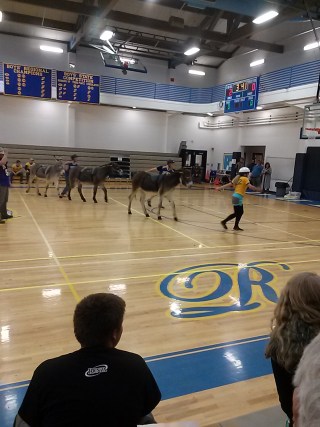 You may dismount to catch a loose ball, but you must always take the donkey with you, keeping a hand on a rein, and you must return the ball and re-mount the donkey within 15 seconds or get a penalty.
Have you tried to hurry a donkey? The term “chasing the ball” takes on a whole new context. Not understanding this rule of the game, any donkey dragged after a loose ball seems to be working for the other team.
“Move it!” Joe shouts. “Move it! Clearly, you’re no mule whisperer.”
Bucking broncos we’re used to. But bucking donkeys? Gimme a break. The ass brays, kicks and rumbles, and throws the player. (Ouch! That’s a gym floor, not rodeo dirt.) The action stops. The mule-buster (typical!) smiles and remounts. We hoot and cheer.
“Meanwhile,” Joe says from the sidelines, “we’re still playing basketball ….”
Until you’ve watched it, you can’t begin to understand how difficult it must be to steer a donkey, bareback, while trying to hold onto a basketball. At one point in the third round, it seems that all of the players are off their mounts, wandering around the court like lost souls. One player regains his mount, and the donkey takes off like a shot — in the wrong direction.
“Complete control,” Joe drawls. “You got this. Thanks for the entertainment.”
Actually there were plenty of scores — nothing in the high double-figures, as in any ordinary basketball game, but enough to keep up the pace. Of course there was a wide range in skill sets, from old-time wranglers to newcomers just relocated West. Adults played better than kids. Teacher Jessica was the slam-dunk champion. Center Craig kept a smile throughout (he had the easy part, always standing on both feet). Hailey looked like she was being a good sport, focused on not falling off.
 The school-teacher Donkey Kongs kicked the phone-company DTE Assets 14-8 in a last-minute surge, to win the championship.
In case you’re wondering about the floor, the donkeys were wearing boots and this event took place near the end of the school year, just before the floor gets refinished.
Although the half-time clowns played around with the idea that something other than a ball might drop, the floor stayed remarkably clean.
© Lois Wingerson, 2017
You can see new entries of Living Dubois every week if you sign up at the top of the right column at www.livingdubois.com.

 For many weeks, it’s been like this up at Sheridan Creek, one of my favorite hiking spots: A slow and steady slog through the slush. Not much fun. Good exercise.
 Don’t count on it, someone said recently. Fire that hot sterilizes the soil for a long time.
 Today, the dirt road was nearly dry, with a stream of snowmelt running along the side.
 Close to the road, these were easily visible. We saw blades of new grass and sprouts of fern beginning to peek up from the soil.
 Instead, I noticed fronds of white extending toward the soil from many of the fallen trunks. I saw these bands of powdery white around the base of many of the dead trees that were still standing.
 And who had walked downhill before our dogs came trotting uphill to add their tracks? I guessed it was a goose. (That’s a bear spray bottle to the left, for perspective.)
 The journey to Dubois in 1911 “must have seemed like a trip to the end of the world,” wrote the late Dubois artist Mary Back, in her 1955 brief biography of Elsie. The new schoolteacher traveled by train to Lander, then by a one-horse buckboard stagecoach to Fort Washakie, changed to another buckboard stage that took her (and the mail) to a ranch on the Wind River where she spent the night.
 She was a school teacher without a school: Classes were held in the saloon dance hall, up against the cave across from Welty’s Store. The cave was used for wine storage and as a jail. (The cave entrance is near the center of this photo, with the saloon at far left, which is also still in operation.) Elsie had to clear away the classroom any time the saloon held a dance.
 I’ve been reading this week about Elsie and Floyd’s world, thanks to two unexpected gifts that dropped into my Inbox from their great-granddaughter, Gabby Cook. She was kind enough to scan and send me Mary Back’s typewritten biography, as well as the century-old account of a hunting trip that Floyd guided, as told in great detail by Fish.
 The hunting party had to sleep outdoors next to the shed, because the Stalnakers took in lodgers and the rooms were all occupied. (Mary Allison wrote that Elsie was a great housekeeper who often ironed her lodgers’ clothing, if they were bachelors.)
 Floyd worked for many years as a guide and ranch manager. Elsie and Floyd survived the great flood of 1919 despite great losses, briefly became mail carriers (Elsie also drove the Jeep), and then purchased the drug store, which they operated until after World War 2. Their son, Dean, was Gabby’s grandfather. Floyd was working as a carpenter in Riverton when he died of a heart attack in 1948. Elsie died in 1965, ten years after Mary Back wrote her biography.
 “Tell your coworkers where you’re calling from,” Ed said at the team meeting.
 I had been commuting two hours each way, by subway, commuter train, and beat-up station car, from our home in Brooklyn to division headquarters in Connecticut. My boss and I were a new product team, just him and me in that office, working on a high-tech online project.
 to a larger space in a dark, quiet, dusty corner of the basement which I hung with dried flowers to make it look more cheery.
 I’ll never forget completing an assignment for my graduate course on digital media management, as we were traveling on the Interstate toward Wyoming. I was reading on my laptop, via wireless Internet, an online reference in my coursework which predicted that soon you’d be able to work online while riding in a car. The future was happening, even as I read about it!
 We’ve entered a new era since I became a digital pioneer. These days, social media is packed with content for and by telecommuters: advice about remote work, products to make home-based workers more productive, link after link to articles talking about the “workplace of the future,” which (of course) is already here.
 Avoiding the dreaded “mud and slush” season, we would always head back East about now. Just in time to see the crocuses popping above ground and the trees turning spring green.
 As we gain access to formerly snowbound spots, we make great discoveries. The dog found a whole ribcage, probably elk, that was nearly large enough for him to walk through.
 There was no sign of charcoal on the stones, so there may have not been a fire. But I could see that those pine branches would have made a dandy hut, when they were still green with needles. And the structure is very solid. It will be interesting to see how long it stands. I’m sure nobody will be motivated to take it down.
 This morning we awoke to a typical spring surprise: A few inches of wet snow. By mid-day it was gone, and the sky was mostly blue. That’s spring for you: Nothing if not fickle.